Honouring Banknotes
Celebrating the legends, landscapes, and landmarks that grace our banknotes! Each note tells a story of our rich history and breathtaking beauty – from iconic figures who shaped a nation to the stunning scenery that takes our breath away.
Sort by
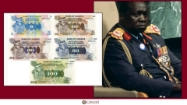
Ugandan Shillings Dedicated to Idi Amin -Thursday, 18 December 2025
When we think of history’s most notorious figures, certain names instantly spring to mind. But few are as complex, terrifying, and strangely charismatic as Idi Amin Dada. Known as the "Butcher of Uganda," Amin wasn't just a distant dictator; he was a larger-than-life character who commanded the world's attention—often for all the wrong reasons. next...
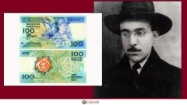
Portugese Escudos Featuring Fernando Pessoa -Wednesday, 17 December 2025
Have you ever felt like there are different versions of you fighting for control? Maybe there’s the "Professional You" who loves spreadsheets, the "Weekend You" who just wants to hike, and the "Philosophical You" who stays up until 3 AM questioning the meaning of life. Now, imagine if all those versions were actually different people—with their own names, birth dates, handwriting, and even astrological charts. next...
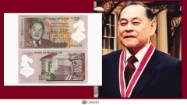
Mauritian Rupees Dedicated to Sir Moilin Jean ah-Chuen -Tuesday, 16 December 2025
Have you ever looked closely at the 25-rupee banknote in Mauritius? The dignified face looking back at you belongs to Sir Moilin Jean Ah-Chuen, a man whose life story reads like a masterclass in resilience and vision. next...
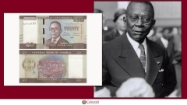
Liberian Dollars Honouring William V S Tubman -Monday, 15 December 2025
If you were to walk down the streets of Monrovia in the humid, salt-tinged air of the 1950s, you would eventually encounter a presence that seemed as permanent as the tides and as inevitable as the tropical rain. He might be found waving from a convertible, holding court at his farm in Totota, or staring down from a portrait in a government office, invariably dressed in a tailcoat and Homburg hat, a cigar often clamped firmly between his teeth. This was William Vacanarat Shadrach Tubman—"Uncle Shad" to the masses, "The Old Man" to his inner circle, and the undisputed President of Liberia for twenty-seven years.1 next...
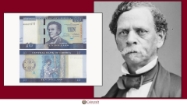
Liberian Dollars Honouring Joseph J Roberts -Friday, 12 December 2025
It’s not every day you hear about a man who starts life as a barber’s apprentice in Virginia and ends up as the first president of an entirely new African republic. But then again, Joseph Jenkins Roberts was anything but ordinary. next...
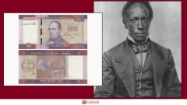
Liberian Dollars Honouring Edward J Roye -Thursday, 11 December 2025
If you look at the history of the American Midwest in the early 19th century, you don’t often hear stories about Black men becoming real estate tycoons and then sailing off to become heads of state. But that is exactly what Edward James Roye did. next...
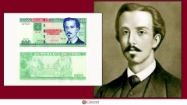
Cuban Pesos Featuring Ignacio Agramonte (Cuban Revolutionary) -Wednesday, 10 December 2025
If you look at the pantheon of Cuban national heroes, you’ll usually find the poet (Martí) and the titans of war (Maceo, Gómez). But standing tall among them—often with a riding crop in hand and a legal text in the other—is Ignacio Agramonte y Loynaz. next...
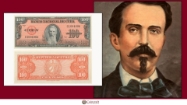
Cuban Pesos Honouring Carlos Manuel de Céspedes (father of Cuba) -Tuesday, 09 December 2025
Picture this: It’s 1868. You are a wealthy landowner in Cuba, born into comfort, educated in the finest schools of Europe, and you have everything to lose. Most people in your position would keep their heads down and enjoy their wealth. But Carlos Manuel de Céspedes wasn't most people. next...
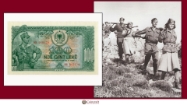
Albanian Leke Honouring Partizan Soldier -Monday, 08 December 2025
When we imagine a soldier, we typically picture a uniformed figure marching in lockstep within a regimented army. But history is equally shaped by a different kind of fighter: the Partisan. next...
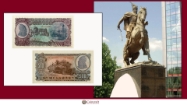
Albanian Leke Honouring Skanderbeg (Gjergj Kastrioti) -Thursday, 04 December 2025
If you think Game of Thrones has the monopoly on political intrigue, underdog battles, and legendary warriors, think again. History has given us figures who make fiction look tame, and sitting comfortably at the top of that list is Gjergj Kastrioti, better known to the world as Skanderbeg. next...
Get in touch icon icon

- icon
45 Great Russell St, London WC1B 3JL
- icon
