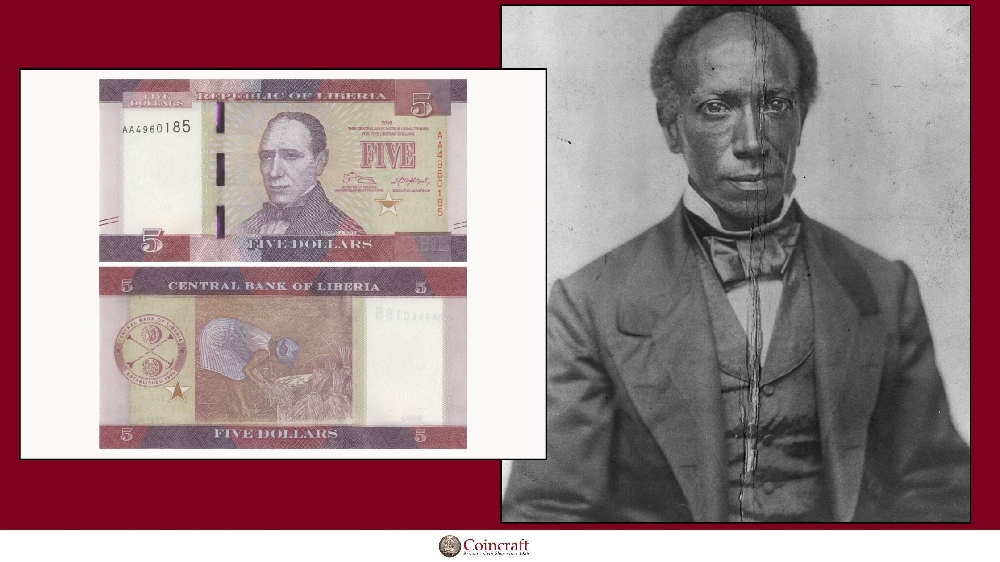
Picture Source of Edward J. Roye: Wikipedia
From Ohio Wealth to Liberian Tragedy: The Story of Edward J. Roye
If you look at the history of the American Midwest in the early 19th century, you don’t often hear stories about Black men becoming real estate tycoons and then sailing off to become heads of state. But that is exactly what Edward James Roye did.
His story is one of incredible ambition, immense wealth, and a political downfall so dramatic it feels like it was ripped from a Shakespearean play. Today, we’re diving into the life of the 5th President of Liberia, a man who broke barriers but couldn't quite outrun the political storms he helped create.
Key Takeaways
Before we get into the details of his journey, here are the main things you need to know about Edward J. Roye:
A Self-Made Tycoon: Before entering politics, Roye was likely the wealthiest Black man in the United States and later the richest man in Liberia due to his shipping and merchant empire.
Breaking the Colour Line: He was the first pure-blooded African descendant to become President of Liberia, breaking the hold that the mixed-race (mulatto) elite previously held on the office.
The True Whig Party: He was the first president from the True Whig Party, which would go on to dominate Liberian politics for over a century.
The Fatal Loan: His presidency unraveled due to a controversial financial loan negotiation with Great Britain and a dispute over extending his presidential term.
A Mysterious End: Roye was violently deposed and died under murky circumstances—historians still debate whether he drowned while trying to escape or was killed on land.
The Ohio Origins
Edward James Roye was born on February 3, 1815, in Newark, Ohio. While many African Americans at the time were born into the horrors of slavery, Roye was born free. His father, John Roye, was a manager of a ferry across the Wabash River and acquired considerable land in Illinois¹.
What stands out about Roye’s early life is his education. In an era where education for Black Americans was often illegal or substandard, Roye attended one of the few high schools open to African Americans and later studied at Ohio University in Athens².
But Roye wasn’t just a scholar; he was a businessman at heart. He opened a luxury barbershop in Terre Haute, Indiana—a common path to wealth for free Black men at the time—and reinvested his profits into real estate. By the time he was in his early 30s, he wasn’t just "doing well"; he was incredibly wealthy. However, despite his financial success, the racial climate in the United States was suffocating. Roye realized that no matter how much money he made, his rights in America would always be limited.
Crossing the Atlantic: The Merchant Prince
In 1846, just one year before Liberia declared its independence, Roye made the life-altering decision to emigrate. He packed up his family and his considerable fortune and sailed for West Africa³.
Upon arriving in Monrovia, he didn't miss a beat. He set up business as a merchant, and because he arrived with capital (unlike many settlers who arrived destitute), he had a massive advantage. He founded the firm Roye and Company.
Here is a fun fact that shows his level of success: Roye was the first Liberian to export goods to Europe and the United States in his own ships, flying the Liberian flag. He became known as a "Merchant Prince," dominating the export trade of palm oil and camwood⁴.
Politics and The True Whig Party
Wealth often leads to politics, and Roye was no exception. He served as the Speaker of the House of Representatives and later as the Chief Justice of the Supreme Court from 1865 to 1868.
But to understand his presidency, you have to understand the social tension of the time. Early Liberian politics were dominated by the Republican Party, which was largely made up of lighter-skinned, mixed-race settlers who had easier access to education and resources in the U.S. before emigrating.
Roye represented something different. In 1869, he ran for president under the banner of the True Whig Party. He appealed to the darker-skinned settlers and the "upriver" farmers who felt ignored by the Monrovia elite. His victory in 1870 was a turning point—it was the first time the "Old Guard" had been defeated⁵.
The Presidency: A Stormy Tenure
Roye took office with grand ambitions. He wanted to modernize the country and build infrastructure. To do this, he needed money—lots of it.
The British Loan Controversy
This is where things started to go wrong. Roye traveled to London to negotiate a loan for £100,000 (a massive sum at the time) to build a railroad and a bank. The terms of the loan, however, were disastrous. Through harsh deductions and interest, Liberia actually received significantly less cash than they borrowed, yet they were on the hook for the full amount⁶.
When he returned to Monrovia, the opposition pounced. They accused him of embezzlement and financial incompetence.
The Term Extension Crisis
To make matters worse, Roye argued that the presidential term should be extended from two years to four years. He claimed he had won a referendum on this issue, but the opposition claimed the vote had failed. When the time came for the next election in 1871, Roye refused to step down, insisting his term was now four years long⁷.
The Tragic Fall
The tension boiled over in October 1871. The people, incited by the Republican opposition and the anger over the loan, rose up. In a dramatic turn of events, cannons were deployed in Monrovia. Roye’s house was ransacked, and he was deposed—the first successful coup in Liberia's history⁸.
He was arrested and imprisoned.
The Mystery of His Death
How Edward J. Roye died remains a subject of historical debate. The most cinematic version of the story is that on February 11, 1872, he escaped his prison cell. He supposedly tried to swim to a British ship waiting in the harbor. The legend says he had weighed himself down with a belt of gold sovereigns (coins) from the loan, and the weight dragged him under, causing him to drown⁹.
Others suggest a darker, less romantic end: that he was beaten to death by a mob on land after his escape attempt failed. Regardless of the specifics, his end was brutal and marked the collapse of his vision for the country.
Conclusion
Edward J. Roye’s life was a rollercoaster of high achievement and deep failure. He proved that a Black man born in early 19th-century Ohio could rise to become a head of state. He built a financial empire that spanned the Atlantic. Yet, his political ambition and the fierce factionalism of Liberian society led to his ruin. He serves as a reminder of the complexities of the Americo-Liberian history—a history of seeking freedom, but also of internal struggle.
FAQs
1. Was Edward J. Roye American or Liberian? He was both. He was born and raised in the United States (Ohio) and lived there until he was 31. He then emigrated to Liberia, became a citizen, and eventually its President.
2. What happened to the True Whig Party after Roye died? Despite Roye's chaotic end, his party didn't die with him. The True Whig Party eventually regained power and ruled Liberia as a one-party state for nearly a century, from 1878 until the coup of 1980.
3. Did Roye steal the money from the British loan? It is unclear if he personally stole the money or if he was simply a victim of predatory lending by British bankers and poor negotiation. While he was accused of embezzlement, the loan terms were objectively terrible for Liberia regardless of Roye's personal intent.
References
Dunn, D.E., Beyan, A.J. and Burrowes, C.P. (2000). Historical Dictionary of Liberia. Lanham, Md.: Scarecrow Press.
Ohio History Central (n.d.). Edward J. Roye. [online] Available at: https://www.google.com/search?q=https://ohiohistorycentral.org/w/Edward_J._Roye [Accessed 11 Dec. 2025].
Library of Congress (n.d.). History of Liberia: A Time Line. [online] Available at: https://www.google.com/search?q=https://www.loc.gov/collections/maps-of-liberia-1830-to-1870/articles-and-essays/history-of-liberia/1847-to-1871/ [Accessed 11 Dec. 2025].
Burrowes, C.P. (2004). Power and Press Freedom in Liberia, 1830-1970. Trenton, NJ: Africa World Press.
Liebenow, J.G. (1987). Liberia: The Quest for Democracy. Bloomington: Indiana University Press.
Sundiata, I.K. (2003). Brothers and Strangers: Black Zion, Black Slavery, 1914–1940. Duke University Press.
GlobalSecurity.org (n.d.). Liberia - The True Whig Party. [online] Available at: https://www.google.com/search?q=https://www.globalsecurity.org/military/world/liberia/politics-twp.htm [Accessed 11 Dec. 2025].
Nelson, H.D. (1984). Liberia, a country study. Washington, D.C.: The American University.
Cassell, C.A. (1970). Liberia: History of the First African Republic. New York: Fountainhead Publishers.