Numismatic Glossary: Your Gateway to Coin Collecting Terminology
Our website proudly features a comprehensive Numismatic Glossary, designed to enhance your coin collecting experience. This valuable resource serves as a bridge between novice enthusiasts and seasoned numismatists, offering clear and concise definitions for a wide range of coin-related terms.
PLEASE NOTE: WE ADD A NEW TERM EVERY WEEK. SO MAKE SURE TO CHECK BACK OFTEN.
Sort by
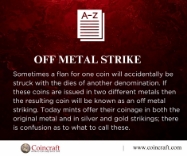
Off Metal Strike -Wednesday, 01 July 2026
Numismatic Term of the Week: "Off-Metal Strike" In the world of coin collecting, some of the most fascinating pieces are the ones that shouldn't exist at all. This week, we are looking at a classic term every collector should know: the Off-Metal Strike. next...
Weak Strike -Wednesday, 17 June 2026
Today, we're diving into the intriguing world of 'Weak Strike' for our weekly glossary. When not enough pressure is used to strike the coin, the design will appear to be weak and an uncirculated coin will look like a used example. next...
Harp Strings -Wednesday, 10 June 2026
We turn our attention to another term in the field of numismatics this week, known as the "Harp Strings". In the reign of Charles II and some other reigns the number of harp strings on the reverse varied, possibly to indicate which dies were being used. next...
Metal Transfer -Wednesday, 03 June 2026
Today, we will explore another phrase from our collection of numismatic terms. Our attention will be directed towards "Metal Transfer". During striking, metal flows from one side of the coin to the other to fill the die. A vague outline can be seen on the `wrong' side of the coin. Not to be confused with clashed dies. next...
Snick -Thursday, 21 May 2026
This week, we are exploring a fascinating term in numismatics: the "Snick". This refers to a small incision or cut made into the edge of a hammered coin to verify its metal content. Most famously mandated by King Henry I, these official test cuts proved the coin was solid silver all the way through without actually removing any metal—reassuring a sceptical public while preserving the coin's full weight. next...
Petition Crown -Tuesday, 28 April 2026
This week's numismatic term is "Petition Crown". Thomas Simon submitted the design for a crown to Charles II in 1663. The workmanship was excellent and Simon managed to get two lines of text on the edge of the coin. next...
Mint Sport -Wednesday, 22 April 2026
We are back with another numismatic definition: Mint Sport. A coin struck illicitly but from genuine dies to produce an error or novelty of some kind. next...
Get in touch icon icon

- icon
45 Great Russell St, London WC1B 3JL
- icon
