Picture Source of Fernando Pessoa: Wikipedia
The Man Who Was a Crowd: Unraveling the Mystery of Fernando Pessoa
Have you ever felt like there are different versions of you fighting for control? Maybe there’s the "Professional You" who loves spreadsheets, the "Weekend You" who just wants to hike, and the "Philosophical You" who stays up until 3 AM questioning the meaning of life. Now, imagine if all those versions were actually different people—with their own names, birth dates, handwriting, and even astrological charts.
Welcome to the mind-bending world of Fernando Pessoa.
Pessoa isn't just Portugal’s most famous modern poet; he is a literary universe unto himself. While he lived a seemingly quiet, somewhat lonely life in Lisbon, inside his head was a bustling crowd of distinct personalities he called "heteronyms." He didn’t just write as them; he lived through them.
Let’s take a walk through the foggy streets of Lisbon and meet the man who once wrote, "I'm the empty stage where various actors act out various plays."¹
Key Takeaways
The Master of Heteronyms: Pessoa created over 70 distinct literary alter egos, known as heteronyms, each with their own biography and writing style.
A Posthumous Giant: During his lifetime, he was largely unknown and published only one book in Portuguese. His fame exploded after his death when a trunk containing over 25,000 documents was discovered.
The "Quiet" Rebel: He lived a mundane outer life as a commercial translator in Lisbon, contrasting sharply with his wild and expansive inner life.
Modernist Pioneer: He is credited with bringing Modernism to Portugal and is considered one of the greatest poets of the 20th century, often compared to Kafka and Joyce.
Astrology Enthusiast: Pessoa was deeply into the occult and astrology, even casting horoscopes for his own fictional characters.
From Durban to the Tagus: The Early Years
Born in Lisbon in 1888, Fernando Pessoa didn’t stay put for long. After his father died when he was just five, his mother remarried a diplomat, and the family moved to Durban, South Africa.²
This is a crucial plot twist! Because of his British education in Durban, Pessoa grew up speaking and writing fluent English. In fact, his first poems were written in English, and he even won the Queen Victoria Memorial Prize for an essay while in high school. He grew up reading Shakespeare and Milton, which gave his later Portuguese writing a unique, rhythmic quality that no one else had.
He returned to Lisbon at age 17 and rarely left the city again. But he didn't need to travel the world to explore it; he had plenty of worlds to explore inside his own mind.
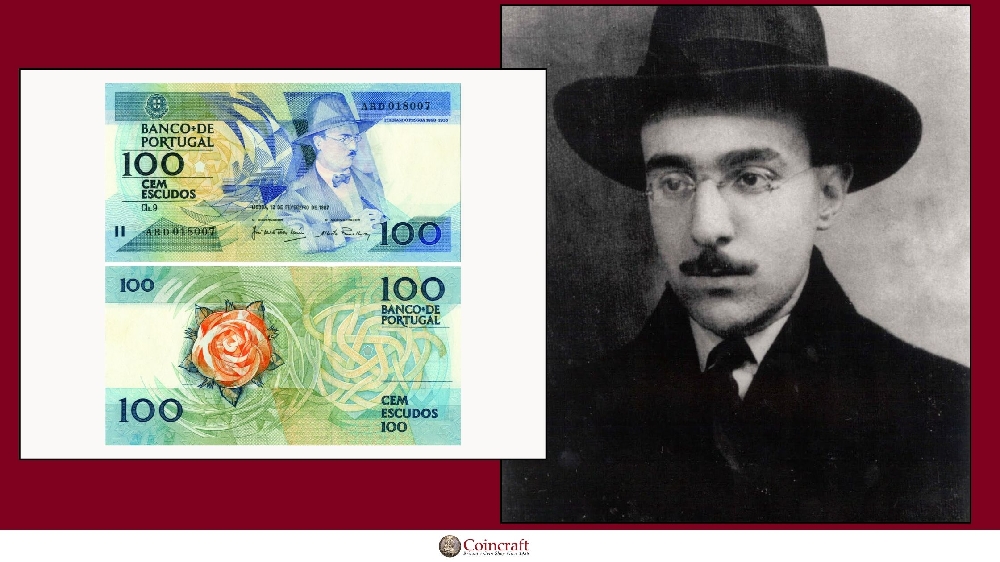
A young Fernando Pessoa, already looking like he knows secrets about the universe.
The "Quiet" Life in Lisbon
If you met Pessoa in the 1920s, you probably wouldn't have guessed he was a genius. He worked as a commercial correspondent (basically a freelance translator for business letters) and lived a very routine life. He was often seen at the famous Café Martinho da Arcada or A Brasileira, smoking endlessly and scribbling on napkins, loose sheets of paper, or the backs of envelopes.³
He was a dapper dresser, usually sporting a bow tie and a hat, blending into the background of the city. He had one significant romantic relationship with a woman named Ophelia Queiroz. Their love letters are fascinating—sometimes sweet, sometimes bizarre. The relationship eventually fizzled out, largely because Pessoa’s heteronyms (specifically the loud and brash Álvaro de Campos) essentially "interfered," and Pessoa declared that his life belonged to his work.⁴
The Day of the Heteronyms
Now, here is where it gets wild. Pessoa didn't just use pen names (pseudonyms). He created heteronyms. A pseudonym is a fake name for a real author. A heteronym is a fake author with a real psychology.
On what he called his "Triumphant Day" in 1914, Pessoa walked over to a high chest of drawers and wrote 30 poems in a row in a state of ecstasy. But he wasn't writing as Fernando Pessoa. He was writing as Alberto Caeiro, a "keeper of sheep" who valued nature and direct experience over philosophy.⁵
Pessoa later explained that Caeiro was the "Master" of all the others. The main trio of heteronyms included:
Alberto Caeiro: The nature poet who didn't believe in thinking, just seeing.
Ricardo Reis: A doctor and classicist who wrote disciplined, stoic odes (and who Pessoa imagined moved to Brazil).
Álvaro de Campos: A bisexual naval engineer who wrote loud, chaotic, Whitman-esque free verse about machines and modern life.
And then there was Bernardo Soares, a "semi-heteronym" who was very close to Pessoa's own personality. Soares is the "author" of Pessoa’s most famous prose work, The Book of Disquiet.
You can still have a coffee with him today! His statue sits eternally at the Café A Brasileira in Lisbon.
"Message" and National Pride
Despite writing thousands of poems, Pessoa published only one book in Portuguese during his lifetime: Mensagem (Message), published in 1934, just a year before he died.⁶
Mensagem is a mystical, patriotic collection that retells the history of Portugal, focusing on its Age of Discovery. But it’s not just a history lesson; it’s an occult, spiritual interpretation of Portugal’s destiny. It won a consolation prize from the government, but it didn't exactly make him a household name at the time.
The cover of the only Portuguese book Pessoa lived to see published.
The Trunk of Treasures
Fernando Pessoa died in 1935 at the age of 47, largely due to liver problems from his heavy drinking. His last words were written in English: *"I know not what tomorrow will bring."*⁷
But the real story began after his death. In his room, friends found a large wooden trunk. Inside were over 25,000 documents—poems, plays, horoscopes, philosophical essays, and fragments of thoughts—written on everything from nice stationery to scraps of waste paper.
Scholars are still going through this trunk today. It wasn't until 1982, nearly 50 years after he died, that The Book of Disquiet (Livro do Desassossego) was first published in Portuguese. It became an instant sensation, revealing a depth of existential angst and beauty that shocked the literary world.
Today, Pessoa is a national hero in Portugal and a global icon for anyone who feels a little bit fragmented.
FAQs
1. What is the difference between a pseudonym and a heteronym? A pseudonym is just a fake name used by an author (like Mark Twain for Samuel Clemens) to hide their identity or separate their works. A heteronym, as invented by Pessoa, is a fully realized character with their own biography, physical appearance, writing style, politics, and even handwriting. Pessoa’s heteronyms would often critique each other’s work in newspapers!
2. Did Fernando Pessoa ever marry? No. His only known romantic relationship was with Ophelia Queiroz, a secretary he met at an office where he worked. They dated in two phases (1919-1920 and 1929-1930), but never married. Pessoa ultimately chose his writing over a domestic life.
3. Why is The Book of Disquiet so famous? It is considered a masterpiece of existentialism and modernism. It’s not a novel with a plot, but a collection of fragmented diary entries and reflections by Bernardo Soares (a semi-heteronym). It captures the feeling of modern alienation, boredom, and the beauty of the mundane in a way that resonates deeply with readers today.
References
Zenith, R. (2002) The Book of Disquiet. London: Penguin Classics.
Britannica, The Editors of Encyclopaedia (2025) 'Fernando Pessoa', Encyclopedia Britannica. Available at: https://www.britannica.com/biography/Fernando-Pessoa (Accessed: 17 December 2025).
Kiddle Encyclopedia (2025) Fernando Pessoa Facts for Kids. Available at: https://kids.kiddle.co/Fernando_Pessoa (Accessed: 17 December 2025).
Poetry Society of America (n.d.) Fernando Pessoa & His Heteronyms. Available at: https://poetrysociety.org/poems-essays/tributes/fernando-pessoa-his-heteronyms (Accessed: 17 December 2025).
Kirsch, A. (2017) 'The Multiple Lives of Fernando Pessoa', The New Yorker, 17 July. Available at: https://www.newyorker.com/magazine/2017/07/24/the-multiple-lives-of-fernando-pessoa (Accessed: 17 December 2025).
Wikipedia (2025) Mensagem. Available at: https://en.wikipedia.org/wiki/Mensagem (Accessed: 17 December 2025).
Portugal.com (2024) 9 Incredible Facts about Fernando Pessoa. Available at: https://www.portugal.com/history-and-culture/9-incredible-facts-about-fernando-pessoa/ (Accessed: 17 December 2025).