Articles
Sort by
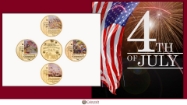
Medals Dedicated to the 4th of July (American independence) -Tuesday, 30 September 2025
The journey to American independence was a challenging and transformative period. The Declaration of Independence, primarily authored by Thomas Jefferson, was adopted by the Continental Congress on July 4, 1776. This historic document proclaimed the thirteen American colonies as free and independent states, no longer under British rule. next...

French Francs dedicated to Pierre Curie (former physicist and chemist) -Monday, 29 September 2025
Pierre Curie is a name that resonates profoundly in the annals of scientific history. As a pioneer of modern physics and chemistry, his contributions have laid the groundwork for many scientific advancements. Born in the 19th century, Curie was a French physicist whose work, particularly in the realm of radioactivity, has had a lasting impact on the scientific community and beyond. next...

Medals Dedicated to Joe Biden (former US president) -Friday, 26 September 2025
Joseph Robinette Biden Jr., known to the world as Joe Biden, was born on November 20, 1942, in Scranton, Pennsylvania. Raised in a middle-class family, Biden faced numerous challenges in his early years, including a severe stutter, which he overcame through persistence and determination. This resilience has been a defining trait throughout his life, shaping his approach to both personal and professional challenges. next...
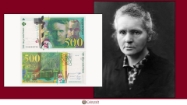
French Francs dedicated to Marie Curie (former physicist and chemist) -Thursday, 25 September 2025
Marie Curie, a name synonymous with groundbreaking scientific discovery and an enduring symbol of perseverance, stands as one of the most influential figures in both science and feminism. next...
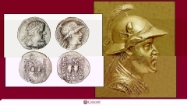
Greek Diademed Dedicated to former King Eukratides I ‘The Great' -Wednesday, 24 September 2025
Eukratides I, one of the most prominent figures in the ancient Greco-Bactrian Kingdom, ruled during the 2nd century BCE. His reign marked a period of significant transformation and expansion, leaving a lasting imprint on the region’s history. Known for his military prowess and strategic acumen, Eukratides I's legacy is a subject of great interest among historians and archaeologists alike. next...
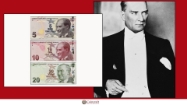
Turkish Lirasi Dedicated to Kemal Ataturk (Founding father of the Republic of Türkiye) -Tuesday, 23 September 2025
Mustafa Kemal Atatürk stands as a pivotal figure in the annals of history, renowned for his remarkable transformation of Turkey from a crumbling Ottoman Empire into a vibrant, modern republic. Born in 1881 in the city of Thessaloniki, then part of the Ottoman Empire, Atatürk was driven by a vision of modernity and progress. His contributions to his nation are profound, and his legacy endures in the fabric of contemporary Turkey. next...

Medals Dedicated to Bruce Lee (former actor) -Monday, 22 September 2025
Bruce Lee, born in 1940 in San Francisco, became a global phenomenon whose influence transcended the realm of martial arts. His unique approach to fitness and his philosophical outlook on life positioned him as a cultural icon. Lee's charisma, combined with his martial arts prowess, redefined how the world perceived Asian actors and martial artists, turning him into a symbol of strength and unity. next...
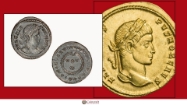
Roman Coins Dedicated to Former Emperor Crispus -Friday, 19 September 2025
Flavius Julius Crispus, known simply as Crispus, was a significant yet often overlooked figure in Roman history. As the eldest son of Constantine the Great, his life and legacy have intrigued historians for centuries. While not as widely recognised as his father, Crispus played a crucial role during the pivotal years of the Roman Empire's transformation. This article aims to shed light on his life, achievements, and the enduring impact he left behind. next...
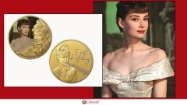
Medal Dedicated to Audrey Hepburn (former actor) -Thursday, 18 September 2025
Audrey Hepburn remains an enduring symbol of elegance and grace, a testament to her remarkable influence in cinema and beyond. She was not just an actress but a style icon whose legacy transcends generations. Her ethereal beauty and captivating performances continue to inspire both fans and new audiences alike. The timeless appeal of Audrey Hepburn lies in her ability to connect with people on a deeper level, both through her films and humanitarian work. next...
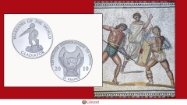
Congolese Franc Dedicated to the Gladiator -Wednesday, 17 September 2025
The grandeur of Ancient Rome is often depicted through its architectural marvels, political structures, and cultural practices. Among these, the spectacle of gladiators stands out as a symbol of Roman entertainment and societal norms. Gladiators were more than just combatants; they were an integral part of Roman tradition, offering insights into the values and priorities of one of history's most powerful empires. next...
Get in touch icon icon

- icon
45 Great Russell St, London WC1B 3JL
- icon
