Picture Source of Vima Kadphises: Wikipedia
The Gold King: Vima Kadphises and the Kushan Zenith
When we think of the great empire-builders of the ancient world, names like Alexander or Caesar usually spring to mind. But if you were traveling along the Silk Road around 100 A.D., there was one name that carried more weight than almost any other in Central Asia: Vima Kadphises. As the third Kushan emperor, Vima didn't just inherit a kingdom; he forged an empire that bridged the gap between the mysterious East and the Mediterranean West. He was a man of "gold and grit," responsible for setting the standard of Kushan royalty that would last for centuries[1].
Key Takeaways
The Gold Pioneer: Vima Kadphises was the first Kushan emperor to introduce gold coinage, signaling the empire's immense wealth and its integration into global trade[2].
Territorial Expansion: He significantly expanded Kushan borders into Northern India, establishing the empire as a dominant power in the subcontinent[3].
Religious Syncretism: Vima was a devoted follower of Shiva, blending Central Asian heritage with Indian spiritual traditions[4].
Silk Road Guardian: Under his rule, the Kushans became the essential "middlemen" of the Silk Road, facilitating trade between Rome and Han China[5].
The Rise of a Conqueror
Vima Kadphises (reigning approx. 113–127 A.D.) was the son of Vima Taktu and the grandson of the empire's founder, Kujula Kadphises. While his grandfather consolidated the Yuezhi tribes into the Kushan state, Vima Kadphises was the one who looked toward the lush, wealthy plains of India and saw a golden opportunity[6].
Historical records, including the famous Rabatak inscription found in Afghanistan, confirm that Vima was a fierce expansionist. He pushed the Kushan frontiers deep into the Indo-Gangetic plain, conquering territories as far as Mathura and potentially beyond[7]. This wasn't just about land; it was about controlling the lucrative trade routes that connected the Roman Empire to the Han Dynasty of China.
A Legacy Written in Gold
Before Vima, the Kushans mostly minted copper and silver. However, Vima Kadphises made a revolutionary move: he introduced the gold dinar. This wasn't just a vanity project. By creating high-quality gold coins that mirrored the weight of Roman aurei, he ensured that Kushan currency was accepted by international merchants from the Mediterranean to the South China Sea[8].
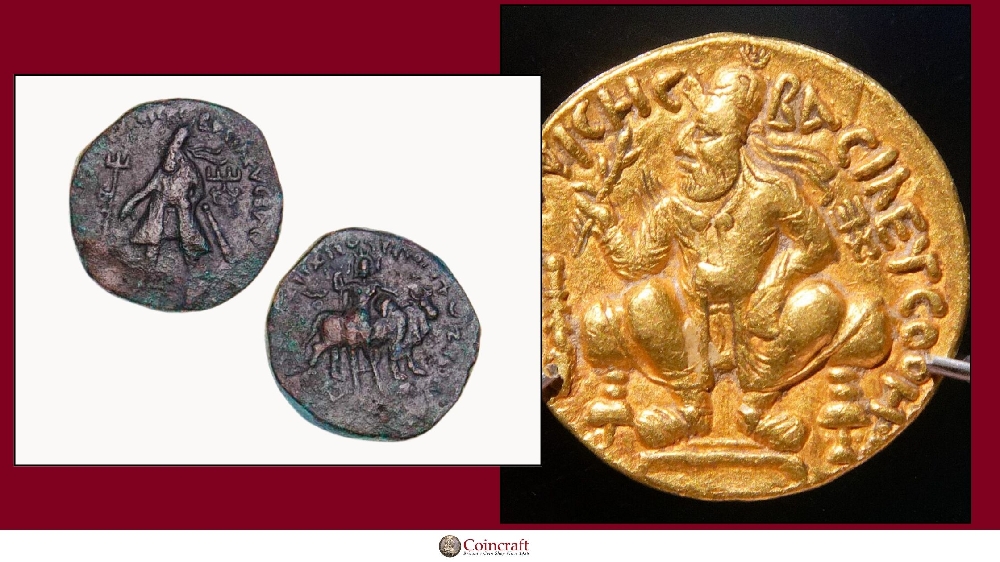
If you look at his coins today, you see a man who knew how to project power. He is often depicted with a thick beard, wearing a heavy tunic and boots suitable for the cold steppes, yet surrounded by the symbols of an Indian deity[9]. He usually appears emerging from the clouds or with flames licking his shoulders—a clear sign that he viewed his kingship as divinely ordained.
The Devotee of Shiva
One of the most fascinating aspects of Vima Kadphises is his religious identity. Unlike his successor Kanishka the Great, who is celebrated as a champion of Buddhism, Vima was a staunch devotee of the Hindu god Shiva. His coins almost always feature the image of Shiva holding a trident (the trishula), often accompanied by the bull Nandi[10].
This was a brilliant bit of cultural diplomacy. By adopting Shivan imagery, Vima made himself relatable to his newly conquered Indian subjects while maintaining his "Lord of All Worlds" status. He called himself Mahisvara (the Great Lord), a title synonymous with Shiva himself[11].
The Global Middleman
Under Vima, the Kushan Empire became the ultimate bridge. He maintained diplomatic ties with the Roman Emperor Trajan and sent embassies to the Han court. Because the Kushans controlled the mountain passes of the Hindu Kush, every scrap of silk going West and every ounce of Roman gold going East had to pass through Vima’s toll booths[12]. This wealth funded the magnificent Gandharan art and architecture that would define the era.
FAQs
Q: Was Vima Kadphises the same person as Kanishka? A: No. Vima Kadphises was the predecessor (and likely the father or grandfather) of Kanishka the Great. While Vima focused on Shivan worship and establishing the gold standard, Kanishka is more famous for his patronage of Buddhism[13].
Q: Why is the Rabatak Inscription important for Vima’s history? A: Discovered in 1993, this inscription clarified the Kushan genealogy. It explicitly links Kujula Kadphises, Vima Taktu, Vima Kadphises, and Kanishka, settling decades of academic debate about the order of the kings[14].
Inline Citations
(Rosenfield 1967, p. 15)
(Göbl 1984, p. 42)
(Thapar 2003, p. 221)
(Mukherjee 1988, p. 89)
(Benjamin 2018, p. 134)
(Sims-Williams & Cribb 1996, p. 76)
(Bopearachchi 2007, p. 55)
(Göbl 1984, p. 45)
(Rosenfield 1967, p. 18)
(Mukherjee 1988, p. 92)
(Thapar 2003, p. 223)
(Benjamin 2018, p. 138)
(Sims-Williams & Cribb 1996, p. 80)
(Sims-Williams 1998, p. 85)
References
Benjamin, C. (2018). The World of the Kushans. 1st edn. London: Routledge. Available at: https://www.routledge.com/The-World-of-the-Kushans/Benjamin/p/book/9781138090880
Bopearachchi, O. (2007). 'The Kushan Empire', in The Oxford Handbook of Ancient Iran. Oxford: Oxford University Press.
Göbl, R. (1984). System und Chronologie der Münzprägung des Kušānreiches. Wien: Verlag der Österreichischen Akademie der Wissenschaften.
Mukherjee, B.N. (1988). The Rise and Fall of the Kushana Empire. Calcutta: Firma KLM.
Rosenfield, J.M. (1967). The Dynastic Arts of the Kushans. Berkeley: University of California Press.
Sims-Williams, N. (1998). 'Further notes on the Bactrian inscription of Rabatak', Proceedings of the British Academy, 96, pp. 79-110.
Sims-Williams, N. and Cribb, J. (1996). 'A New Bactrian Inscription of Kanishka the Great', Silk Road Art and Archaeology, 4, pp. 75-142.
Thapar, R. (2003). Early India: From the Origins to AD 1300. Berkeley: University of California Press.


