Picture Source of Herennia Etruscilla: Wikipedia
Unveiling Herennia Etruscilla: The Resilient Empress of Rome's Crisis
Introduction: Stepping into the Chaos of the Third Century
The third century of the Roman Empire was not merely a time of transition; it was a desperate struggle for survival. Imagine a world where the very foundations of the Pax Romana had crumbled, replaced by a relentless cycle of civil war, devastating plagues, and a frontier that bled under the weight of foreign incursions. This was an era where the purple cloak of an emperor was often a death warrant, and the golden eagles of Rome faced an existential threat unlike any they had seen before.
But behind every scrambling emperor, there is usually a steady, fascinating woman holding the domestic and political fort together. Today, we're shining a well-deserved spotlight on Herennia Etruscilla, the wife of Emperor Trajan Decius. While she might not be as universally famous as Cleopatra or Livia, her story is one of grace, ultimate tragedy, and remarkable survival in a world that was quite literally falling apart. Let's dive into the life of this captivating Roman Empress!
Key Takeaways
A Brief but Impactful Reign: Herennia Etruscilla served as Augusta (Empress) from late 249 AD to mid-251 AD during one of Rome's most unstable periods.
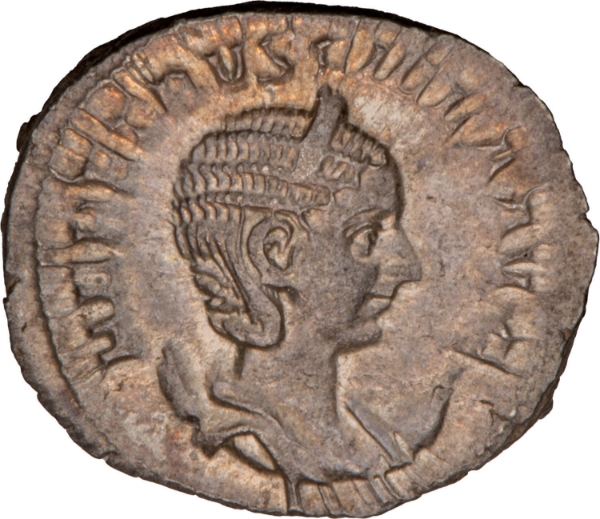
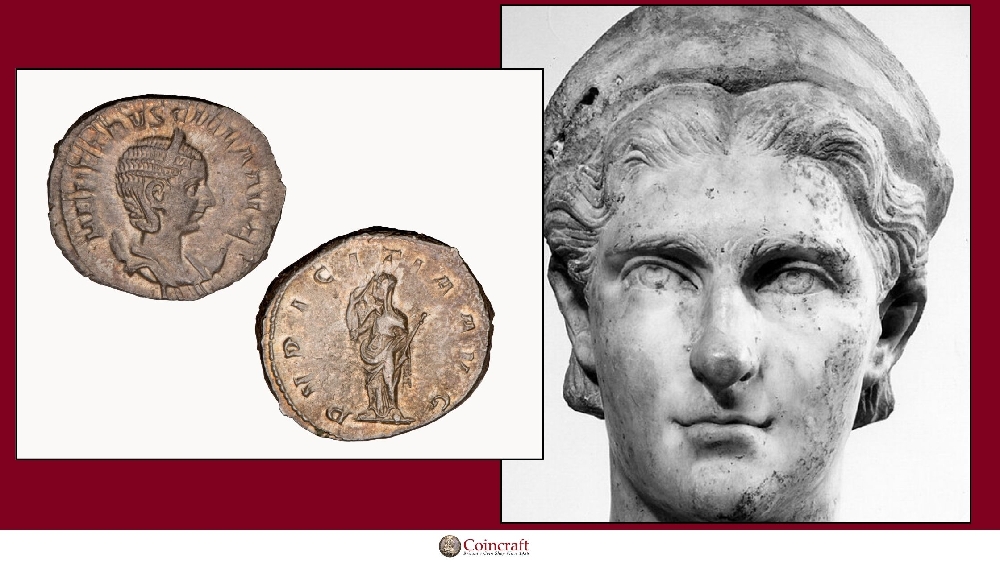
The Ultimate Symbol of Modesty: She was heavily used in imperial propaganda—mostly through coins—to project Pudicitia (modesty and chastity), acting as the moral anchor for her husband's reign.
Heartbreaking Tragedy: She is one of the few empresses to lose both her husband and her eldest son in a single, devastating battle against foreign invaders.
A Survivor: Despite her massive familial losses and a deadly plague, she managed to navigate the tricky political waters and retain her royal titles under a new regime before quietly fading from the historical record.
From Noble Roots to the Imperial Throne
As is the case with many women from antiquity, the exact date and place of Herennia Etruscilla's birth are lost to the sands of time. However, historians believe she was born sometime in the early 3rd century AD. She likely hailed from a wealthy, highly respected senatorial family, and her name suggests that her ancestors settled in the Etrurian lands of Italy.(1)
She married Decius sometime before 230 AD, long before he had any inkling that he would wear the purple cloak of an emperor. By all accounts, it was a solid, traditional Roman match. When Decius seized power and was proclaimed emperor in 249 AD, Herennia was elevated right alongside him, officially gaining the prestigious title of Augusta.
Interestingly, while coins struck in Rome refer to her simply as "Herennia Etruscilla," silver tetradrachms minted over in Alexandria give us a fantastic clue about her full name. They include the abbreviation "Coup," revealing her full name to be Annia Cupressenia Herennia Etruscilla. The name "Cupressenia" derives from the Latin word for the cypress tree, which was a sacred symbol of the goddess Juno!(2)
The Ultimate PR Campaign: Modesty on a Coin
Imagine you are the new emperor in a deeply unstable time. How do you convince the public that your reign will bring a return to the "good old days" of traditional Roman values? You put your wife on the money!
In the ancient world, coins were the equivalent of billboards, social media, and news broadcasts all rolled into one. Herennia Etruscilla's face was stamped on thousands of coins across the empire, giving us a clear picture of how the imperial family wanted to be seen.
Her coins almost always featured the goddess Pudicitia on the back.(3) In Roman culture, Pudicitia meant modesty, chastity, and absolute devotion to one's husband. It was the absolute highest compliment you could pay a Roman matron. By associating Herennia with this goddess, Decius was sending a loud and clear message to his subjects: My household is moral, stable, and traditionally Roman. You can trust us. Other coins featured the goddess Fecunditas (fertility), proudly celebrating the fact that Herennia had provided the empire with two healthy male heirs: Herennius Etruscus and Hostilian.
Heartbreak at Abritus
Tragically, the stability Herennia's coins promised was an illusion. In 251 AD, a massive coalition of Gothic tribes crossed the Danube River, wreaking havoc on the Roman provinces. Emperor Decius and their eldest son, Herennius Etruscus, marched out to meet them in battle.
At the Battle of Abritus (in modern-day Bulgaria), disaster struck. The Roman army was lured into a deadly swamp. Both Decius and young Herennius Etruscus were slaughtered.(4) It was a cataclysmic shock to the Roman world—it was the very first time a Roman emperor had been killed in battle by a foreign enemy.
For Herennia, waiting back in Rome, the news must have been utterly world-shattering. In an instant, she lost her partner, her eldest child, and the political foundation of her life.
Survival and a Quiet Fade into the Shadows
So, what happens to an Empress when the Emperor is killed? Often, they are exiled or worse by the incoming regime. But Herennia Etruscilla's story takes a slightly different turn.
The surviving Roman legions elected a general named Trebonianus Gallus as the new emperor. In a surprisingly savvy and compassionate political move, Gallus didn't cast Herennia aside. To legitimize his rule and prevent a civil war, he adopted her surviving younger son, Hostilian, making him co-emperor. Furthermore, he allowed Herennia to keep her title of Augusta.(5)
Sadly, her grief was not yet over. Just months later, a horrific pandemic known as the Plague of Cyprian swept through Rome, and young Hostilian succumbed to the disease. Having survived the violent deaths of her husband and eldest son, Herennia was now forced to mourn her youngest.
After November 251 AD, Herennia Etruscilla slowly fades from the historical record. It is believed she lived quietly in Rome until around 253 AD, finally slipping away into the shadows of history. While her time in the spotlight was short and marked by immense tragedy, she remains a poignant symbol of grace, resilience, and the enduring strength of women during Rome's darkest days.
Frequently Asked Questions (FAQs)
Q: How long was Herennia Etruscilla officially the Empress? A: Her tenure as the primary Augusta was quite brief, lasting only from September 249 AD to June 251 AD. However, she retained her title as an empress-mother for a short period after her husband's death under the reign of Trebonianus Gallus.
Q: Did she have any children? A: Yes! She had two sons who both briefly held the title of Emperor: Herennius Etruscus (who died in battle alongside his father) and Hostilian (who died shortly after from the plague).
Q: What does "Pudicitia" mean on her coins? A: Pudicitia translates roughly to modesty, chastity, and moral purity. It was considered the highest virtue for Roman women. By putting this on her coins, the imperial family was broadcasting her upstanding moral character to the entire empire.
References
Adkins, L. and Adkins, R. A., 1998. Handbook to Life in Ancient Rome. New York: Oxford University Press.
Wikipedia, 2026. Herennia Etruscilla. [online] Available at: https://en.wikipedia.org/wiki/Herennia_Etruscilla [Accessed 6 March 2026].
Salisbury, F. S. and Mattingly, H., 1924. 'The Reign of Trajan Decius'. The Journal of Roman Studies, [online] 14, pp.1-23. Available at: [suspicious link removed].
Bunson, M., 2014. Encyclopedia of the Roman Empire. New York: Facts On File.
Kienast, D., 2017. Römische Kaisertabelle. Darmstadt: Wissenschaftliche Gesellschaft.