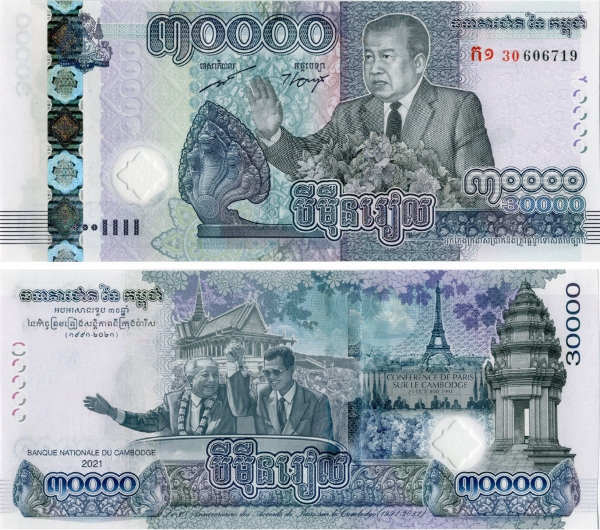
 (1922-2012) - WCA0526.jpg)
Picture Source of Preah Borom Ratanak Kaudh (Norodom Sihanouk): Wikipedia
Preah Borom Ratanak Kaudh: The Life, Reign, and Legacy of King Norodom Sihanouk
Upon his passing on October 15, 2012, King Norodom Sihanouk of Cambodia was officially bestowed the posthumous title Preah Karuna Preah Norodom Sihanouk Preah Borom Ratanak Kaudh (ព្រះបរមរតនកោដ្ឋ), meaning "The King who lies in the Supreme Golden/Diamond Urn" [1]. This title reflects the profound, almost spiritual status he held among the Khmer people. As a king, prime minister, head of state, rebel leader, exile, and filmmaker, Sihanouk's life was completely intertwined with the modern history of Cambodia [2]. He was the central pillar around which the nation revolved during the colonial, post-colonial, Cold War, and post-conflict eras.
Key Takeaways
Father of Independence: Securing Cambodia's full independence from France in 1953 without a bloody war remains his crowning political achievement [1, 3].
The "Sangkum" Golden Age: During his leadership in the 1950s and 1960s, Cambodia experienced an era of rapid modernization, cultural revival, and architectural growth known as the Sangkum Reastr Niyum [3].
Cold War Neutrality: Sihanouk’s foreign policy relied on a high-wire balancing act between Western powers (the United States) and Eastern communist bloc nations (China, North Korea, and North Vietnam) to protect Cambodian sovereignty [2].
The Khmer Rouge Tragedy: His alignment with the Khmer Rouge after being deposed in the 1970 coup remains the most controversial decision of his life, leading to his own house arrest and the loss of several of his children during the Cambodian Genocide [4].
Unification Icon: In his twilight years, he returned as constitutional monarch in 1993, serving as a vital symbol of national reconciliation and peace after decades of civil conflict [5].
Key Facts
Category | Details |
|---|---|
Birth | October 31, 1922, in Phnom Penh, Cambodia [1] |
Death | October 15, 2012 (aged 89), in Beijing, China [1, 4] |
Posthumous Title | Preah Borom Ratanak Kaudh (ព្រះបរមរតនកោដ្ឋ) |
First Reign | April 24, 1941 – March 2, 1955 (Abdicated in favor of his father) [3] |
Second Reign | September 24, 1993 – October 7, 2004 (Abdicated in favor of his son) [5] |
Political Roles | King, Prime Minister (multiple terms), Head of State, President in Exile |
Spouse | Queen Mother Norodom Monineath Sihanouk (married 1952) [5] |
Successor | King Norodom Sihamoni (his son) [3] |
Artistic Outputs | Produced, directed, and scored over 50 feature-length films [2] |
Preah Borom Ratanak Kaudh: A Comprehensive Biography
1. Early Life and the Unexpected Throne (1922–1941)
Born on October 31, 1922, Norodom Sihanouk was the eldest son of Prince Norodom Suramarit and Princess Sisowath Kossamak [1]. His lineage directly connected him to the two major branches of the Cambodian royal family: the Norodoms and the Sisowaths. Sihanouk received his early education in Phnom Penh before being sent to Saigon (now Ho Chi Minh City, Vietnam) to study at the prestigious Lycée Chasseloup-Laubat [3].
In 1941, following the death of King Sisowath Monivong, the French colonial administration bypassed more senior princes to select eighteen-year-old Sihanouk for the throne [2]. The French believed the young, artistic prince would be easily managed and subservient to colonial interests [3]. Sihanouk later recounted that he wept upon hearing the news, overwhelmed by the burden of the crown [4]. However, the French colonial authorities severely underestimated the young monarch’s nationalistic ambition and political acumen.
2. The Royal Crusade for Independence (1941–1953)
During World War II, Cambodia was occupied by Japanese forces, though the French Vichy administration remained nominally in charge [3]. In March 1945, under Japanese pressure, Sihanouk declared Cambodia's independence. Following Japan's defeat later that year, the French returned to re-establish colonial rule, but Sihanouk had already set his sights on true sovereignty [4].
In the early 1950s, Sihanouk launched his famous "Royal Crusade for Independence" [1]. He traveled to France, the United States, and Canada, writing letters and giving interviews to raise international awareness about Cambodia's colonial subjugation. Recognizing that France was deeply bogged down in its military campaign against the Viet Minh in neighboring Vietnam, Sihanouk successfully pressured Paris [2]. On November 9, 1953, France officially conceded, granting Cambodia full, bloodless independence [1]. For this monumental achievement, his subjects revered him as the "Father of Independence" [5].
3. The Sangkum Era and "Buddhist Socialism" (1955–1970)
To directly enter the political arena without the constraints of the monarchy, Sihanouk made a shocking move in March 1955: he abdicated the throne in favor of his father, Norodom Suramarit, and assumed the title of "Prince" [3]. He quickly formed a national political movement called the Sangkum Reastr Niyum (People's Socialist Community) [3].
Under Sihanouk's leadership as Prime Minister and later Head of State (following his father’s death in 1960), Cambodia entered what is widely remembered as a "Golden Age" of stability, modernization, and cultural flourishing [2]. Sihanouk championed a unique ideology he termed "Buddhist Socialism," which combined state-led modernization with Buddhist values of compassion, community, and respect for traditional hierarchies [4]. Phnom Penh was transformed into the "Pearl of Asia," boasting avant-garde Khmer architecture, a thriving music and cinematic scene (often directed by Sihanouk himself), and a rapidly expanding education system [5].
However, the escalation of the Vietnam War on Cambodia's borders placed immense pressure on Sihanouk. He declared strict neutrality, but secretly permitted North Vietnamese troops to use Cambodian territory (the Ho Chi Minh Trail and Sihanoukville port) while simultaneously turning a blind eye to secret U.S. bombing campaigns within Cambodian borders to prevent a direct invasion [3, 4].
4. The Tragic Pivot: Coup, Exile, and the Khmer Rouge (1970–1979)
Sihanouk's balancing act collapsed in March 1970. While he was out of the country on an official visit to Moscow and Beijing, his pro-Western Prime Minister, General Lon Nol, led a bloodless coup d'état backed by the National Assembly [1]. Lon Nol abolished the monarchy, established the right-wing Khmer Republic, and allied closely with the United States [3].
Stranded in Beijing and burning with resentment, Sihanouk made the most controversial decision of his life. Urged by Chinese Premier Zhou Enlai, Sihanouk formed an alliance with his former domestic enemies, the radical communist insurgents known as the Khmer Rouge [2]. He urged the Cambodian peasantry to flee to the jungles and fight against the Lon Nol regime under his banner, the National United Front of Kampuchea (FUNK) [1].
When the Khmer Rouge captured Phnom Penh on April 17, 1975, Sihanouk returned to the country as its nominal Head of State [4]. However, he quickly realized he was a powerless puppet. He was placed under strict house arrest in the Royal Palace [2]. During the agrarian totalitarian regime of Pol Pot, approximately 1.7 to 2 million Cambodians perished [4]. Among the dead were five of Sihanouk's own children and fourteen of his grandchildren [3, 5]. He was evacuated to China by the Khmer Rouge just before Vietnamese forces captured Phnom Penh in January 1979 [3].
5. Reconciliation and Restoration (1979–2004)
For the next decade, Sihanouk lived in exile, primarily in Beijing and Pyongyang, North Korea, where he formed a close friendship with President Kim Il Sung [3]. He remained the diplomatic face of the anti-Vietnamese resistance coalition, which awkwardly included the Khmer Rouge [2].
As the Cold War ended, Sihanouk played a crucial role in negotiating the 1991 Paris Peace Agreements, which brought an end to Cambodia's civil war [5]. He returned to Cambodia in triumph in November 1991. Following democratic elections managed by the United Nations (UNTAC), a new constitution was adopted in September 1993, restoring the monarchy [1]. Sihanouk was crowned King of Cambodia for the second time, but now as a constitutional monarch who "reigned but did not rule" [5]. He focused his remaining active years on national healing, social development, and preserving Cambodia’s cultural heritage.
6. Final Abdication, Death, and Legacy
In October 2004, citing failing health and advanced age, King Norodom Sihanouk abdicated for the final time [3]. The Royal Council of the Throne chose his son, Prince Norodom Sihamoni, a former classical ballet dancer and diplomat, to succeed him [5]. Sihanouk took the title of King-Father (Samdech Euv) [1].
On October 15, 2012, King-Father Norodom Sihanouk passed away from a heart attack at a hospital in Beijing, just weeks shy of his 90th birthday [1, 4]. His body was returned to Phnom Penh, where over a million mourners lined the streets to pay their respects to the late king, now formally designated as Preah Borom Ratanak Kaudh [1].
His legacy remains complex and deeply debated. To critics, his mercurial alliances, political maneuvering, and partnership with the Khmer Rouge left Cambodia vulnerable to catastrophic violence [2]. To his supporters and the majority of the Cambodian population, he was a charismatic patriot who secured independence, championed Khmer culture, and acted as a protective father figure during the country's darkest hours [5].
Frequently Asked Questions (FAQs)
Why is Norodom Sihanouk called Preah Borom Ratanak Kaudh?
"Preah Borom Ratanak Kaudh" is the official Khmer posthumous title given to King Norodom Sihanouk after his death in 2012 [1]. In Cambodian royal tradition, deceased kings are given a posthumous name to honor their spirit. The title translates to "The King who lies in the Supreme Golden/Diamond Urn," referencing his royal cremation ceremony and eternal resting place [1].
Did Norodom Sihanouk support the Khmer Rouge?
Sihanouk’s relationship with the Khmer Rouge was complex and highly tragic. In 1970, after being ousted by Lon Nol, he allied with them from exile to regain Cambodian sovereignty [2]. He encouraged Cambodians to join the resistance, which dramatically boosted Khmer Rouge recruitment. However, once they took power in 1975, they stripped him of authority, kept him under house arrest, and murdered several members of his family [4].
Why did Sihanouk abdicate twice?
Sihanouk abdicated twice for strategic and personal reasons:
1955 Abdication: He abdicated in favor of his father, King Norodom Suramarit, to directly enter politics. As a prince, he could run for office, eventually founding the Sangkum Reastr Niyum and serving as Prime Minister with direct executive power [3].
2004 Abdication: He abdicated due to poor health (including struggles with cancer, diabetes, and hypertension) and to ensure a peaceful royal transition to his son, King Norodom Sihamoni, before his passing [5].
What were Sihanouk’s artistic achievements?
Sihanouk was a passionate artist, filmmaker, composer, and writer. Between 1941 and 2006, he wrote, produced, and directed around 50 films, often casting himself, his wife Queen Monineath, and other members of the royal family in lead roles [2]. He was also a prolific composer of romantic and patriotic songs in Khmer, French, and English, and played multiple instruments, including the saxophone [3].
Bibliography
Press and Quick Reaction Unit of the Office of the Council of Ministers. (2017). Summary Biography of His Majesty Preah Bat Samdech Preah Norodom Sihanouk. Phnom Penh: Royal Government of Cambodia.
Osborne, Milton. (2012). The Nine Lives of Norodom Sihanouk. Asian Visual and Performing Arts Series. Association for Asian Studies, Vol. 17:1.
Chandler, David. (2007). A History of Cambodia (4th ed.). Routledge / Taylor & Francis.
Becker, Elizabeth. (1998). When the War Was Over: Cambodia and the Khmer Rouge Revolution. PublicAffairs / Google Books.
Jeldres, Julio A. (2017). The Royal House of Cambodia. Sleuth Rith Institute / Documentation Center of Cambodia (DC-Cam).