 - WBU2324.jpg)
Picture Source of Prince Louis Rwagasore (1932 - 1961): Wikipedia
The Martyred Prince on the Banknote: The Tragic Story of Louis Rwagasore and Burundi's 100 Francs
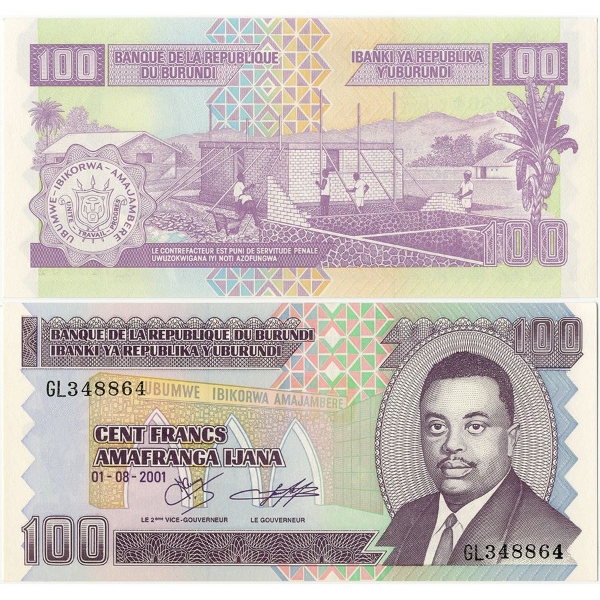
If you examine the obverse of the modern Burundi 100 Francs banknote, you are greeted by the calm, dignified portrait of a man in a sharp suit and tie. To a casual observer, he might look like a standard mid-century politician. But this is Prince Louis Rwagasore, the crown prince of Burundi, a fierce anti-colonial revolutionary, and the founding father of his nation.
His story is one of royal duty, radical political vision, and ultimate tragedy. Rwagasore fought tirelessly to free his country from Belgian colonial rule and to unite the historically divided Hutu and Tutsi populations. He succeeded in securing his nation's independence, but he never lived to see it. Just months before Burundi officially became a sovereign nation, Rwagasore was assassinated in a plot that would alter the destiny of Central Africa forever.
To hold a Burundi 100 Francs note is to hold a memorial to a man whose vision of unity cost him his life.
Key Facts: Prince Louis Rwagasore & The 100 Francs Note
Numismatic & Historical Specs | Details |
|---|---|
Featured Figure | Prince Louis Rwagasore (1932–1961) |
Historical Role | Crown Prince, Prime Minister, and National Independence Hero of Burundi. |
Banknote Denomination | 100 Francs (Amafranga Ijana) |
Issuing Authority | Banque de la République du Burundi (Bank of the Republic of Burundi) |
Obverse Design Elements | Portrait of Prince Louis Rwagasore facing slightly left; modern architectural arches in the background. |
Reverse Design Elements | A collaborative scene of citizens constructing a brick house; the national coat of arms. |
National Motto Featured | Ubumwe, Ibikorwa, Amajambere (Unity, Work, Progress) |
Assassination Date | October 13, 1961 (Assassinated at the Hotel Tanganyika in Bujumbura). |
Numismatic Insights: At a Glance (Key Takeaways)
A Royal Revolutionary: Unlike many African independence leaders who overthrew monarchies, Rwagasore was a Crown Prince who used his royal status to legitimize a modern, anti-colonial, and democratic independence movement.
The Architect of Unity: He is revered not just for defeating Belgian colonial rule, but for successfully bridging the deep, historical ethnic divides between the Hutu and Tutsi populations through his UPRONA political party.
A Vision of Progress: The reverse of the 100 Francs note depicts citizens building a home. This is a direct numismatic tribute to Rwagasore’s core political philosophy: that true independence required hard physical work and national cooperation.
The Heir Who Chose the People
Louis Rwagasore was born on January 10, 1932, into the highest echelons of Central African royalty. He was the son of Mwami (King) Mwambutsa IV, who ruled the Kingdom of Burundi. At the time, Burundi was part of Ruanda-Urundi, a territory administered by Belgium under a League of Nations (and later United Nations) mandate following the defeat of the German Empire in World War I.
As the Crown Prince, Rwagasore was expected to become a compliant figurehead for the Belgian colonial administrators. He received an elite education, eventually traveling to Belgium in 1956 to study at university in Antwerp. However, Europe in the late 1950s was a hotbed of anti-colonial thought. Rwagasore was deeply influenced by the sweeping wave of African nationalism and the independence movements rocking the neighboring Belgian Congo.
When he returned to Burundi, he shocked the colonial authorities. Instead of settling into a life of quiet luxury, Rwagasore threw himself into radical politics. In 1958, he founded the Union pour le Progrès national (UPRONA), a nationalist political party dedicated to achieving immediate, total independence from Belgium.
Bridging the Hutu and Tutsi Divide
Rwagasore’s greatest political achievement was his ability to transcend ethnic lines. Burundi, like its neighbor Rwanda, was demographically split between the majority Hutu population and the minority Tutsi population (from which the royal family descended).
The Belgian colonial administration had historically exploited these ethnic divisions to maintain control—a tactic known as "divide and rule." Rwagasore understood that an independent Burundi would immediately collapse into civil war if the Hutu and Tutsi did not stand together. Because of his royal charisma, his marriage to a Hutu woman, and his genuinely inclusive platform, he successfully united both groups under the UPRONA banner. He became a unifying symbol, proving that national identity could supersede ethnic tribalism.
The Belgians, terrified of losing control over the territory, actively opposed Rwagasore. They placed him under house arrest in 1960 to prevent him from campaigning. However, the move backfired spectacularly, turning the Prince into a political martyr and skyrocketing his popularity.
In the UN-supervised parliamentary elections of September 1961, UPRONA won a staggering landslide victory, taking 80% of the vote. On September 28, 1961, Prince Louis Rwagasore was officially declared the Prime Minister of Burundi, with a mandate to lead the country to full independence.
The Shot at the Hotel Tanganyika
Rwagasore’s victory was a death sentence. His political rivals—the pro-Belgian Christian Democratic Party (PDC)—realized they had lost at the ballot box and resorted to violence.
On the evening of October 13, 1961, just two weeks after becoming Prime Minister, Rwagasore was dining with his cabinet members on the open-air terrace of the Hotel Tanganyika in the capital city of Bujumbura. An assassin, a Greek national named Jean Kageorgis who had been hired by PDC leaders, hid in the nearby bushes. With a single rifle shot to the chest, Kageorgis assassinated the 29-year-old Prime Minister.
The assassination sent shockwaves across the globe. While the trigger was pulled by a hired gunman, historical evidence and later testimonies strongly suggested complicity by certain Belgian colonial officials who wished to see the radical prince removed.
On July 1, 1962, Burundi officially gained its independence, but it did so without its visionary leader. Without Rwagasore’s unifying presence, the ethnic tensions he had worked so hard to heal eventually fractured, leading to decades of tragic political instability and violence in the region.
Decoding the 100 Francs Banknote
In the decades following his death, Prince Louis Rwagasore was immortalized as the ultimate symbol of Burundian patriotism. His appearance on the nation's currency is a masterclass in numismatic storytelling.
If we examine the 2001 issue of the 100 Francs note, we see the duality of his legacy:
The Obverse (The Visionary): Rwagasore’s portrait dominates the right side of the note. He is depicted not in traditional royal regalia, but in a modern Western suit. This was a deliberate choice during his life; he wanted to present Burundi as a modern, forward-thinking nation ready to take its place on the global stage. Behind him, intricate geometric patterns and modern architectural arches symbolize the dawn of a new era.
The Reverse (The Reality): While the front honors the man, the back honors his philosophy. The reverse depicts an active construction site, with ordinary citizens laboring together to build a brick house. Next to this scene is the official coat of arms of Burundi, featuring a lion's head and the national motto: Ubumwe, Ibikorwa, Amajambere (Unity, Work, Progress).
This imagery is incredibly poignant. Rwagasore famously told his people that independence was not a magical cure for poverty; it meant that they now had to roll up their sleeves and build their nation themselves. The reverse of the 100 Francs note is a literal illustration of his rallying cry for "Unity" and "Work."
Today, holding this beautifully engraved banknote is a sobering reminder of the high price of freedom. Prince Louis Rwagasore sacrificed his royal privilege, and ultimately his life, for the dream of a united Burundi.
Frequently Asked Questions (FAQs)
Who is on the Burundi 100 Francs banknote?
The portrait on the Burundi 100 Francs banknote features Prince Louis Rwagasore. He was the Crown Prince of Burundi, the nation's first elected Prime Minister, and the primary leader of its movement for independence from Belgium.
Why was Prince Louis Rwagasore assassinated?
Rwagasore was assassinated on October 13, 1961, because of his overwhelming success in uniting the Hutu and Tutsi populations to demand immediate independence from Belgian colonial rule. He was killed by a hired assassin acting on behalf of a rival, pro-colonial political party (the PDC) just weeks after winning a landslide democratic election.
What does the motto on the Burundi banknote mean?
The phrase Ubumwe, Ibikorwa, Amajambere written on the Burundi coat of arms translates to "Unity, Work, Progress." This motto heavily reflects the political philosophy of Prince Rwagasore, who believed that true national progress could only be achieved through hard physical labor and ethnic unity.
Academic References & Further Reading
Lemarchand, R. (1970). Rwanda and Burundi. Praeger Publishers. (A seminal academic history of the political dynamics leading to independence in Central Africa).
Gahama, J. (1983). Le Burundi sous administration belge. Karthala Editions. (Detailed accounts of the Belgian colonial era and the rise of UPRONA).
Standard Catalog of World Paper Money. Burundi Banknote Index. Krause Publications.