Picture Source: Wikipedia
Why Was Julius Caesar's Face Depicted on Roman Coins? The Ultimate Act of Ancient Propaganda
For nearly five centuries, the Roman Republic operated under a strict, unbending, and unwritten rule: no living man, no matter how powerful, wealthy, or victorious, was permitted to place his own face on a Roman coin. Coinage was a sacred medium of the state, strictly reserved for the gods, mythological personifications of Roman virtues, and long-dead, legendary ancestors. To mint a coin featuring your own living portrait was to declare yourself a king—and in Rome, kings were violently despised.
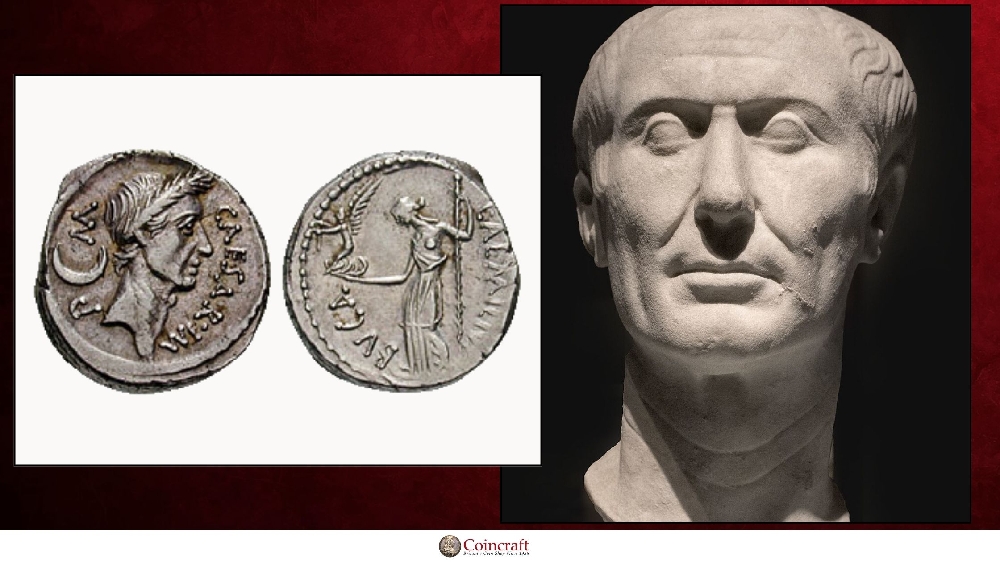
Yet, in early 44 BC, Julius Caesar shattered this ancient, 500-year-old taboo. He authorized the production of a silver denarius featuring his own wreathed profile, boldly accompanied by the legend Dictator Perpetuo (Dictator for Life).
Why did he do it? It was a calculated, brilliant, and ultimately fatal piece of political propaganda. Caesar's decision to depict his face on Roman coinage fundamentally changed the history of Western currency, but it was also the smoking gun that directly triggered his brutal assassination on the Ides of March.
Numismatic Insights: At a Glance (Key Takeaways)
Breaking a 500-Year Taboo: Before Caesar, Roman coins only depicted gods (like Jupiter or Roma) or deceased ancestors. Putting a living face on a coin was viewed as a tyrannical claim to absolute monarchy.
The Mass Media of Antiquity: In an era without mass communication, coinage was the fastest, most inescapable way to broadcast political supremacy to millions of citizens, merchants, and soldiers across the known world.
The Catalyst for Assassination: The 44 BC Dictator Perpetuo portrait coins proved to the Roman Senate that Caesar had no intention of restoring the Republic. It was the final visual proof of his monarchical ambitions, leading directly to his murder just weeks later.
Key Facts: The Portrait Denarius of Julius Caesar
Numismatic Specification | Details |
|---|---|
Issuer | Julius Caesar (Struck by moneyers such as P. Sepullius Macer, M. Mettius, L. Aemilius Buca, and C. Cossutius Maridianus) |
Date of Issue | January – March, 44 BC |
Denomination | Denarius |
Composition | Solid Silver |
Obverse Design | Wreathed, right-facing bust of Julius Caesar. Some issues feature a veil (capite velato) indicating his role as chief priest. |
Obverse Legend | CAESAR DICT PERPETVO (or variations like CAESAR IMP and CAESAR DICT QVART) |
Reverse Design | Venus Victrix standing, holding Victoria (Victory) and a scepter, resting her left arm on a shield. |
Historical Impact | The first widely circulated, state-sanctioned Roman coin to feature the portrait of a living person. |
The Golden Rule of Republican Coinage
To truly understand the shockwave Caesar caused, we must look at how the Roman Republic functioned prior to his rise. Since the expulsion of the last Roman King, Lucius Tarquinius Superbus, in 509 BC, the Republic was fiercely and violently anti-monarchy. Power was meant to be shared by the Senate and the people (Senatus Populusque Romanus - SPQR).
This shared power was heavily reflected in the Republic’s money. The officials in charge of minting money, known as the tresviri monetales (the three moneyers), used coinage to honor the state and its collective history. A typical silver denarius from the 2nd century BC might feature the helmeted head of the goddess Roma on the obverse (front) and a chariot driven by Jupiter on the reverse (back).
As ambitious politicians began using coins to promote their own specific families in the 1st century BC, they were still restricted by law and culture to depicting dead ancestors who had achieved great military victories. Sulla, Pompey, and even Cicero understood this line. The visual message across the Republic was clear: no living man is greater than Rome itself.
The Elephant in the Room: Caesar's First Nudge
Julius Caesar did not put his face on a coin immediately; he approached absolute power in highly calculated stages.
In 49 BC, Caesar famously crossed the Rubicon River with his army, igniting a massive civil war against Pompey the Great and the traditionalist Senate. To fund this war and pay his loyal legions, Caesar seized the Roman treasury and began striking his own military coinage at a traveling mint moving with his troops.
This resulted in the famous "Elephant Denarius." The obverse featured a powerful elephant trampling a horned serpent (often interpreted as a dragon or carnyx, representing the defeated Gauls or the forces of evil), with the name CAESAR struck boldly beneath it. The reverse depicted priestly implements—a lituus (curved wand), simpulum (ladle), aspergillum (sprinkler), and secespita (sacrificial axe)—reminding the public of his esteemed role as Pontifex Maximus, the chief priest of Rome.
While the Elephant Denarius did not feature his face, it was incredibly aggressive for its time. It was a massive departure from state-sanctioned coinage, serving as a direct, personal paycheck from a rogue general to his soldiers. It conditioned the Roman public to see the name "Caesar" as synonymous with wealth and power.
44 BC: The "Dictator Perpetuo" Portrait Coin
By early 44 BC, Caesar had defeated all his military rivals. He was the undisputed master of the Roman world. The Senate, now heavily stacked with his supporters, showered him with unprecedented honors. In February of 44 BC, he was granted the ultimate title: Dictator Perpetuo—Dictator in Perpetuity.
It was during this brief window that Caesar took the fatal step that would define his legacy. The mints in Rome began striking silver denarii featuring his aged, deeply realistic profile on the obverse.
The imagery on these coins was dense with deliberate political messaging:
The Portrait: Caesar was depicted wearing the corona aurea (golden wreath). While his supporters claimed this was merely a tribute to his military triumphs, his detractors saw it as a substitute for a royal diadem (crown). Some issues even depicted him wearing a veil, reminding the viewer of his absolute religious authority.
The Legend: Surrounding his face was his new, unchallengeable title,
CAESAR DICT PERPETVO.The Divine Connection: The reverse of many of these issues depicted the goddess Venus. Caesar claimed that his family line, the gens Iulia, descended directly from Venus through the Trojan hero Aeneas.
By combining his own living, heavily wrinkled face with his divine ancestor on a single piece of currency, Caesar was telling the entire empire that his authority was not just absolute, but divinely ordained.
Coinage as the Ultimate Propaganda Tool
Why take the risk of offending the traditionalists by breaking a 500-year taboo? Because in the ancient world, coinage was the only form of mass communication.
Caesar could give a rousing speech in the Forum, but only a few thousand people would hear it. He could erect statues, but they remained fixed in one city. A silver denarius, however, possessed wings. It passed through the hands of merchants, soldiers, farmers, and politicians from the rainy shores of Britain to the deserts of Syria.
When a legionary in Gaul bought a cup of wine, he paid for it with Caesar's face. When a merchant in Alexandria sold grain, he accepted Caesar's face. The portrait coin forced every single citizen participating in the Roman economy to physically handle, and therefore acknowledge, Caesar's absolute supremacy. It was an inescapable, daily psychological campaign designed to normalize one-man rule.
The Fatal Backlash: The Ides of March
Caesar's numismatic propaganda worked too well. The portrait coins, circulating rapidly through the streets of Rome, confirmed the absolute worst fears of the Republican senators.
For men like Marcus Junius Brutus and Gaius Cassius Longinus, the coins were the ultimate smoking gun. Caesar was not going to step down. He was not going to restore the Republic. The appearance of a living man on the currency was the undeniable hallmark of a Rex (King), matching the behavior of the despotic Hellenistic kings in the East.
On March 15, 44 BC (The Ides of March), just weeks after the portrait coins began circulating, a group of senators ambushed Caesar in the Theatre of Pompey and stabbed him 23 times.
In a profound twist of historical irony, the men who murdered Caesar to stop his monarchical ambitions quickly realized the power of the numismatic precedent he had set. Just two years later, in 42 BC, Brutus minted his own military coinage to pay his armies in Greece. The result was the infamous "EID MAR" denarius. The reverse celebrated the assassination with two daggers and a liberty cap. The obverse? It featured the living portrait of Brutus himself.
Julius Caesar had died for his arrogance, but the Roman Republic’s sacred taboo against living portraits was broken forever. The path was paved for the Roman Empire, where every emperor for the next five centuries would follow Caesar's lead, stamping their face onto the wealth of the Western world.
Frequently Asked Questions (FAQs)
Did Julius Caesar put his face on a coin?
Yes. In early 44 BC, Julius Caesar became the first living Roman to systematically issue widely circulating coinage featuring his own portrait. Prior to this, Roman coins only depicted mythological figures, deities, or deceased ancestors. He struck these portrait coins shortly before his assassination.
Why was Julius Caesar's face depicted on Roman coins?
Caesar put his face on Roman coins as an inescapable tool of mass political propaganda. By distributing currency bearing his portrait and his new title Dictator Perpetuo (Dictator for Life), he asserted his absolute, unchallengeable authority over the Roman Empire to millions of soldiers and citizens alike.
What is the meaning of the symbols on Roman coins from Caesar's era?
Symbols on Caesar's coinage were carefully chosen to legitimize his power. The elephant represented his military conquests. The simpulum and lituus (priestly tools) highlighted his role as Rome's chief priest. The goddess Venus, frequently depicted on the reverse of his portrait coins, was a direct reminder to the public that Caesar claimed descent from the gods.
Why did the Romans consider portrait coins dangerous?
The Roman Republic was founded on the violent overthrow of a monarchy in 509 BC. For 500 years, the Romans culturally associated the portrait of a living man on currency with the despotic kings of Eastern empires (such as the Ptolemies in Egypt). Putting a living face on a coin was seen as an open declaration of tyranny and a threat to the Republic.
Academic References & Bibliography
Crawford, M. H. (1974). Roman Republican Coinage. Cambridge University Press.
Sear, D. R. (1998). The History and Coinage of the Roman Imperators 49–27 BC. Spink & Son Ltd.
Suetonius (Translated by J.C. Rolfe, 1913). The Twelve Caesars: Life of Julius Caesar. Loeb Classical Library, Harvard University Press. (Hosted by University of Chicago).
Cassius Dio. Roman History, Book 44. Loeb Classical Library. (Hosted by University of Chicago).

