Picture Source of Bible: Canva
The Widow's Mite: The Real Story Behind the World’s Most Famous Biblical Coin
Few ancient coins carry the emotional weight, narrative power, and cultural resonance of the "Widow’s Mite." Mentioned in the Gospels of Mark and Luke, this humble bronze coin has transcended its physical status as minor provincial currency to become a universal symbol of selfless giving, faith, and the true measure of generosity.
To the ancient Romans and Judaeans, however, the coin was not a symbol of virtue; it was the lowest denominator of everyday street change. Often crudely struck, poorly centred, and worth less than a fraction of a day's wage, these tiny bronze pieces are highly sought after by modern historians, biblical scholars, and numismatists alike. This guide decodes the history, identity, economic realities, and collecting landscape of the world's most famous biblical coin.
Key Facts
Feature / Metric | Details |
|---|---|
Biblical Reference | Mark 12:41–44, Luke 21:1–4 |
Historical Denomination | Judean Lepton (singular) / Lepta (plural) |
Alternative Denomination | Judean Prutah (equal to two Lepta) |
Most Common Issuer | Alexander Jannaeus, Hasmonean King of Judaea (103–76 BC) |
Composition | Bronze (low-grade copper alloy) |
Average Weight | 0.5 to 1.5 grams |
Average Diameter | 10 mm to 12 mm |
Common Motifs | Anchor, eight-rayed star, wheel, double cornucopia, diadem |
Circulating Market Value | £12 to £40 (for common, average-circulated specimens) |
Key Takeaways
The Translation Origin: The word "mite" does not appear in original Greek biblical texts. It is a Middle English term for a tiny, low-value Flemish coin, popularized by William Tyndale’s 1526 English translation and cemented by the 1611 King James Bible.
A Hasmonean Legacy: Though circulated widely during the life of Jesus, the vast majority of "Widow's Mites" were struck nearly a century earlier during the Hasmonean Dynasty under King Alexander Jannaeus.
The Ultimate Fraction: The lepton was the absolute smallest, thinnest coin minted in the classical Mediterranean, representing half of a Judaean prutah and a mere $\frac{1}{128}$ of a standard Roman denarius.
An Abundance of Fakes: Because of their massive popularity with tourists and religious collectors, the market is flooded with crude cast replicas, requiring buyers to learn the distinct indicators of genuine, hand-struck ancient planchets.
The Biblical Narrative: The Measure of Sacrifice
The legendary status of the coin stems entirely from a single observed event in the Court of the Women inside the Second Temple in Jerusalem. According to the Gospel of Mark:
"And Jesus sat over against the treasury, and beheld how the people cast money into the treasury: and many that were rich cast in much. And there came a certain poor widow, and she threw in two mites, which make a farthing." (Mark 12:41-42, King James Version).
Jesus famously called his disciples over to explain that the widow had given more than all the wealthy donors combined. While they had given out of their surplus, she, in her poverty, had given "all that she had, even her living."
For centuries, this passage has been analysed for its theological depth. However, for numismatists, it provides a highly precise economic and terminological map of ancient Judaean currency.
                  THE CURRENCY CONVERSION CHAIN
┌────────────────────────────────────────────────────────────────────────┐
│  1 Roman Denarius (1 Day's Labour) = 16 Roman Asses                     │
├────────────────────────────────────────────────────────────────────────┤
│  1 Roman As                       = 4 Roman Quadrantes ("Farthings")  │
├────────────────────────────────────────────────────────────────────────┤
│  1 Roman Quadrans ("Farthing")    = 2 Judean Prutot                    │
├────────────────────────────────────────────────────────────────────────┤
│  1 Judean Prutah                  = 2 Judean Lepta ("Mites")           │
└────────────────────────────────────────────────────────────────────────┘
The Greek text uses the word lepta (singular lepton, meaning "thin" or "peeled"). The text also helpfully translates this local currency into Roman terms for its non-Jewish readers, stating that the two lepta make a kodrantes (the Greek transliteration of the Roman quadrans, or farthing).
The True Identity: Lepton vs. Prutah
While any tiny, low-value Judaean bronze coin from the late Hellenistic or early Roman period can broadly be categorised as a "Widow's Mite," numismatists point to two specific coins as the primary candidates: the Lepton and the Prutah (Hendin, 2010).
                      CANDIDATES FOR THE WIDOW'S MITE
┌────────────────────────────────────────────────────────────────────────┐
│  1. THE HASMONEAN LEPTON (Alexander Jannaeus, 103-76 BC)               │
│     - The most common candidate. Features an anchor and an 8-ray star. │
├────────────────────────────────────────────────────────────────────────┤
│  2. THE HERODIAN PRUTAH (Herod Archelaus / Pontius Pilate, c. 6-36 AD) │
│     - Coexistent currency. Features double cornucopias or a palm branch.│
└────────────────────────────────────────────────────────────────────────┘
1. The Widely Accepted Winner: The Lepton of Alexander Jannaeus
By far the most common coin found in archaeological digs around the Temple Mount is the bronze lepton issued by the Hasmonean King Alexander Jannaeus (Madden, 1864). Jannaeus ruled Judaea from 103 to 76 BC, and his mints produced millions of cheap, low-weight bronze coins to fuel the local economy.
Because these bronze coins were of very little metal value, they remained in circulation for generations. By the first century AD, the markets of Jerusalem and the Temple treasury were still completely saturated with Jannaeus's bronze coins.
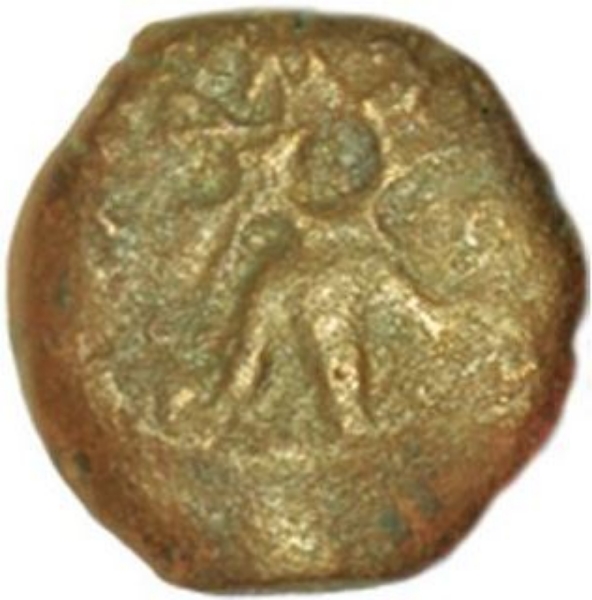
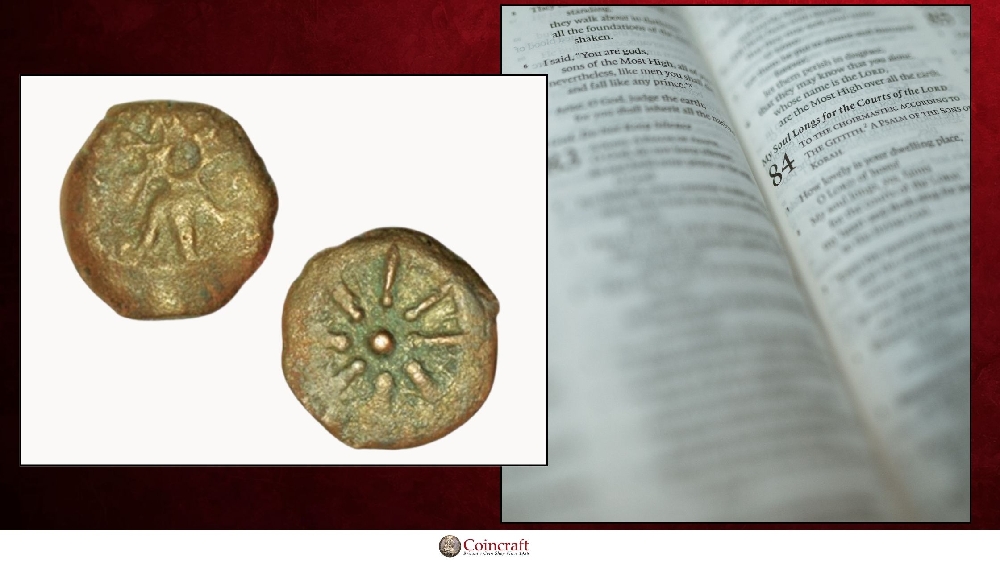
Obverse Design: An anchor surrounded by a circle, usually accompanied by the Greek inscription BASILEOS ALEXANDROU ("Of King Alexander"). The anchor was a design adapted from the Seleucid Empire, representing maritime trade and naval power.
Reverse Design: An eight-rayed star surrounded by a circular diadem (royal crown). Between the rays of the star, ancient Paleo-Hebrew lettering reads Yehonatan HaMelek ("Jonathan the King").
2. The Next-Step Alternative: The Judean Prutah
The prutah was the standard, slightly larger bronze denomination of Jewish currency. If the widow cast in two "mites" (lepta) that equaled one farthing, she may have cast in two individual lepta, or she may have cast in a single prutah coin, which was economically equivalent to two lepta (Hendin, 2010).
During the Roman provincial administration of Judaea (which included the rule of procurators like Pontius Pilate), both lepta and prutot were struck locally. These coins featured highly localized symbols—such as barley ears, palm branches, simpula (Roman ladle), and double cornucopias—carefully designed to avoid depicting human or pagan figures, which would have violated the Jewish Second Commandment.
The Economics of Poverty: What Was a Mite Worth?
To truly appreciate the biblical story, one must translate the buying power of the widow's two coins into modern economic terms.
During the early Roman Empire, a standard day's wage for an agricultural labourer or a Roman legionary soldier was one silver denarius (Soderglen, 2018).
The Breakdown: One denarius was worth 16 copper asses. One as was worth 4 bronze quadrantes (farthings). One quadrans was worth 2 prutot. One prutah was worth 2 lepta.
The Math: Therefore, a single Roman denarius was worth 128 lepta (mites).
If a labourer earned a single denarius for a grueling 12-hour shift under the Mediterranean sun, the widow’s total donation of two lepta represented approximately 9 minutes of work (Soderglen, 2018).
In terms of purchasing power in first-century Jerusalem, two lepta could buy almost nothing of substance. It was not enough to buy a single loaf of cheap barley bread or a cup of cheap wine. The absolute minimum purchase in the temple market was typically a pair of sparrows (sold for sacrificial purposes to the poorest pilgrims), which cost one Roman as—equivalent to eight lepta (Madden, 1864).
By donating two lepta, the widow was giving an amount that was economically useless on its own, yet structurally represented her entire remaining livelihood.
Anatomy and Production: Why They Look So "Crude"
Collectors acquiring their first "Widow's Mite" are often shocked by how crude, misshapen, and worn the coins appear. Unlike the beautifully round, highly detailed silver coins of the Roman Empire, Judaean bronze coins were manufactured under extreme budget constraints (Hendin, 2010).
Cast Flans: Rather than cutting precise circular blanks, mint workers poured molten bronze into double-sided stone moulds connected by narrow channels. Once the metal cooled, the coins were snapped off the resulting tree-like structure. This is why many Widow's Mites have distinct flat "tabs" or jagged edges on opposite sides where they were broken from the mould.
Hand-Hammered Striking: A blank bronze planchet was placed on an anvil die, and a mint worker held an upper die over it before striking it hard with a heavy mallet. Because the planchets were tiny (often smaller than a thumbnail) and the production speed was high, the dies were almost always struck off-centre.
Incomplete Legends: It is extremely rare to find a Widow’s Mite where the entire anchor or all eight rays of the star are perfectly centred on the coin. Most specimens feature only 40% to 60% of the design, with the Greek or Hebrew inscriptions completely cut off by the edge of the bronze.
A Collector's Guide: Spotting the Fakes
Because millions of Alexander Jannaeus bronze coins were struck, the Widow's Mite is actually one of the most affordable and accessible ancient coins in the world today. However, its massive popularity makes it a prime target for counterfeiters and tourist scams in the Middle East.
                       GENUINE VS. COUNTERFEIT MITE
┌─────────────────────────────────────────────────────────────────────────┐
│  GENUINE COIN:                                                          │
│  - Struck from individual hand-carved dies.                             │
│  - Features sharp, distinct lines under magnification.                  │
│  - Irregular shapes with dynamic thickness and casting sprue tabs.      │
│                                                                         │
│  COUNTERFEIT COIN:                                                      │
│  - Cast in sand moulds using a genuine coin as a pattern.                │
│  - Soft, "mushy" details and rounded edges on relief elements.          │
│  - Microscopic bubbles, pitting, and modern filing marks on the rim.     │
└─────────────────────────────────────────────────────────────────────────┘
When verifying the authenticity of a Widow's Mite, check the following details (Soderglen, 2018):
Surface Texture: Genuine coins have a smooth, hard surface patina that has built up over thousands of years in the earth. Fake coins, which are often created by pouring molten metal into crude sand moulds, will exhibit microscopic pitting, tiny bubbles, or a grainy, spongy texture.
Edge Marks: Genuine ancient bronze planchets were broken off a cast sprue tree before being struck. Fake cast coins are often cast individually or in modern moulds that leave a distinct seam running around the entire edge of the coin. Look for filing marks where a counterfeiter has tried to grind away this telltale mould line.
Weight Integrity: A genuine Alexander Jannaeus lepton should weigh between 0.5 and 1.5 grams. If a coin feels unusually heavy or thick, or is made of modern yellow brass rather than dark, aged bronze, it should be approached with extreme scepticism.
Patina Integrity: Beware of "applied" green patinas. Genuine ancient bronze often features a beautiful green or dusty desert-brown patina that cannot be easily scraped off. Fakers often paint modern cast replicas with green acrylic paint or chemical agents to simulate centuries of burial.
Frequently Asked Questions (FAQs)
Are "Widow's Mites" rare or expensive?
No. Because Alexander Jannaeus minted millions of these bronze coins to support his military campaigns and trade networks, they are incredibly common. Uncleaned or poorly preserved specimens can often be purchased for under £8. Nice, clearly identifiable, and certified authentic specimens generally retail between £15 and £50, making them highly accessible to novice collectors.
Can these coins be legally owned and imported?
Yes, but with strict legal parameters. Under international cultural property agreements, ancient coins imported into the United States or Europe must comply with strict export regulations from their country of origin (such as Israel). When purchasing a Widow's Mite, always buy from a reputable dealer who belongs to professional organisations like the International Association of Professional Numismatists (IAPN) and can provide a lifetime guarantee of authenticity and legal provenance.
Why did the widow have to pay in Judaean coins rather than Roman coins?
The Temple treasury in Jerusalem operated under strict religious laws. Roman coins, which prominently featured the bust of the Roman Emperor alongside pagan inscriptions declaring him a deity, were considered an abomination and could not be deposited directly into the treasury. Worshipers had to exchange their foreign, imperial currency for local, non-portrait Judean coins (like the lepton, prutah, or half-shekel) to pay their taxes and make offerings.
Why are there two different designs associated with the coin?
Because multiple designs circulated simultaneously in first-century Jerusalem. The most common "Widow's Mite" design features the anchor and star of Alexander Jannaeus. However, later coins struck by the Roman governors (like Pontius Pilate) or Herod the Great's family also circulated as fractional bronze change and are considered equally historical "mites."
Bibliography
British Museum. (n.d.). The Bronze Lepton of Alexander Jannaeus. Collection Online. Museum Number: 1908,0610.12. London.
Hendin, D. (2010). Guide to Biblical Coins. 5th Edition. New York: Amphora Books.
Madden, F. W. (1864). History of Jewish Coinage and of Money in the Old and New Testaments. London: Bernard Quaritch.
Soderglen, R. T. (2018). The Numismatist's Guide to Material Preservation: Understanding PVC, Mylar, and Polypropylene. New York: Academic Numismatic Press.
The Israel Museum. (2015). The Coins of the Hasmonean Dynasty. Jerusalem: Israel Museum Publications. Available at: Israel Museum Portal