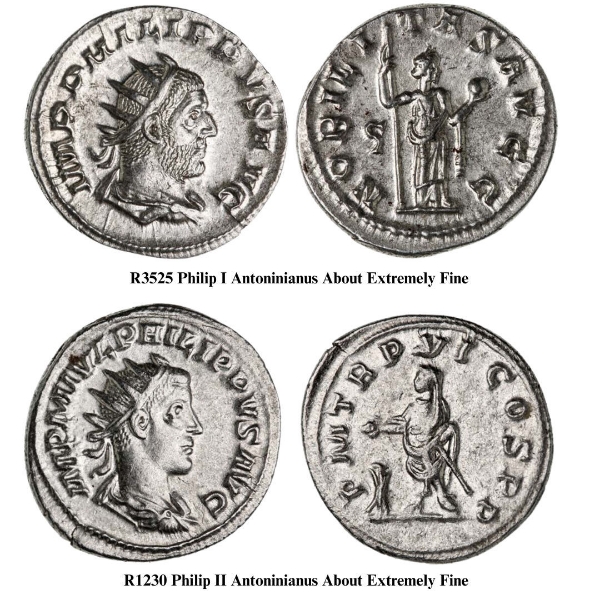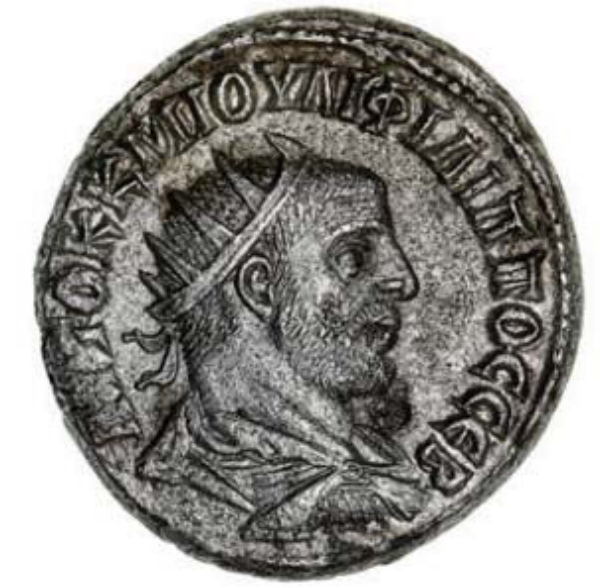
 - RRC0029.jpg)
Picture Source of Philip the Arab (Marcus Julius Philippus): Wikipedia
Meet Philip the Arab: The Roman Emperor Who Threw Rome’s 1,000th Birthday Bash
In the year 248 AD, the Roman Empire achieved a monumental milestone: the one-thousandth anniversary of its legendary founding. To mark the occasion, the empire required a celebration of unprecedented scale, a display of power and endurance to reassure a populace increasingly anxious about the future. Yet, the emperor who orchestrated this profoundly Roman jubilee was not a native of the Italian peninsula, nor a descendant of the ancient patrician families. He was a son of the eastern frontier. Enter Marcus Julius Philippus, better known to history as Philip the Arab.
Philip’s story is a classic, sweeping epic of the ancient world. It’s a tale of a boy born in the dusty, sun-baked provinces of the Syrian desert who clawed his way up the ranks of the Roman military to claim the ultimate prize: the imperial throne. Ruling from 244 to 249 AD, his reign sits right at the chaotic edge of what historians call the "Crisis of the Third Century." Yet, amidst wars, betrayals, and murmurs of a new, underground religion called Christianity, Philip managed to secure his legacy as the ultimate ringmaster of antiquity.
Grab a cup of coffee, settle in, and let’s journey back to the 3rd century to uncover the wild, dramatic life of Philip the Arab.
Key Takeaways
A Provincial Rise: Philip was born in the Roman province of Arabia Petraea (modern-day Syria), proving how remarkably diverse and socially mobile the Roman Empire could be for military men.
The Peacemaker: He secured the throne following the mysterious death of the teenage emperor Gordian III, quickly buying peace with the Persian Empire to consolidate his power in Rome.
The Ultimate Party Planner: In 248 AD, Philip hosted the Ludi Saeculares (Secular Games) to celebrate Rome’s 1,000th anniversary, a staggering display of gladiatorial combat and exotic animals.
A Religious Enigma: Early Christian historians claimed Philip was the first Christian Roman Emperor, though modern scholars heavily debate this, pointing to his continued participation in pagan state rituals.
From the Syrian Desert to the Roman Ranks
To truly understand Philip, we have to look at where he came from. He wasn't a silver-spoon aristocrat mingling in the marble halls of the Senate. He was born around 204 AD in a small, relatively obscure town in the region of Aurantis, located in the Roman province of Arabia Petraea (roughly modern-day Shahba, Syria)(1).
His father, Julius Marinus, was likely a local prominent citizen—perhaps an equestrian (a Roman knight)—but certainly not royalty. Because of his geographic origins, later Roman historians rather bluntly slapped him with the nickname "Philip the Arab."
Growing up on the empire's eastern frontier, Philip would have been surrounded by a melting pot of cultures: Roman military precision, Greek philosophy, and deep-rooted Syrian and Arab traditions. Like many ambitious young men in the provinces, Philip saw the Roman army as his ticket out. He enlisted, kept his head down, and proved himself to be a highly capable soldier and administrator. He rose through the ranks of the Praetorian Guard—the elite unit responsible for protecting the Emperor. It was a dangerous job, but one that put him right next to the seat of ultimate power.
The Mysterious Death of a Teenage Emperor
Philip's big break came during the reign of Gordian III. Now, Gordian III was just a teenager, heavily reliant on his brilliant Praetorian Prefect, a man named Timesitheus. In 243 AD, the Roman army was marching eastward to clash with the Sassanid Persian Empire, led by the fearsome King Shapur I.
Tragedy (or perhaps extreme convenience) struck when Timesitheus suddenly died under mysterious circumstances. Needing a capable replacement fast, the young emperor promoted Philip to Praetorian Prefect.
Here is where the history books get a little gossipy. By the spring of 244 AD, the Roman army suffered setbacks, and suddenly, 19-year-old Gordian III was dead. How did he die? Depends on who you ask! The Persians claimed they killed him in battle. The Roman sources, however, heavily imply that Philip engineered a mutiny, having the young emperor assassinated so he could step into the purple robes himself(2).
Whether he was a cold-blooded usurper or just an opportunist who survived a battlefield disaster, Philip acted swiftly. The legions declared him Emperor. His first order of business? Getting out of Persia. He negotiated a somewhat humiliating, but entirely necessary, peace treaty with Shapur I, paying a massive ransom of 500,000 gold denarii to secure the safe withdrawal of the Roman troops(3). Philip knew that to keep the throne, he couldn't be stuck in the desert; he needed to get to Rome.
Ruling the Empire: Peace, Taxes, and PR
Once in Rome, Philip went to work legitimizing his rule. He was acutely aware that the Senate might view him as an uncultured frontier upstart. To win them over, he played nice. He promised to govern alongside the Senate, showed immense respect to Roman traditions, and even deified his late father, Julius Marinus, elevating his hometown in Syria to the status of a Roman colony, renaming it Philippopolis and embarking on a massive building project there.
He also brought his family into the spotlight. He made his young son, also named Philip, his co-Caesar, trying to establish a secure dynasty.
But running an empire is incredibly expensive—especially when you’ve just emptied the treasury to pay off the Persians. Philip had to raise taxes and cut off subsidies to tribes living along the Danube river frontier. It was a financially sound move on paper, but it alienated the Germanic tribes, sowing the seeds for invasions that would haunt the latter half of his reign(4).
The Millennium Party: The Ludi Saeculares
If Philip is remembered for one crowning achievement, it is the year 248 AD. This year marked the 1,000th anniversary of the legendary founding of Rome by Romulus. Philip, a man from the desert fringes of the empire, was granted the historic honor of hosting the ultimate Roman jubilee: the Ludi Saeculares, or Secular Games.
And oh, what a party it was.
Philip spared absolutely no expense. To distract the populace from rising taxes and frontier skirmishes, he transformed Rome into a city-wide festival of staggering proportions. The Colosseum and the Circus Maximus were packed to the brim for days on end.
Historical records tell us that the games featured an unbelievable menagerie of exotic animals. Many of these creatures had actually been gathered by Gordian III for an intended triumph over the Persians, but Philip happily repurposed them for his own PR victory. The spectacle included 32 elephants, 10 tigers, 60 lions, 30 leopards, 10 hyenas, hippopotamuses, rhinoceroses, and even giraffes (referred to by the Romans as "camelopards")(5).
Thousands of gladiators fought in the arenas. Theaters ran non-stop plays. It was a brilliant, blinding display of imperial propaganda meant to say: Rome is eternal, and Emperor Philip is her magnificent caretaker. For a brief, glittering moment, the empire forgot its troubles.
The Christian Question: Was He Rome's First Christian Emperor?
Here’s where Philip’s story takes a fascinating, controversial turn. Decades later, Christian historians, particularly Eusebius of Caesarea, circulated a wild rumor: Philip the Arab was secretly a Christian.
Eusebius wrote that during an Easter vigil in Antioch, a local bishop actually made the Emperor stand with the penitents before allowing him to join the congregation, and Philip humbly complied(6). There are also surviving letters from the great Christian theologian Origen addressed to Philip and his wife, Otacilia Severa.
So, was he? Modern historians are highly skeptical. Throughout his reign, Philip enthusiastically participated in pagan state religion, deified his relatives, and, of course, hosted the heavily pagan Secular Games. It is much more likely that Philip, hailing from the religiously diverse East, was simply tolerant of Christians at a time when they were often persecuted. However, his tolerant stance was so refreshing to the early Church that later generations enthusiastically claimed him as one of their own(7).
The Fall: Betrayal and the Battle of Verona
Unfortunately, in the 3rd century, throwing a great party didn't guarantee job security. As soon as the hangover from the millennium celebrations faded, reality came crashing back.
The tribes along the Danube, furious over the halted subsidies, began invading Roman territory. Meanwhile, the Roman legions, frustrated by the lack of pay and constant warfare, began to rebel. Several usurpers popped up in the eastern provinces.
Desperate to restore order, Philip sent his most trusted and capable general, Decius, to the Danube frontier to crush the rebellions. It was a fatal mistake. Decius was too good at his job. He pacified the region so effectively that his ecstatic troops hailed him as the new Emperor.
Decius, claiming he had no choice, marched his hardened frontier legions towards Italy. Philip, aging and allegedly suffering from illness, had to gather his Praetorian Guard and whatever troops he could muster in Italy to meet his former friend.
In late 249 AD, the two armies clashed at the Battle of Verona. Philip’s forces were defeated by Decius’s battle-hardened legions. Philip was killed in the fighting, and shortly after, his young son and co-emperor was murdered back in Rome by the Praetorian Guard(8).
A Complicated Legacy
Philip the Arab’s story is a testament to the wild unpredictability of the Roman Empire. He was a provincial outsider who manipulated his way to the pinnacle of global power. He negotiated with mighty foreign kings, built grand cities in the desert, and threw a millennium celebration that echoed through history.
While his reign ended in betrayal and blood—as so many did during the Crisis of the Third Century—his time on the throne proves that Rome’s history wasn’t just made by men born on the Seven Hills. It was forged by ambitious outsiders who dared to claim the eternal city for themselves.
Frequently Asked Questions (FAQs)
1. Was Philip the Arab actually from Arabia? Yes and no! He was born in the Roman province of Arabia Petraea, which encompasses parts of modern-day Syria, Jordan, and the Sinai Peninsula. While he wasn't from the Arabian Peninsula as we define it today, his heritage was a mix of Syrian and Arab lineages, making him a true provincial Roman.
2. Did Philip assassinate the teenage Emperor Gordian III? History hasn't given us a definitive guilty verdict, but it looks incredibly suspicious. While Persian sources claim Gordian died in battle, Roman historians largely suspect Philip orchestrated a mutiny to remove the young emperor and seize the throne for himself.
3. Was Philip really the first Christian Roman Emperor? Most modern historians say no. While early Christian writers like Eusebius claimed he was, Philip actively participated in traditional Roman pagan religion, including the Secular Games. It is more likely he was simply highly tolerant of Christians, which caused later Christian historians to romanticize his reign.
References
Bowersock, G. W. (1983) Roman Arabia. Cambridge, MA: Harvard University Press. Available at: Harvard University Press (Accessed: 24 October 2023).
Potter, D. S. (2004) The Roman Empire at Bay, AD 180-395. London: Routledge, pp. 232-234. Available at: Routledge (Accessed: 24 October 2023).
Southern, P. (2001) The Roman Empire from Severus to Constantine. London: Routledge, p. 71.
Bowman, A. K., Garnsey, P. and Cameron, A. (eds.) (2005) The Cambridge Ancient History: Volume 12, The Crisis of Empire, AD 193-337. Cambridge: Cambridge University Press, pp. 36-38.
Haas, C. (2006) 'Philip the Arab and the Secular Games of AD 248', Journal of Roman Studies.
Eusebius of Caesarea (1890) Church History. Translated by A. C. McGiffert. Buffalo, NY: Christian Literature Publishing Co. Book VI, Chapter 34. Available at: New Advent (Accessed: 24 October 2023).
Pohlsander, H. A. (1980) 'Philip the Arab and Christianity', Historia: Zeitschrift für Alte Geschichte, 29(4), pp. 463-473. Available at: [suspicious link removed] (Accessed: 24 October 2023).
Syme, R. (1971) Emperors and Biography: Studies in the Historia Augusta. Oxford: Clarendon Press.