Picture Source of Azes II: Wikipedia
The Ultimate Historical Plot Twist: The Story of Indo-Scythian King Azes II
In the heart of ancient Gandhara and the Punjab, a bustling crossroads stretching across what is now Pakistan and Afghanistan. We are setting our sights on the late 1st century BCE. This was a volatile, transformative era when the remnants of the Indo-Greek kingdoms were giving way to the expanding power of the Sakas—nomadic tribes sweeping down from the Central Asian steppes. In this dynamic geopolitical landscape, where Hellenistic, Indian, and Persian traditions collided, a powerful Indo-Scythian ruler emerged: King Azes II.
Or does he?
Grab a cup of coffee and settle in, because the biography of this Indo-Scythian king isn't just a tale of ancient empires, spectacular bilingual coins, and early Buddhist art. It’s also the center of one of the greatest historical "plot twists" in modern numismatics. Let’s dive right into the story of the king who ruled an empire... and who might never have actually existed!
Key Takeaways
A Cultural Crossroads: Azes II was an Indo-Scythian king believed to have ruled from roughly 35 to 12 BCE in the northwestern Indian subcontinent.
The Power of Coins: He is primarily known through his incredible bilingual coinage, which perfectly blended Greek script and deities with local Indian languages and symbols.
Buddhist History: Coins bearing his name were found inside the famous Bimaran Casket, helping historians date one of the earliest known human depictions of the Buddha.
The Grand Illusion: Modern numismatic research suggests "Azes II" might actually just be Azes I, meaning this great king might be a historical illusion created by different coin mints!
Setting the Scene: The Indo-Scythian Empire
To understand Azes II, we first need to look at his people: the Indo-Scythians (or Sakas). Originally nomadic tribes from Central Asia, they migrated south, eventually setting up a powerful kingdom that swept across Bactria, the Indus Valley, and Gandhara[1].
According to traditional historical timelines, Azes II took the throne around 35 BCE. He inherited an empire that was an absolute powerhouse of trade, situated right along the vital arteries of the ancient Silk Road. Under his watch, the Indo-Scythian kingdom saw a period of cultural syncretism—a fancy way of saying that people from vastly different backgrounds were sharing ideas, art, and religion like never before.
Coins as Ancient Cultural Passports
If you want to know about Azes II, you have to look at his money. Ancient coins weren't just cash; they were tiny metal billboards used by kings to spread their brand. And Azes II’s "brand" was incredibly inclusive.
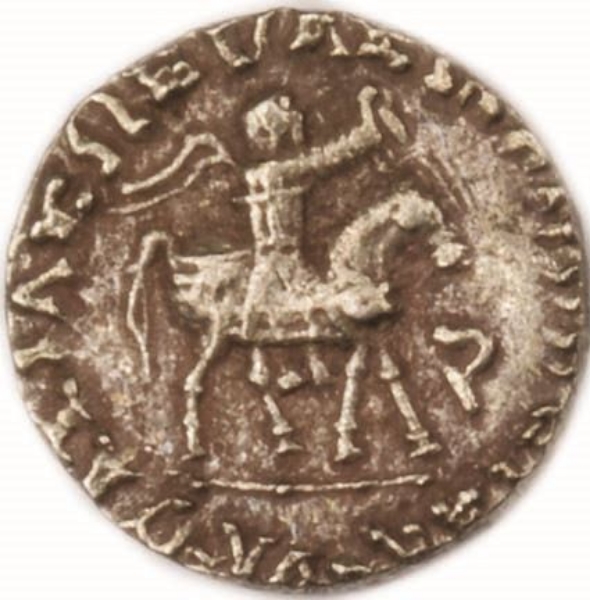
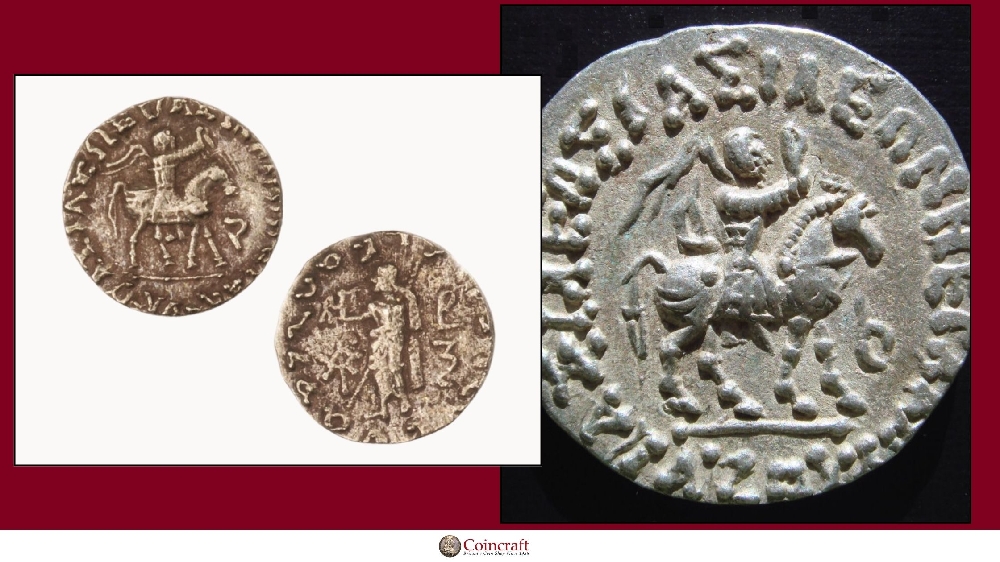
His coins are famous for being bilingual. On one side, you'll find Greek lettering (a leftover influence from the conquests of Alexander the Great) proclaiming him the "Great King of Kings." On the flip side, the exact same title is written in Kharosthi, an ancient script used in the region[2].
The imagery is just as mixed. Instead of a traditional Greek bust profile, Azes II is usually depicted proudly riding a horse, holding a whip or a scepter—a proud nod to his nomadic, equestrian roots. But flip that coin over, and you might see the Greek goddess Pallas Athena or Zeus. Other coins from his reign feature the humped Brahmanic cow of Shiva or the Buddhist lion. It shows us a ruler who was eager to accommodate the diverse cultures and faiths of his subjects.
The Bimaran Casket Connection
Azes II doesn't just hold a special place in the hearts of coin collectors; he’s also a vital anchor for art historians.
In the 1830s, an archaeologist named Charles Masson excavated a Buddhist stupa in Bimaran, Afghanistan. Inside, he found a breathtakingly beautiful golden reliquary studded with garnets, known today as the Bimaran Casket. The casket features one of the earliest known anthropomorphic (human-form) representations of the Buddha, surrounded by the Hindu deities Brahma and Indra[3].
But how do we know how old it is? Well, packed inside that golden casket along with burnt pearls and precious stones, archaeologists found four pristine coins minted in the name of Azes II. Because the coins were in near-new condition, historians used them to help date the casket to around the late 1st century BCE or early 1st century CE. It proved that the Indo-Scythian rulers were closely tied to early Buddhist dedications and helped secure Azes II's legacy in the history of art.
The Ultimate Plot Twist: Did He Even Exist?
Alright, here is where our history lesson turns into a detective story.
For over a century, historians neatly organized the Indo-Scythian kings: First came Azes I, then a king named Azilises, and finally, our guy, Azes II. They told the difference by looking at the coins. On "Azes I" coins, the king holds a spear. On "Azes II" coins, the king holds a whip. Simple, right?
Not so fast. Enter modern numismatist Robert Senior. While studying these ancient coins, Senior made a jaw-dropping discovery: he found a coin where an "Azes I" design was overstruck (stamped over) an "Azes II" design[4].
Think about that for a second. If Azes II ruled after Azes I, it is physically impossible for Azes I to mint his coins over the top of his grandson's money! Senior's groundbreaking research suggests a wild new theory: Azes II never existed. Instead, it’s highly likely that there was only ever one King Azes. The differences in the coins (spear vs. whip) weren't different kings; they were just different local mints operating at the same time in different parts of the empire, striking coins for the exact same guy.
So, was Azes II the last great Indo-Scythian king before the Kushans took over? Or is he just a spectacular historical phantom created by a mix-up at the ancient mint? Either way, the coins bearing his name leave behind a fascinating legacy of a world where East met West, and where art, religion, and trade flowed freely across borders.
Frequently Asked Questions (FAQs)
Q: Where exactly did Azes II rule? A: If we treat him as a distinct ruler (or as part of the reign of a single King Azes), he ruled over the Indo-Scythian Kingdom in the northwestern Indian subcontinent, encompassing areas of modern-day Pakistan and eastern Afghanistan.
Q: Why are his coins considered so historically important? A: His coinage is a perfect example of cultural syncretism. By blending Greek scripts and deities with Indian languages (Kharosthi) and local religious symbols, the coins prove how deeply intertwined these different cultures were along the ancient Silk Road.
Q: Is it definitely proven that Azes II didn't exist? A: It is widely accepted among modern numismatists today! Thanks to the discovery of overstruck coins by researcher Robert Senior, the prevailing academic consensus is that "Azes I" and "Azes II" were actually the exact same person, and the different coin designs simply came from different regional mints.
References
Wikipedia contributors, "Indo-Scythian Kingdom," Wikipedia, The Free Encyclopedia. Available at: https://en.wikipedia.org/wiki/Indo-Scythian_Kingdom (Accessed: May 6, 2026).
Coincraft, "Indo Scythian Azes II silver Tetradrachm," Coincraft. Available at: https://coincraft.com/indo-scythian-azes-ii-silver-tetradrachm (Accessed: May 6, 2026).
Wikipedia contributors, "Bimaran casket," Wikipedia, The Free Encyclopedia. Available at: https://en.wikipedia.org/wiki/Bimaran_casket (Accessed: May 6, 2026).
Senior, R. C., 2008. "The final nail in the coffin of Azes II," Journal of the Oriental Numismatic Society, 197. Mentioned via Wikipedia: https://en.wikipedia.org/wiki/Azes_II.