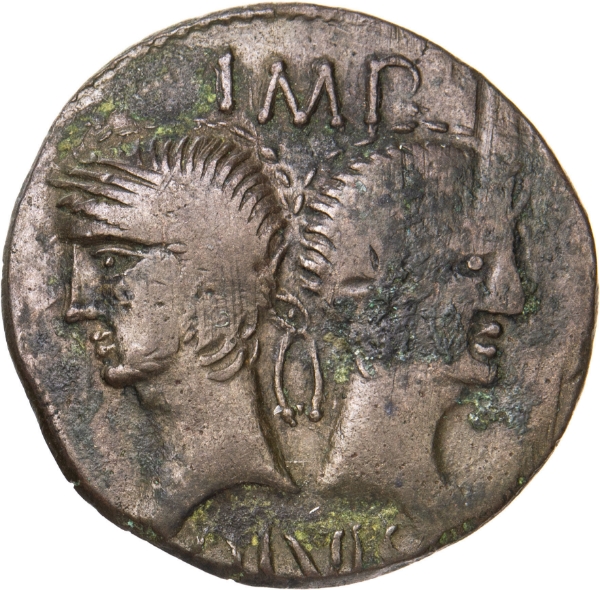
 - SGM293-6149.jpg)
Picture Source of Augustus: Wikipedia
Augustus: The Teenager Who Outsmarted an Empire
In 44 BC, the assassination of Julius Caesar plunged the Roman Republic into an unprecedented crisis. Among the power-hungry generals and seasoned politicians vying for control, an unlikely figure emerged: Gaius Octavius, Caesar's eighteen-year-old great-nephew. Designated as Caesar's posthumously adopted son and primary heir, young Octavius stepped into a treacherous political landscape. Through a combination of ruthlessness, strategic alliances, and political acumen, he would eventually dismantle the failing Republic and rise as Augustus, the first Emperor of Rome. His reign not only ended decades of civil war but fundamentally reshaped the western world.
Key Takeaways
A Surprise Heir: Augustus (originally Octavian) was Julius Caesar’s great-nephew and surprise heir, stepping into power at just 18 years old.
The Ultimate Survivor: He outmaneuvered seasoned military commanders, including Mark Antony, to become the sole ruler of the Roman world after the Battle of Actium in 31 BC.
Architect of Empire: He transitioned Rome from a failing Republic into a massive Empire, cleverly masking his absolute power behind traditional republican titles.
The Pax Romana: His reign initiated a 200-year period of relative peace and stability across the Mediterranean known as the Roman Peace.
From Teenager to Heir: The Rise of Octavian
Born in 63 BC as Gaius Octavius, the future emperor didn't come from the absolute highest tier of Roman nobility, though his family was wealthy and respectable. However, his grandmother was Julius Caesar's sister. When Caesar was assassinated on the Ides of March in 44 BC, the Roman world was thrown into chaos.
When Caesar's will was read, it dropped a political bombshell: he had adopted young Octavius and named him his primary heir. Against the frantic advice of his family to stay out of it, the teenager sailed to Rome, took the name Gaius Julius Caesar Octavianus (we call him Octavian), and demanded his inheritance.(1)
He was immediately dismissed as a minor nuisance by Caesar's right-hand man, the battle-hardened Mark Antony. But Octavian had Caesar's name, Caesar's money, and a brilliant knack for political theater. He quickly raised a private army from Caesar's loyal veterans.
The Second Triumvirate and Civil War
Realizing they were better off working together than destroying each other, Octavian, Mark Antony, and a general named Lepidus formed the "Second Triumvirate" in 43 BC. It was a legally sanctioned dictatorship aimed at restoring the state—and avenging Caesar.
Their first order of business was brutal: they issued "proscriptions," effectively hit lists of their political enemies. Hundreds of senators and aristocrats, including the famous orator Cicero, were executed.(2) After defeating Caesar's assassins, Brutus and Cassius, at the Battle of Philippi in 42 BC, the triumvirs divided the Roman world among themselves.
But a three-way split was never going to last. Lepidus was soon politically marginalized by Octavian. The final showdown was inevitable: Octavian in the West (Rome) versus Mark Antony in the East (Egypt), where Antony had allied with—and fallen in love with—the brilliant Egyptian queen, Cleopatra.
In 31 BC, Octavian's top general and lifelong friend, Marcus Agrippa, defeated the combined fleets of Antony and Cleopatra at the Battle of Actium. Antony and Cleopatra famously died by suicide shortly after, leaving Octavian as the undisputed master of the Roman world.(3)
Architect of the Empire: The Principate
At 33 years old, Octavian had won the game of thrones. But he was smart enough to know that acting like a king in Rome would get him stabbed to death, just like his adoptive father.
His genius lay in the "First Settlement" of 27 BC. He dramatically walked into the Senate and offered to give all his power back to the Republic. Predictably, his loyalists in the Senate begged him to stay and manage the most dangerous frontier provinces (which conveniently kept him in control of the vast majority of the Roman army).
During this event, the Senate awarded him the title Augustus, meaning "The Revered One."(4) He never called himself emperor or king; he preferred Princeps (First Citizen). He maintained the illusion of the Republic—there were still consuls, senators, and elections—but Augustus held the strings. This system, known as the Principate, became the blueprint for the Roman Empire.
The Pax Romana and a City of Marble
Augustus ruled for over 40 years, an incredibly long time that allowed a whole generation to grow up knowing nothing but his leadership. He reformed the military, established a standing army, created a police force and fire brigade in Rome, and expanded the empire's borders into Egypt, northern Spain, and central Europe.
He also went on a massive building spree. According to the ancient historian Suetonius, Augustus famously boasted on his deathbed, "I found Rome a city of bricks and left it a city of marble."(2)
Perhaps his greatest achievement was the Pax Romana (Roman Peace). After a century of bloody, exhausting civil wars, Augustus brought order to the Mediterranean. It wasn't entirely peaceful—there was plenty of conquering on the borders—but internally, the empire enjoyed an unprecedented era of economic prosperity and cultural flourishing.
The Final Curtain
Augustus died in AD 14 at the age of 75. Ever the theatrical politician, his reported last words to his friends who had gathered around his bed were, "Have I played the part well? Then applaud as I exit."(1)
He had played the part flawlessly. He took a broken, bleeding Republic and forged it into an Empire that would dominate the western world for centuries to come.
Frequently Asked Questions
Did Augustus actually declare himself Emperor? No, he strictly avoided titles like "King" (Rex) or "Dictator." He called himself Princeps (First Citizen). The word "Emperor" comes from Imperator, a military title for a successful commander that Augustus used, but he maintained the facade that he was simply a servant of the Roman Republic.
Who succeeded Augustus? Because he outlived many of his preferred heirs (including his grandsons), he eventually adopted his stepson, Tiberius, leaving him the powers of the state. This established the Julio-Claudian dynasty.
Why did he change his name so many times? He was born Gaius Octavius. Upon his adoption by Julius Caesar, he took his adoptive father's name: Gaius Julius Caesar Octavianus (to show his legitimacy). Finally, the Senate granted him the honorific "Augustus" in 27 BC to mark his new, elevated status as the savior of Rome.
References
History.com Editors, (2009). Augustus. HISTORY. A&E Television Networks. [Accessed 9 April 2026].
Suetonius, (121 AD). The Lives of the Twelve Caesars. Translated by J. C. Rolfe. Loeb Classical Library. [Accessed 9 April 2026].
Cartwright, M., (2013). Augustus. World History Encyclopedia. [Accessed 9 April 2026].
Beard, M., (2015). SPQR: A History of Ancient Rome. London: Profile Books.