.png)
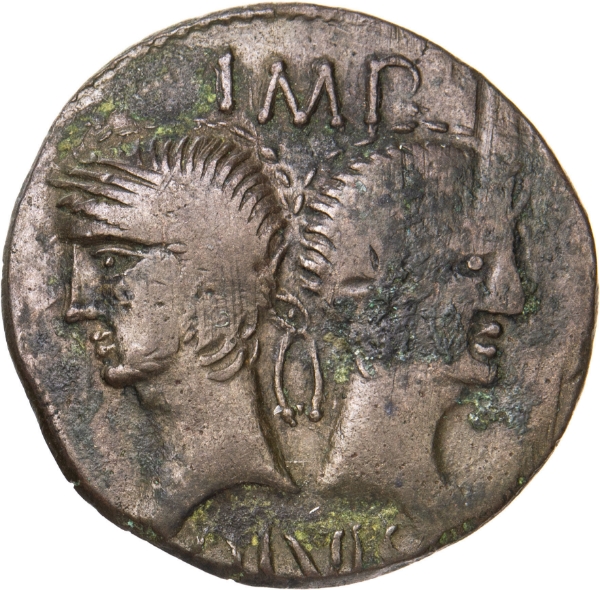
Picture Source of Agrippa: Wikipedia
Meet Marcus Vipsanius Agrippa: The Right-Hand Man Who Built the Roman Empire
Introduction: The Man Behind the Emperor
When we examine the founding of the Roman Empire, history's spotlight is almost entirely dominated by Augustus, Rome's first emperor. Yet, the grandeur of the Pax Romana was not built by one man alone. Have you ever wondered who actually commanded the legions, engineered the monumental architecture, and secured the borders while Augustus held the throne? The true heavy lifting of empire-building was often managed behind the scenes.
Enter Marcus Vipsanius Agrippa.
If Augustus was the CEO of the newly formed Roman Empire, Agrippa was his Chief Operating Officer, head of security, and lead architect all rolled into one. He wasn't born into royalty; he was a self-made powerhouse whose absolute loyalty and brilliant mind shaped the Western world as we know it. Let's dive into the fascinating life of the ultimate historical best friend!
Key Takeaways
The Ultimate Wingman: Agrippa was the indispensable right-hand man to Emperor Augustus, providing the military genius that Augustus himself lacked.
Naval Mastermind: He secured the Roman Empire by winning the legendary Battle of Actium against Mark Antony and Cleopatra.
Visionary Architect: Agrippa transformed the city of Rome, famously building the original Pantheon and vastly improving the city's aqueducts and public baths.
Unwavering Loyalty: Despite holding enough wealth, military power, and public adoration to take the throne for himself, Agrippa remained fiercely loyal to Augustus until his dying day.
From Humble Beginnings to Imperial Besties
Unlike the aristocratic snobs of the Roman Senate, Marcus Vipsanius Agrippa came from somewhat humble beginnings. Born around 63 BC to a plebeian family, his early life isn't well-documented, but his trajectory changed forever when he was educated alongside a young man named Gaius Octavius (who we later know as Augustus).(1)
The two became fast friends while studying in Apollonia (in modern-day Albania). When Julius Caesar was assassinated in 44 BC, Octavius discovered he was Caesar’s adopted heir. It was a terrifying, dangerous time, but Agrippa stood by his friend's side, advising him to march on Rome and claim his inheritance. From that moment on, their fates were sealed together. Agrippa wasn't just a follower; he was the tactical muscle to Octavius's political brain.(2)
The Master of the Battlefield
Let's be honest: Augustus was a brilliant politician, but he was a pretty terrible military commander. He frequently fell ill before major battles and lacked tactical genius. Thankfully, he had Agrippa.
Agrippa was a military prodigy. He repeatedly saved Augustus's skin, putting down rebellions and securing Rome's borders. His crowning achievement, however, was on the water. In 31 BC, at the Battle of Actium, Agrippa designed an ingenious naval strategy that completely crushed the combined fleets of Mark Antony and the Egyptian Queen Cleopatra.(3)
To win this battle, Agrippa even invented a new weapon called the harpax—a ship-mounted grapnel shot from a catapult that would snag enemy ships so they could be boarded. Thanks to Agrippa’s genius at Actium, Augustus became the sole, undisputed ruler of the Roman world.
Rome's Ultimate Builder
Once the wars were over, Agrippa didn't just kick back and relax. He turned his boundless energy toward urban planning. Augustus famously boasted that he "found Rome a city of bricks and left it a city of marble," but it was actually Agrippa who oversaw most of that construction!(4)
As aedile (a magistrate responsible for public buildings), Agrippa overhauled Rome's crumbling infrastructure. He built the Aqua Virgo, an aqueduct that still supplies water to the Trevi Fountain today. He created Rome's first major public bath complex and laid out beautiful gardens for the public to enjoy.
But his most famous architectural legacy is the Pantheon. Although the domed building we see today was later rebuilt by the Emperor Hadrian, Hadrian kept Agrippa's original inscription on the front: M·AGRIPPA·L·F·COS·TERTIVM·FECIT ("Marcus Agrippa, son of Lucius, made this when consul for the third time"). Even centuries later, Roman emperors knew you didn't mess with Agrippa's legacy!(5)
A Legacy That Outlasted an Empire
Agrippa became so vital to the Empire that Augustus basically forced him to divorce his wife and marry Augustus's own daughter, Julia the Elder. Together, they had several children, intertwining Agrippa's plebeian bloodline with the imperial family. Through his children, Agrippa became the grandfather of the Emperor Caligula and the great-grandfather of the infamous Emperor Nero.(6)
When Agrippa died unexpectedly in 12 BC at the age of 51, Augustus was absolutely devastated. He gave Agrippa a massive state funeral, delivered the eulogy himself, and even had his best friend buried in his own imperial mausoleum.
Marcus Vipsanius Agrippa is a rare historical figure. He had the military might, the immense wealth, and the adoration of the people—more than enough to seize the Empire for himself. Yet, he chose a lifetime of steadfast loyalty. He was the architect of an empire and the friend everyone wishes they had.
Frequently Asked Questions (FAQs)
Did Agrippa ever want to be Emperor? There is no historical evidence to suggest Agrippa ever tried to usurp Augustus. Despite holding massive military and political power (he was given tribunician power, making him practically a co-emperor), his defining trait was his absolute loyalty to his childhood friend.
Is the current Pantheon in Rome the exact one Agrippa built? Not quite! Agrippa built the original Pantheon around 27 BC, but it burned down. The magnificent domed structure you can visit in Rome today was rebuilt by the Emperor Hadrian around 126 AD. However, Hadrian respectfully retained Agrippa's original dedicatory inscription on the portico.
Who were Agrippa's famous descendants? Agrippa's marriage to Augustus's daughter, Julia, made him an ancestor to several famous (and infamous) Roman figures. His daughter, Agrippina the Elder, married the famous general Germanicus. Through her, Agrippa was the grandfather of Emperor Caligula and the great-grandfather of Emperor Nero!
References
Syme, R. (1939) The Roman Revolution. Oxford: Oxford University Press. Available at: Google Books: The Roman Revolution (Accessed: 10 April 2026).
Goldsworthy, A. (2014) Augustus: First Emperor of Rome. New Haven: Yale University Press. Available at: Yale University Press: Augustus (Accessed: 10 April 2026).
Meyer, M. (2000) The Battle of Actium: The Rise & Triumph of Augustus Caesar. New York: History Press. Available at: Wikipedia: Battle of Actium (Accessed: 10 April 2026).
Suetonius (1957) The Twelve Caesars. Translated by R. Graves. Harmondsworth: Penguin Classics. Available at: Penguin: The Twelve Caesars (Accessed: 10 April 2026).
Claridge, A. (1998) Rome: An Oxford Archaeological Guide. Oxford: Oxford University Press. Available at: Oxford Reference: Rome (Accessed: 10 April 2026).
Levick, B. (1990) Claudius. New Haven: Yale University Press. Available at: Wikipedia: Julio-Claudian dynasty (Accessed: 10 April 2026).