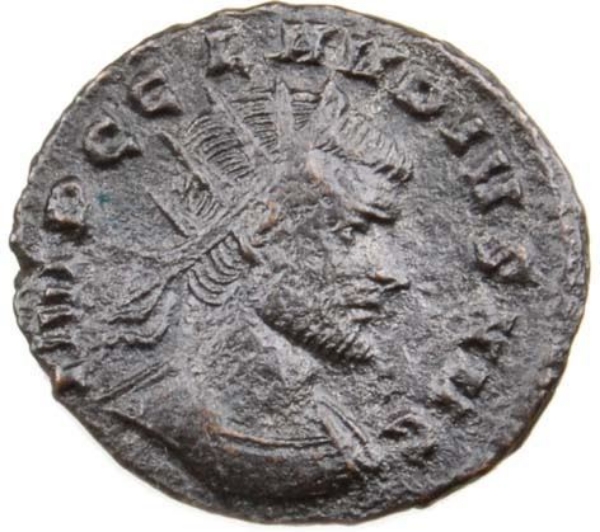
Picture Source of Claudius II Gothicus: Wikipedia
 - ARC1001 .jpg)
Claudius Gothicus: The Two-Year Emperor Who Pulled Rome Back from the Brink
Imagine ascending to the throne of the world's greatest empire, only to find it actively burning to the ground. Rival factions have torn away your wealthiest provinces, foreign invaders are breaking through the borders, and a devastating plague is wiping out your legions. That was the grim reality of the job description for a Roman Emperor in the mid-3rd century AD.
Rome was in the absolute thick of the "Crisis of the Third Century." The empire was actively crumbling, split into three fractured pieces and hammered by invasions. It looked like the end of the line for one of history's greatest superpowers. But then, a hardened soldier from the Balkans stepped up to the plate. His name was Marcus Aurelius Claudius, but history remembers him as Claudius II, or "Claudius Gothicus." His reign was incredibly short—barely two years—but the sheer impact of his military genius saved the Roman Empire from complete collapse. Let’s dive into the action-packed, plague-ridden, and surprisingly romanticized life of the man who became Rome's ultimate firefighter.
Key Takeaways
A Savior in Crisis: Claudius Gothicus ruled from just 268 to 270 AD, but his short reign was the crucial turning point that stopped the total collapse of the Roman Empire.
Master of the Battlefield: He earned his legendary moniker "Gothicus" by obliterating a massive, civilization-threatening Gothic invasion at the Battle of Naissus.
The Valentine's Villain: Despite his heroic military record, he is most famous in modern pop culture as the legendary emperor who banned marriage and executed Saint Valentine.
Felled by the Plague: His life wasn't ended by an enemy sword, but by the devastating Plague of Cyprian, prematurely ending a reign that could have fully reunited Rome.
Welcome to the 3rd Century: Rome on Fire
To really get why Claudius was such a big deal, we have to look at the absolute mess he inherited. By the 260s AD, the mighty Roman Empire had shattered. To the west, Britain, Gaul, and Spain had broken off to form the "Gallic Empire." To the east, the wealthy provinces of Syria and Egypt were under the control of the breakaway "Palmyrene Empire"¹.
If losing two-thirds of the empire wasn't bad enough, the economy was in hyperinflation, the central government was broke, and a horrific pandemic called the Plague of Cyprian was ravaging the population. Furthermore, the Roman army had developed a terrible habit of assassinating their own emperors whenever they got unhappy. It was a bleak, brutal era. Rome didn't need a politician; it needed a warrior.
A Soldier's Rise: The Plot at Milan
Claudius was born around 214 AD in Illyricum (a region encompassing parts of modern-day Serbia, Croatia, and Albania). The Illyrians were tough, no-nonsense people who supplied the Roman army with its fiercest soldiers and most capable cavalrymen². Claudius was exactly that: a hardened, career military man who fought his way up the ranks based on pure merit and skill.
By 268 AD, Claudius was a top-ranking commander, leading the elite cavalry forces for Emperor Gallienus. Gallienus was a decent ruler dealing with an impossible hand, and at that moment, he was laying siege to a usurper in the city of Mediolanum (modern Milan).
But in the dead of night, a group of high-ranking officers lured Gallienus out of his tent and assassinated him. Who was behind the plot? The historical sources are murky, but the primary beneficiaries were Claudius and his brilliant cavalry commander, Aurelian³. The army immediately declared the 54-year-old Claudius as the new Emperor of Rome. Showing his political savvy, Claudius immediately paid off the soldiers with a massive cash bonus to secure their loyalty, and forced the Senate to deify the man he had just replaced.
The Battle of Naissus: Earning the Title 'Gothicus'
Claudius barely had time to put on the imperial purple before he faced an existential threat. A massive coalition of Gothic tribes—estimates suggest anywhere from 100,000 to over 300,000 warriors, traveling with their families and wagons—had poured across the Danube River. They were ravaging the Balkans and threatening to drive a permanent wedge right through the center of the empire.
Leaving his brother to guard Italy, Claudius marched his legions east. In 268 or 269 AD, the two massive forces collided at the Battle of Naissus (in modern-day Serbia). The fighting was brutal and chaotic. But Claudius, likely utilizing his brilliant cavalry commander Aurelian, executed a flawless tactical maneuver. The Romans feigned a retreat, drawing the massive Gothic horde into a deadly ambush.
The trap sprang, and the Romans slaughtered the invaders. It was one of the most decisive and devastating Roman military victories of the entire century. The Gothic threat was neutralized for generations. The Senate was so thrilled that they officially awarded Claudius the title Gothicus Maximus, the name he is still known by today.
The Alamanni and the Legend of Saint Valentine
Claudius wasn't done playing whack-a-mole with barbarian invasions. Just as he was cleaning up the Goths, another Germanic tribe called the Alamanni crossed the Alps and invaded Italy itself. Claudius rapidly marched his tired troops back west and smashed the Alamanni at the Battle of Lake Benacus, saving the city of Rome from a potential sacking.
But here is where history takes a strange turn into folklore. Despite saving Western civilization, Claudius II is probably most famous today for a story that has little historical evidence backing it up.
According to medieval Christian tradition, Claudius was desperate for fresh recruits for his endless wars. He allegedly decided that single men made better, braver soldiers than men who were worried about their wives and children. So, Claudius supposedly issued a decree banning all marriages and engagements for young men⁴.
A brave Christian priest named Valentine felt this was a horrific injustice. He defied the emperor and continued performing secret marriages for young lovers. When Claudius found out, he had Valentine beaten, stoned, and finally beheaded—allegedly on February 14th, 269 AD.
While historians generally agree this specific story is a later invention rather than historical fact, it forever cemented Claudius Gothicus as the unwitting "villain" behind Valentine's Day.
A Hero Felled by an Invisible Enemy
By early 270 AD, Claudius Gothicus was at the height of his power. He had secured the borders, crushed two massive invasions, and stabilized the core of the Roman Empire. His next goal was to march east to deal with Queen Zenobia and reclaim the breakaway Palmyrene Empire.
Tragically, he would never make the journey. While preparing for his campaign in Sirmium (modern Sremska Mitrovica), Claudius contracted the plague that had been ravaging his military camps. The man who had survived the deadliest battlefields of the ancient world was killed by a microscopic virus.
He died in early 270 AD. Unlike many emperors of his era, Claudius was genuinely mourned by his troops and the Senate. He was immediately deified as "Divus Claudius." Though his time on the throne was remarkably brief, he accomplished the impossible. He stopped the bleeding of the Roman Empire, setting the stage for his successor, Aurelian, to finally reunite the fractured world.
FAQs
How did Claudius Gothicus die? Despite being a lifelong soldier who fought in some of the ancient world's most brutal battles, Claudius died of an illness. He succumbed to the Plague of Cyprian (possibly a form of smallpox or measles) in early 270 AD while preparing for a military campaign.
Is the story about Claudius Gothicus and Saint Valentine true? Most historians consider it a myth. While there was a historical Saint Valentine (or possibly two distinct martyrs by that name) in the 3rd century, the specific story about Claudius banning marriage to improve his army was popularized by Geoffrey Chaucer and other writers much later in the Middle Ages to romanticize the holiday.
Who took over after Claudius Gothicus died? His brother, Quintillus, briefly took power for a few weeks or months. However, the army quickly rallied behind Aurelian, Claudius's brilliant cavalry commander. Aurelian swiftly took the throne and went on to successfully reunite the entire Roman Empire.
References
Potter, D.S. (2004) The Roman Empire at Bay, AD 180-395. London: Routledge. Available at: Taylor & Francis
Southern, P. (2001) The Roman Empire from Severus to Constantine. London: Routledge.
Watson, A. (1999) Aurelian and the Third Century. London: Routledge. Available at: Taylor & Francis
Kelly, H.A. (1986) Chaucer and the Cult of Saint Valentine. Leiden: Brill.