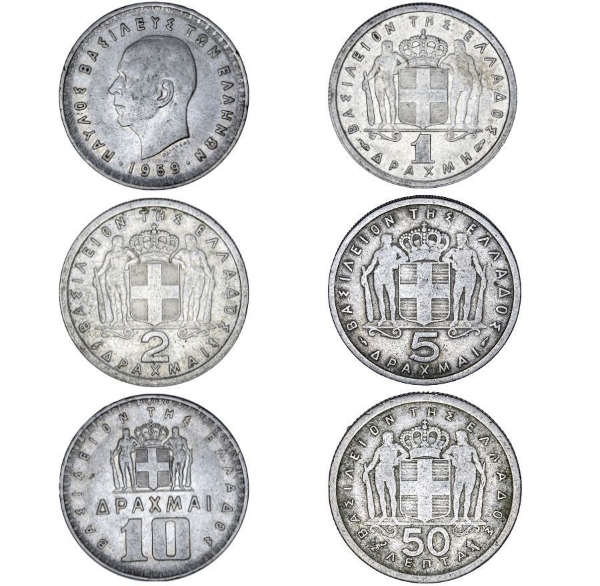
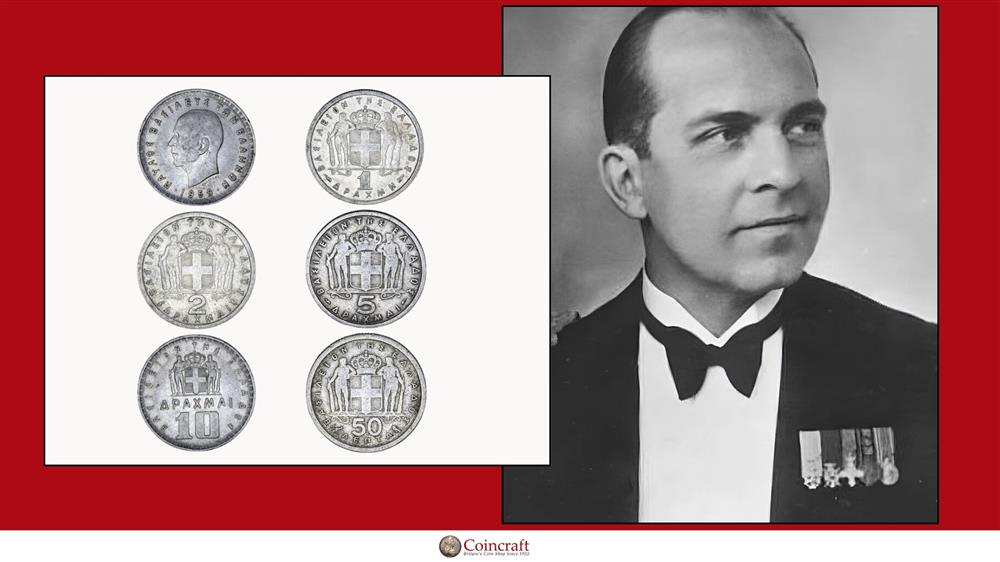
Picture Source of Paul I of Greece: Wikipedia
King Paul I of Greece
Paul I (Greek: Παύλος, Pav́los) reigned as King of Greece from April 1, 1947, until his death on March 6, 1964. Born on December 14, 1901, at Tatoi Palace near Athens, he was the third son of Crown Prince Constantine (later King Constantine I) and Princess Sophia of Prussia.
Early Life and Education
To his family, Paul was affectionately known as "Palo." He grew up in the Presidential Mansion and Tatoi Palace, speaking English to his parents while learning Greek as his second language. As the third son, Paul was not expected to inherit the throne, and thus received a less rigorous education than his older brothers.
Paul was privately tutored by foreign teachers and Greek university professors. From 1911 to 1914, he attended summer courses in Eastbourne, England, at Saint Peter's Preparatory School for Young Gentlemen, where he excelled in physical subjects like woodwork.
Military Career and Exile
In 1912, at just eleven years old, Paul joined the Royal Hellenic Navy, becoming its youngest cadet. His military career was interrupted by the political turmoil that forced his father's abdication in 1917 during World War I. The family went into exile in Switzerland while Paul's brother Alexander became king.
When Alexander died in 1920 from an infection caused by a pet monkey bite, Paul was offered the throne but declined, stating that it belonged to his father and that his eldest brother George was the rightful successor. A plebiscite confirmed his judgment, restoring Constantine to the throne in December 1920.
Following further political upheaval, Constantine was forced to abdicate again in 1922, and George became king. However, growing anti-monarchy sentiment led to George's exile in 1923, with Paul accompanying him. The monarchy was officially abolished in 1924, and Paul spent years in exile in Italy, England, and London.
Marriage and Family
On January 9, 1938, Paul married Princess Frederica of Hanover, a granddaughter of Kaiser Wilhelm II. Their union produced three children: Princess Sofia (born 1938, later Queen of Spain), Crown Prince Constantine (1940-2023, later King Constantine II), and Princess Irene (born 1942).
World War II
During World War II, from 1941 to 1946, Paul was forced to flee Greece when the country fell to Axis powers. He spent time with the Greek government-in-exile in London and Cairo, from where he broadcast messages to the Greek people. While in Egypt, he participated in campaigns against the German-Italian Axis.
His wife Frederica took refuge with their children in Capetown, South Africa, while Paul was in Egypt and London helping to form a Greek Government-in-Exile.
Reign as King
Paul succeeded to the throne on April 1, 1947, following the death of his childless elder brother, King George II, from a heart attack. His ascension came during the Greek Civil War, and initially, the monarchy was not a popular institution. Paul was viewed with suspicion due to his Danish-German ancestry and his German wife.
Shortly after becoming king, Paul contracted typhoid fever, which limited his ability to manage the ongoing civil war. By 1949, however, the conflict effectively ended with the defeat of Communist insurgents, allowing Greece to begin rebuilding.
Paul and Frederica worked tirelessly to rally their disheartened people, traveling constantly across the country, sometimes under hostile fire. Their modern approach to monarchy and dedication to supporting citizens during difficult times earned them widespread popularity that few monarchs attain.
During the 1950s, Greece recovered economically under Paul's reign. He strengthened diplomatic and trade links through state visits abroad and became the first Greek monarch to visit a Turkish head of state. However, relations with Britain became strained over the issue of Cyprus, where the majority Greek population favored union with Greece.
Personal Life and Death
Paul and Frederica spoke English to each other and their children despite being fluent in Greek. They enjoyed outdoor sports, were skilled automobile drivers, and were well-versed in Greek history and archaeology.
The royal family regularly vacationed in Falken, Austria for skiing in winter, and in Petalis during summers. They frequently hosted royal relatives from the houses of Baden, Hesse, Hanover, and Hohenlohe, as well as surviving members of the Romanov dynasty.
In late February 1964, Paul underwent surgery for stomach cancer. Approximately a week later, on March 6, 1964, he died in Athens at the age of 62. He was succeeded by his son, Constantine II.
Despite initial skepticism toward his reign, Paul transformed the Greek monarchy through his dedication to his country and people, leaving behind a legacy of modernization and recovery during a challenging period in Greek history.