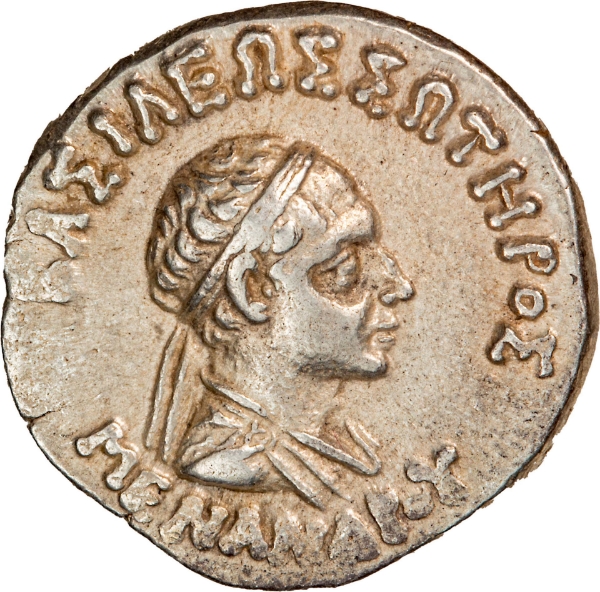
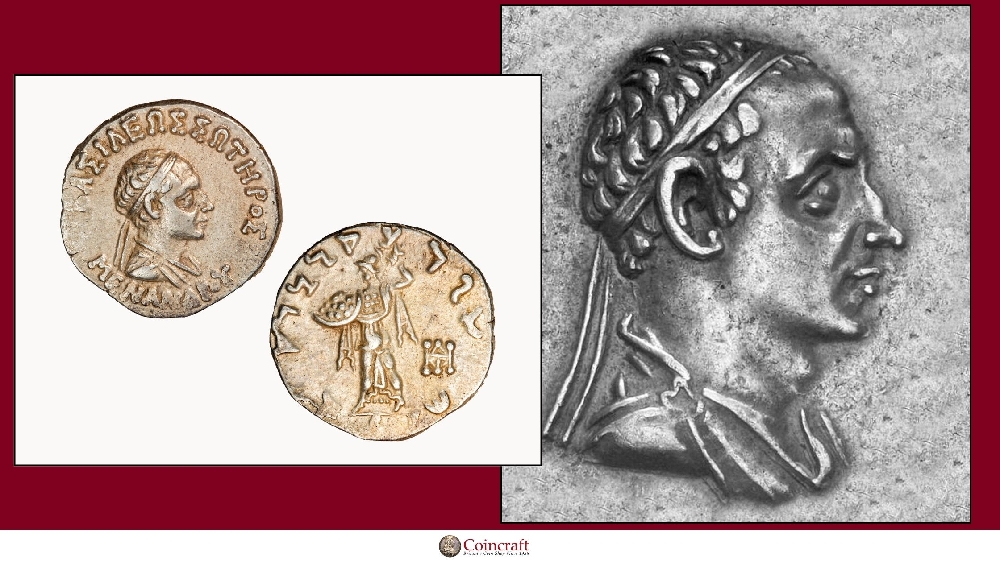
Picture Source of Menander I: Wikipedia
The Philosopher King: The Life and Legacy of Menander I
When we think of the great Greek conquerors, Alexander the Great usually steals the spotlight. But if you head east, past the rugged mountains of the Hindu Kush and into the heart of ancient India, you’ll find the story of a man who was arguably just as fascinating: Menander I Soter. Known to history as the greatest of the Indo-Greek kings, Menander wasn't just a brilliant general; he was a seeker of truth whose spiritual journey remains a cornerstone of Buddhist philosophy today.
Key Takeaways
Expansionist Leader: Menander I was the most powerful Indo-Greek king, ruling a vast territory that stretched from modern-day Afghanistan to the Punjab region¹⁴.
The Milinda Panha: He is immortalized in Buddhist literature as "King Milinda," the protagonist of a famous dialogue with the sage Nagasena regarding the nature of the soul and reality⁴.
Cultural Fusion: His reign represented the height of "Graeco-Buddhism," a unique blending of Hellenistic art, language, and administration with Indian philosophy and religion⁶.
Lasting Legacy: Unlike many conquerors whose empires crumbled instantly, Menander’s influence was so profound that his ashes were reportedly distributed among various cities, much like the Buddha himself⁵.
A Soldier of the Hellenistic Frontier
To understand Menander, we have to look at the world Alexander the Great left behind. By the 2nd century BCE, the Greek presence in Bactria (modern Afghanistan) had evolved into a powerhouse of its own. Born in a village called Kalasi near Alexandria of the Caucasus, Menander rose to power around 165 or 155 BCE¹.
He wasn't content to sit on a throne in Bactria. Menander was a man of action. He pushed his armies further into the Indian subcontinent than any Greek before him—even Alexander. Historical records suggest his campaigns reached as far as the Ganges River and the city of Pataliputra (modern Patna), essentially carving out an empire that bridged the gap between the Mediterranean world and the Indian heartland².
The Dialogue that Changed Everything
While his military conquests were impressive, it’s Menander’s intellectual curiosity that makes him a "friendly" face in the often-bloody pages of history. He is famously the "Milinda" mentioned in the Milinda Panha (The Questions of King Milinda)³.
As the story goes, Menander was a sharp-witted intellectual who loved to debate. He reportedly sought out various teachers, but none could satisfy his questions about the nature of existence until he met the Buddhist monk Nagasena. Their conversation wasn't just a dry lecture; it was a lively, sophisticated exchange where Nagasena used the famous "chariot analogy" to explain that there is no permanent "self" or "soul"—only a collection of parts⁴.
This meeting changed Menander. While historians debate whether he "converted" in the modern sense, his coins began to feature Buddhist symbols, such as the Dharmachakra (the Wheel of Law), alongside Greek inscriptions⁵.
A King of Two Worlds
Menander’s reign was a golden age of syncretism. He ruled as a "Soter" (Savior) and a "Dikaios" (Just), titles that appealed to his Greek subjects. Simultaneously, he was a protector of the Dhamma for his Indian subjects⁶.
This wasn't just good politics; it was a flourishing of art and culture. This era gave birth to the Gandhara style of art, where the Buddha began to be depicted in human form, often looking remarkably like a Greek god (with wavy hair and toga-like robes)⁷. Menander didn't just rule a territory; he presided over a civilization where East met West and shook hands.
The End of an Era
Menander passed away around 130 BCE. The Greek historian Plutarch tells us that his death sparked a unique tribute: various cities in his empire fought for the honor of housing his remains. Eventually, his ashes were divided among them, and monuments (stupas) were raised in his memory—a tribute usually reserved for the most holy of men in the Buddhist tradition⁸.
FAQs
1. Was Menander I really a Buddhist? While we can't look into his heart, the evidence is strong. His coins transitioned from purely Olympic deities to including Buddhist symbols, and the Milinda Panha treats him as a devoted lay follower who eventually retired to become a monk⁸.
2. How large was Menander’s empire? It was massive for the time. It encompassed parts of modern-day Afghanistan, Pakistan, and Northwest India, making him the most successful Greek king in India¹.
3. Why is he called "Milinda"? "Milinda" is the Pali version of the Greek name "Menander." Because much of his religious legacy was preserved in Pali Buddhist texts, that is the name by which he is most commonly known in Asia³.
References
Bopearachchi, O. (1991) Monnaies gréco-bactriennes et indo-grecques, Catalogue raisonné. Paris: Bibliothèque Nationale de France.
Narain, A.K. (1957) The Indo-Greeks. Oxford: Clarendon Press.
Rhys Davids, T.W. (1890) The Questions of King Milinda. Oxford: The Clarendon Press. [Online]. Available at: https://www.sacred-texts.com/bud/milinda.htm (Accessed: 24 May 2024).
Pesala, B. (2001) The Debate of King Milinda: An Abridgement of the Milinda Panha. Delhi: Motilal Banarsidass Publishers.
Thapar, R. (2002) Early India: From the Origins to AD 1300. London: Penguin Books.
Woodcock, G. (1966) The Greeks in India. London: Faber & Faber.
Boardman, J. (1994) The Diffusion of Classical Art in Antiquity. Princeton: Princeton University Press.
Plutarch (1936) Moralia, Volume X. Translated by H.N. Fowler. Loeb Classical Library. Cambridge, MA: Harvard University Press. [Online]. Available at: https://www.loebclassics.com/view/LCL321/1936/pb_LCL321.1.xml (Accessed: 24 May 2024).