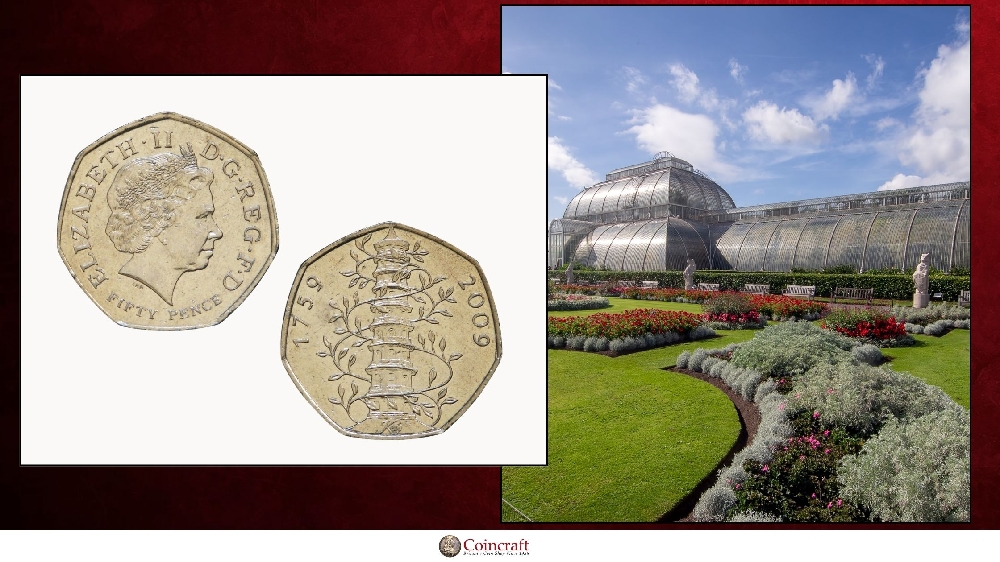
Picture Source of Kew Gardens 50p & Kew Gardens: Numista & Canva
Decoding the Kew Gardens 50p: Why is it the UK's Most Hunted Coin?
For more than a decade, one tiny piece of cupronickel has held an iron grip on the imagination of the British public. To the untrained eye, it is just a fifty-pence piece. But to collectors, numismatists, and everyday individuals sorting through their pocket change, the 2009 Kew Gardens 50p is nothing short of the "holy grail" of modern British coinage.
While hundreds of commemorative designs have passed through the Royal Mint’s presses, none have matched the cultural hysteria, value appreciation, and enduring mystique of this single release. This guide decodes the history, the numbers, the controversies, and the counterfeit dangers surrounding the UK's most hunted coin.
Key Facts
Metric / Feature | Details |
|---|---|
Year of Issue | 2009 |
Commemorative Subject | 250th Anniversary of the Royal Botanic Gardens at Kew (founded 1759) |
Circulating Mintage | 210,000 |
Reverse Designer | Christopher Le Brun RA |
Obverse Designer | Ian Rank-Broadley FRBS |
Weight | 8.00 grams |
Diameter | 27.30 mm |
Circulated Market Value | £150 – £250 (depending on condition) |
BUNC / Proof Market Value | £300 – £800+ (depending on presentation packaging) |
Key Takeaways
The Scarcity Standard: With a circulating mintage of just 210,000, the Kew Gardens 50p represents a mere $0.013\%$ of all fifty-pence coins currently in active circulation.
The Usurper to the Throne: After a 14-year reign as the absolute rarest circulating 50p in the UK, it was officially mathematically overtaken in late 2024 by the 2023 Atlantic Salmon 50p, which has a mintage of 200,000. Despite this, the Kew Gardens coin remains significantly more valuable on the secondary market.
The Reissue Trap: A secondary, non-circulating commemorative version was struck in 2019 to mark the 50th anniversary of the 50p coin. While collectible, these reissues are worth a fraction of the 2009 original.
Counterfeit Proliferation: Due to its high price tag, the Kew Gardens 50p is the most widely counterfeited coin in modern British history, requiring buyers to exercise extreme caution.
                       UK COMMEMORATIVE 50p SCARCITY
┌─────────────────────────────────────────────────────────────────────────┐
│  2012 Olympic Football (Offside) ─> 1,125,500 Minted                    │
├─────────────────────────────────────────────────────────────────────────┤
│  2016 Jemima Puddle-Duck         ─> 2,100,000 Minted                    │
├─────────────────────────────────────────────────────────────────────────┤
│  2009 Kew Gardens                ─> 210,000 Minted (Value: £150+)       │
├─────────────────────────────────────────────────────────────────────────┤
│  2023 Atlantic Salmon            ─> 200,000 Minted (Value: £50 - £120)  │
└─────────────────────────────────────────────────────────────────────────┘
The Genesis of a Legend: Why Only 210,000?
The story of the Kew Gardens 50p begins in 2009, when the Royal Mint sought to celebrate the 250th anniversary of the Royal Botanic Gardens at Kew, which opened in Surrey in 1759 (Royal Mint, 2009). The Mint commissioned the acclaimed artist Christopher Le Brun RA to design the coin's reverse.
Le Brun's design is widely considered an aesthetic masterpiece. It depicts the iconic Great Pagoda at Kew—constructed in 1762 by Sir William Chambers—spiraled beautifully by a leafy, decorative vine. At the base of the design, the word "KEW" is nestled alongside the dates "1759" and "2009."
At the time of its release, the British economy was navigating the aftermath of the 2008 financial crash, and the demand for new physical currency was relatively low. Consequently, the Royal Mint struck only 210,000 of these commemorative coins for general circulation (Change Checker, 2024). To put this figure into perspective, a standard commemorative run often exceeds five to ten million coins. For several years, these 210,000 coins quietly circulated in pockets, cash registers, and piggy banks across the country, largely unnoticed by the wider public.
The "Great British Coin Hunt" Phenomenon
The status of the Kew Gardens 50p changed permanently in February 2014, when the Royal Mint published a blog post highlighting its low mintage (Royal Mint, 2014). This simple announcement acted as a catalyst. National newspapers, morning television shows, and early internet blogs immediately seized on the story, running sensational headlines about "the 50p in your pocket worth £50."
Within weeks, a nationwide treasure hunt was born. People who had never previously looked at their change began meticulously checking every single 50p coin they received. Collectors flooded eBay to secure the coin, and as demand outstripped supply, the secondary market price skyrocketed.
By the early 2020s, the price of a circulated specimen had stabilized between £150 and £250 (MyCoinage, 2026). The coin effectively transformed how the British public viewed everyday currency, establishing what collectors call the "modern numismatic boom."
The 2024 Plot Twist: The Atlantic Salmon
For fourteen years, the Kew Gardens 50p sat unchallenged as the undisputed king of circulating UK coinage. However, in October 2024, the Royal Mint released its official mintage figures for the preceding year, revealing a massive surprise (Change Checker, 2024).
The 2023 "Atlantic Salmon" 50p, featuring a modern wildlife design honoring King Charles III's coronation year, was revealed to have a circulating mintage of just 200,000 coins (Royal Mint, 2024). This was 10,000 fewer than the Kew Gardens 50p, technically stripping the Kew of its title as the "rarest circulating 50p."
Yet, despite losing its crown in terms of mintage figures, the Kew Gardens 50p has held onto its financial supremacy. Because it has had over fifteen years to build its status as a legendary pop-culture icon, demand for the Kew remains monumentally higher than for the Atlantic Salmon (MyCoinage, 2026). The Salmon coin generally sells for £50 to £120, while the 2009 Kew Gardens continues to easily command £150 to £250 in circulated condition, and up to £800 in high-tier proof formats.
2009 vs. 2019: The Reissue Trap
In 2019, to celebrate the 50th anniversary of the introduction of the 50p coin, the Royal Mint released a special retrospective set featuring popular historical designs, including the Kew Gardens pagoda (BUNC, 2025).
This reissue has caused immense confusion on the secondary market. Unscrupulous or uneducated sellers often list the 2019 reissue at 2009 prices. To avoid falling into this trap, buyers must look at the obverse (the Queen's portrait side) of the coin:
The 2009 Original: Features the fourth portrait of Queen Elizabeth II by Ian Rank-Broadley. Crucially, the obverse side has no date. The year "2009" is located entirely on the reverse side at the bottom of the pagoda.
The 2019 Reissue: Features the fifth portrait of Queen Elizabeth II by Jody Clark. The year "2019" is clearly stamped on the obverse side of the coin, while the reverse still retains the historical design (BUNC, 2025).
While the 2009 original is worth hundreds of pounds, the 2019 Brilliant Uncirculated (BU) reissue was sold as part of collector packs and is generally valued at only £15 to £30 on the secondary market.
The Dark Side: How to Spot a Fake Kew 50p
Because the 2009 Kew Gardens 50p regularly commands three-figure sums, counterfeiters have flooded the market with highly sophisticated fakes. If you are buying a loose coin on sites like eBay, you must verify its authenticity.
Here are the primary diagnostic checks used by professional numismatists to identify fakes:
                      ANATOMY OF A GENUINE KEW 50p
┌─────────────────────────────────────────────────────────────────────────┐
│ OBVERSE (Heads):                                                        │
│  - Weight: Must be precisely 8.00 grams (use micro-scales).             │
│  - Neckline: Pointed tip of the Queen's neck points directly to the     │
│    letter "P" in the word "PENCE". Fakes often point to the "E".        │
│  - Initials: "IRB" initials below the neck must be small and sharp.     │
│                                                                         │
│ REVERSE (Tails):                                                        │
│  - Pagoda Roof: The very top roof of the pagoda is rounded. Fakes       │
│    often feature a very sharp, exaggerated point.                       │
│  - Lettering: The word "KEW" is clear, but does NOT feature frosted     │
│    lines on standard circulating versions.                              │
└─────────────────────────────────────────────────────────────────────────┘
The Weight Test: A genuine, modern UK 50p coin weighs exactly 8.00 grams (Great British Coin Hunt, 2019). Many cheap counterfeits are made from inferior steel or alloy metals and often weigh significantly less (some as low as 4 to 6 grams). Always weigh the coin using precision pocket scales before purchasing.
The Neckline Pointer: On a genuine 2009 coin, the bottom pointed tip of Queen Elizabeth II's neck aligns perfectly with the letter "P" in the word "PENCE" at the bottom of the obverse rim (Check Your Change, 2019). On most common fakes, the portrait is slightly rotated, causing the neckline to point toward the letter "E" in "ELIZABETH."
The "IRB" Initials: Beneath the Queen's neck are the tiny initials "IRB" (representing designer Ian Rank-Broadley). On genuine coins, these initials are crisp and beautifully proportioned. On fake coins, they are often bloated, overly large, or accompanied by the micro-etched word "COPY" (Great British Coin Hunt, 2019).
The Pagoda Roof Detail: Look closely at the miniature roof at the very top of the Christopher Le Brun pagoda design. On genuine circulating coins, this roof has a subtle, realistic, slightly rounded dome. On counterfeit coins, the roof is often stamped as a crude, overly sharp, triangular point.
The Wire Wool Hair: Inspect the Queen's hair on the obverse. Genuine strikes have distinct, defined waves. Counterfeits frequently suffer from "mushy" details, making the hair look flat or resembling a messy, wire-wool texture (Great British Coin Hunt, 2019).
Frequently Asked Questions (FAQs)
Is it still possible to find a Kew Gardens 50p in my loose change?
Yes, it is technically possible, but highly statistically improbable. Because the coin has been aggressively hunted for over a decade, almost all circulating copies have been pulled from public change and placed into private collections. Your chances of finding one in a standard transaction are estimated at less than 1 in 10,000.
Why is the Kew Gardens 50p worth more than the rarer Atlantic Salmon 50p?
Coin valuation is driven by a combination of scarcity, demand, and cultural fame. The Kew Gardens 50p spent 14 years as the undisputed symbol of coin collecting in the UK, building a legendary status that the Atlantic Salmon (released in 2023) has not yet matched. The massive, sustained demand for the Kew Gardens coin keeps its market price much higher.
Are the two lines on either side of the word "KEW" a sign of a fake?
Not necessarily. On standard circulating 2009 coins, the details are struck with less force, meaning the horizontal lines bordering the word "KEW" are often faint or invisible. However, on the official Brilliant Uncirculated (BU) and Proof versions of the coin, these lines are highly visible because they were struck multiple times with polished dies (Change Checker, 2024).
How can I safely buy or sell a Kew Gardens 50p?
If you are buying, purchase only from reputable dealers who offer a lifetime guarantee of authenticity, or look for coins that have been professionally graded and slabbed by official bodies like the Numismatic Guaranty Company (NGC) or the Professional Coin Grading Service (PCGS). If selling online, provide high-resolution, macro photos of both the obverse and reverse alongside the coin's exact weight.
Bibliography
BUNC. (2025). Kew Gardens 50p Value & Guide (2009 Pagoda 50p). BUNC Coin Index. Available at: https://bunc.co.uk/coins/kew-gardens-bunc-2009/
Change Checker. (2024). So you think you know the Kew Gardens 50p?. Change Checker Archive. Available at: https://www.changechecker.org/2024/07/24/so-you-think-you-know-the-kew-gardens-50p/
Check Your Change. (2019). 2009 Fifty Pence FAKE KEW. Check Your Change Guides. Available at: https://www.checkyourchange.co.uk/50p-coins-in-circulation/2009-fifty-pence-fake-kew/
Great British Coin Hunt. (2019). How to Spot a Fake Kew Gardens 50p. Coin Hunting Guides. Available at: https://thegreatbritishcoinhunt.co.uk/how-to-spot-a-fake-kew-gardens-50p/
MyCoinage. (2026). Rare 50p Coins UK 2026: Top 25 Values (Kew to Salmon). MyCoinage Registry. Available at: https://mycoinage.co.uk/guides/rare-50p-coins-uk
The Royal Mint. (2009). Kew Gardens 50p Coin Pack Release Statement. Royal Mint Museum Archives. Llantrisant.
The Royal Mint. (2014). The Rarest Circulating Coins in Great Britain. Royal Mint Press Room. Llantrisant.
The Royal Mint. (2024). UK Coin Mintage Figures: Fifty Pence Mintage Figures. Royal Mint Collector Resources. Available at: https://www.royalmint.com/collect/collector-resources/uk-coin-mintage-figures/50p-mintage-figures/

