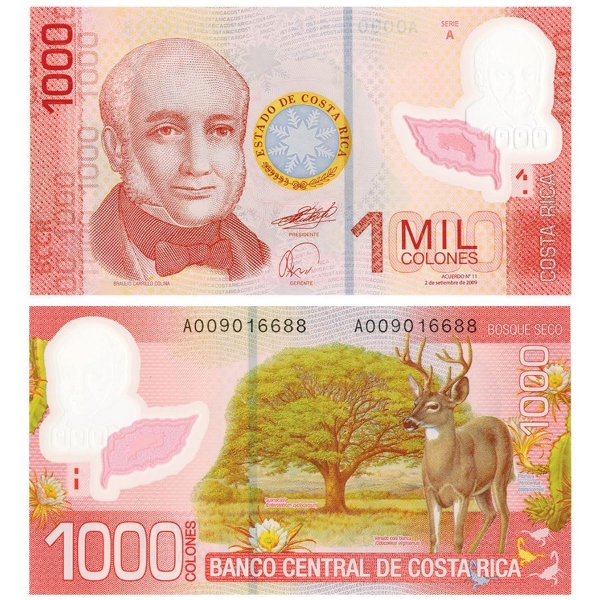
Picture Source of Braulio Carrillo Colina (1800-1845): Wikipedia
. UNC - WCO3828 .jpg)
The Architect of the Costa Rican Nation-State: A Historical Profile of Braulio Carrillo Colina (1800–1845)
Introduction
Braulio Evaristo Carrillo Colina remains one of the most polarizing yet foundational figures in Costa Rican history. Serving as Head of State during two critical periods—first from 1835 to 1837, and later as a de facto dictator from 1838 to 1842—Carrillo is widely revered as the "Architect of the Costa Rican National State" (Arquitecto del Estado Costarricense) (Obregón, 1989).
Operating in an era characterized by regional instability, civil war, and the slow dissolution of the Federal Republic of Central America, Carrillo pursued a vision of central authority, economic modernization, and absolute sovereignty. His regime successfully established San José as the permanent capital, initiated a major coffee export boom, and codified the nation's first comprehensive legal system. However, his modernization efforts came at a steep democratic cost, culminating in a self-declared lifetime presidency and an authoritarian governance style that ultimately led to his forced exile and tragic assassination.
Key Facts
Full Name: Braulio Evaristo Carrillo Colina
Lifespan: March 20, 1800 (Cartago, Costa Rica) – May 15, 1845 (Sociedad, El Salvador)
Titles Held: magistrate and President of the Supreme Court, Deputy to the Federal Congress of Central America, and Head of State of Costa Rica (1835–1837; 1838–1842)
Political Ideology: Pragmatic Liberalism; State-Centralist
Key Legal Achievements: Author of the General Code of the State of Costa Rica (Código General de Carrillo, 1841) and the Ley de Bases y Garantías (1841)
National Declaration: Declared Costa Rica a fully sovereign, independent state, separating it permanently from the Central American Federation in November 1838.
Historical Honor: Declared Benemérito de la Patria (Worthy of the Homeland) by the Legislative Assembly of Costa Rica in 1971.
Key Takeaways
Foundational State Consolidation: Carrillo dismantled the unstable, rotating presidency system (Ley de la Ambulancia), permanently establishing San José as the political capital and ensuring structural stability through centralized governance.
Architect of Complete Sovereignty: Under his leadership, Costa Rica formally severed ties with the failing Central American Federation in 1838, successfully shielding the young nation from the prolonged regional civil wars that devastated neighboring states.
The Coffee Revolution Catalyst: By abolishing the religious tithe on coffee and distributing public land and seedlings, Carrillo laid the economic foundation for the "Golden Bean" (grano de oro) boom, transforming Costa Rica into a prosperous export-driven economy.
Legal and Institutional Pioneer: The Código General of 1841 established the country’s first organized civil and penal codes, replacing obsolete Spanish colonial laws with a cohesive national legal framework.
The Paradox of Progressive Dictatorship: Carrillo's legacy is defined by a deep historical tension; his sweeping modernization, infrastructure projects, and administrative order were achieved via iron-fisted autocracy, censorship, and the undemocratic declaration of a lifetime presidency.
Early Life and Rise to Power
Born in Cartago in 1800 to an influential local family, Carrillo grew up during the transition from Spanish colonial rule to independence (Monge Alfaro, 1980). He traveled to Nicaragua to study law at the National Autonomous University of Nicaragua in León, a major intellectual hub of the era. Upon returning to Costa Rica, Carrillo quickly established himself as a brilliant jurist and public servant.
By the age of 28, Carrillo was elected to the state legislature, serving briefly as its president. In 1834, he was dispatched to El Salvador to represent Costa Rica in the Federal Congress of the Central American Republic. When the weak and indecisive Costa Rican Head of State José Rafael Gallegos resigned in 1835, the local assembly turned to Carrillo, electing him to finish the term (Cerdas Cruz, 1978). At just 35 years old, Carrillo assumed control of a state fractured by local rivalries and structural instability.
The First Administration (1835–1837): Capitalization and the War of the League
When Carrillo took office, Costa Rican politics were paralyzed by localism. The "Ambulance Act" (Ley de la Ambulancia), passed in 1834, required the seat of government to rotate every four years among the four main cities of the Central Valley: Cartago, San José, Heredia, and Alajuela. Believing this system made efficient governance impossible, Carrillo spearheaded the repeal of the law in August 1835 and established a permanent capital in San Juan del Murciélago (modern-day Tibás), before eventually settling it in San José (Molina & Palmer, 2007).
          [ Local Rivalry: Cartago, Alajuela, Heredia ]
                                vs.
                     [ Centralist San José ]
                                |
             (Resulted in the War of the League, 1835)
                                |
             [ Outcome: Victory for Carrillo & San José ]
This decision provoked immediate armed rebellion from the other three rival cities, sparking the brief but bloody War of the League (Guerra de la Liga) in September 1835. Despite his forces being heavily outnumbered, Carrillo's tactical organization and the military leadership of his commanders secured a decisive victory for the central government (Obregón, 1989). This triumph permanently broke the political power of the old colonial capital of Cartago and consolidated San José as the undisputed center of Costa Rican political and economic life.
Simultaneously, Carrillo sought to reduce the power of the Catholic Church to foster economic growth. In 1835, he abolished the ecclesiastical tithe (diezmo) on coffee production (Cerdas Cruz, 1978). This policy stripped the Church of a major revenue source while drastically lowering overhead costs for coffee planters, positioning the crop as the primary engine of Costa Rica's export economy.
The Second Administration (1838–1842): Sovereignty and Dictatorship
In 1837, Carrillo lost his bid for re-election to the moderate Manuel Aguilar. However, Aguilar’s administration struggled to handle the mounting chaos within the collapsing Central American Federation. Fearing that Costa Rica would be dragged into the violent regional civil wars ravaging neighboring states, Carrillo orchestrated a military coup (cuartelazo) that overthrew Aguilar in May 1838 (Monge Alfaro, 1980).
Assuming absolute, dictatorial powers, Carrillo took immediate action to isolate Costa Rica from regional strife. On November 14, 1838, he convened a constituent assembly that formally declared Costa Rica’s complete separation and independence from the Federal Republic of Central America (Molina & Palmer, 2007). This historic declaration marked the birth of Costa Rica as a fully sovereign state.
Federal Republic of Central America (Decline)
  ├── Guatemala (Civil Conflict)
  ├── El Salvador (Military Battles)
  └── Costa Rica ──> [Declared Sovereign State by Carrillo, Nov 1838]
To structure this new state, Carrillo promulgated two landmark documents in 1841:
The General Code of the State of Costa Rica (Código General de 1841): This was the first comprehensive body of civil, penal, and procedural law in the nation's history, replacing archaic Spanish colonial law with modernized, organized statutes (Obregón, 1989).
The Law of Bases and Guarantees (Ley de Bases y Garantías): This decree functioned as a highly centralized constitution. Crucially, it stripped local municipalities of their autonomy, concentrated power in the executive branch, and declared Carrillo the "First Magistrate" and lifetime Head of State (Cerdas Cruz, 1978).
Economic Modernization and Infrastructure
As an autocratic modernizer, Carrillo believed that social progress required strict civil discipline and robust infrastructure. His administration enacted aggressive laws to suppress vagrancy, public vice, and crime, implementing a civil service system that demanded rigorous accountability from public employees.
Carrillo’s most enduring economic legacy was his aggressive promotion of the coffee sector. He decreed that municipalities must distribute free coffee seedlings to any citizen willing to plant them and streamlined the acquisition of public lands (tierras baldías) for agricultural cultivation (Molina & Palmer, 2007).
Recognizing that Costa Rica's isolation was its greatest economic bottleneck, Carrillo initiated the construction of a vital export route to the Caribbean coast, known as the Camino de Carrillo (the road to Matina). Though the route was extremely difficult to build due to the dense, disease-ridden tropical rainforests of the Atlantic slope, it laid the geographical framework for the future railroad and modern highway systems (Monge Alfaro, 1980).
Downfall, Exile, and Tragic Death
Carrillo’s authoritarianism and his self-proclamation as ruler for life alienated many within the Costa Rican elite. In 1842, Francisco Morazán—the charismatic, exiled former President of the Central American Federation—invaded Costa Rica with an expeditionary force, aiming to use the country as a launchpad to resurrect the Central American Union (Cerdas Cruz, 1978).
Carrillo dispatched an army under General Vicente Villaseñor to repel the invasion. However, Villaseñor betrayed Carrillo, signing the Pact of El Jocote (Pacto del Jocote) with Morazán on April 11, 1842. Recognizing that he had lost the support of his military and the local aristocracy, Carrillo chose to step down to avoid a bloody civil war. He was allowed to leave the country peacefully, embarking on an exile that would take him to El Salvador.
Morazán’s rule in Costa Rica was short-lived; his aggressive tax levies and conscription policies quickly alienated the populace, leading to his capture and execution in September 1842. Despite Morazán's death, Carrillo was never permitted to return to his homeland. On May 15, 1845, while living in poverty in the remote village of La Sociedad, El Salvador, Carrillo was brutally assassinated by political enemies (Obregón, 1989). He was only 45 years old.
Legacy and Modern Assessment
The historical assessment of Braulio Carrillo evolved significantly over the century following his death. While early liberal historians often criticized his dictatorial excesses and the suppression of municipal freedoms, 20th-century scholars began to emphasize his role as the indispensable founder of the Costa Rican state apparatus (Cerdas Cruz, 1978). Without his firm centralization of power, the young nation might have fractured into local fiefdoms or been absorbed by larger regional neighbors.
In 1971, on the centennial of the 1871 Constitution (which was heavily influenced by Carrillo’s centralist legal framework), the Legislative Assembly of Costa Rica officially declared Carrillo a Benemérito de la Patria. Today, his contribution is commemorated globally: his face adorns the 2,000-colón banknote, his statue stands in San José, and the massive Braulio Carrillo National Park—preserving the pristine, rugged cloud forests through which he tried to carve his historic road to the Caribbean—stands as a monumental tribute to his vision of a connected, sovereign nation.
Bibliography
Cerdas Cruz, Rodolfo. (1978). Formación del estado de Costa Rica (2nd ed.). San José: Editorial Universidad de Costa Rica.
Molina, Iván, & Palmer, Steven. (2007). The History of Costa Rica: Brief, Up-to-Date, and Illustrated. San José: Editorial de la Universidad de Costa Rica.
Monge Alfaro, Carlos. (1980). Historia de Costa Rica (16th ed.). San José: Trejos Editores.
Obregón, Clotilde. (1989). Carrillo: Una época y un hombre, 1835–1842. San José: Editorial Costa Rica.