Picture Source of Juan Rafael Mora Porras (1814 – 1860): Wikipedia
 - WCO3900 .jpg)
Juan Rafael Mora Porras: The Architect of Costa Rican Sovereignty and Economic Modernization
Juan Rafael Mora Porras, affectionately remembered by generations of Costa Ricans as "Don Juanito," stands as one of the most transformative and polarizing figures in nineteenth-century Central American history. Serving as the second President of the Republic of Costa Rica from 1849 to 1859, his tenure was defined by aggressive economic modernization, structural infrastructure overhauls, and, most famously, his absolute military defiance against foreign expansionism during the Filibuster War.
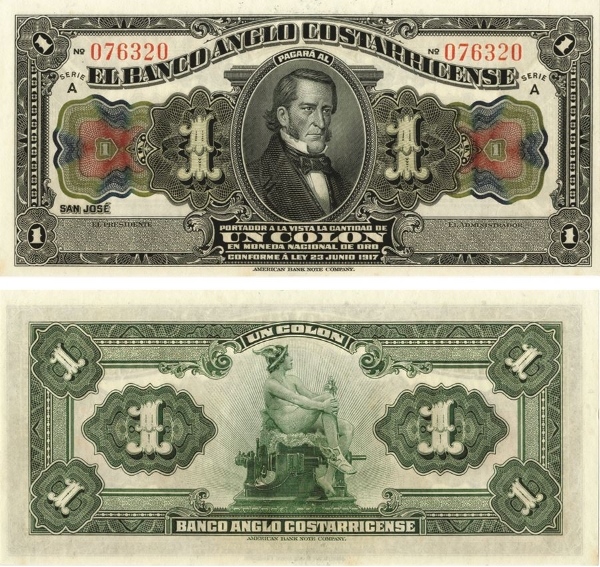
His striking portrait—characterized by a piercing gaze, a Roman nose, and a high-collared French-style coat—is famously immortalized on historical numismatic assets, such as the 1917 one-colon banknote issued by El Banco Anglo Costarricense, visible in the file image_862b82.jpg. Beyond his aesthetic legacy on currency, Mora Porras engineered the institutional and physical defenses that preserved Costa Rica’s sovereignty at a time when the nation’s very survival hung in the balance.
Key Facts
| Attribute | Details |
| Full Name | Juan Rafael Mora Porras |
| Date of Birth | February 8, 1814 (San José, Captaincy General of Guatemala) |
| Date of Death | September 30, 1860 (Aged 46; Executed in Puntarenas, Costa Rica) |
| Presidency | November 26, 1849 – August 14, 1859 (Three consecutive terms) |
| Key Military Conflicts | The Filibuster War / Central American National War (1856–1857) |
| Major Battles Led | Battle of Santa Rosa, Second Battle of Rivas |
| Key Allies / Partners | José Joaquín Mora Porras (brother/general), Crisanto de Medina (financial associate) |
| Official Title | "National Hero and Liberator" (Decreed posthumously in 2010) |
Key Takeaways
Sovereignty Preserved: Mora Porras successfully organized a domestic and regional coalition to crush the invasion of William Walker, preventing the forced colonization and expansion of slavery into Central America.
Coffee Boom Pioneer: Long before entering politics, Mora was a highly successful self-made merchant and planter who helped scale Costa Rica’s transatlantic coffee export economy.
Monetary and Structural Reformer: He challenged elite merchant cartels by creating a national currency-issuing state bank (Banco de Medina) to provide fair credit to small agricultural producers.
Tragic Downfall: His centralizing economic policies, elite opposition to his state bank, and post-war fiscal fragility culminated in a military coup in 1859, leading to his eventual execution when he attempted to return and reclaim power.
Early Life and Rise to Economic Power
Unlike many of his political contemporaries in Central America, Juan Rafael Mora Porras did not possess a university education. Born into an influential but financially volatile family in San José, he was forced to embark on a mercantile career following the death of his father in 1836.
By the late 1830s, Mora recognized the massive economic potential of the burgeoning coffee industry in Costa Rica's Central Valley. He became one of the country's first large-scale wholesale traders and coffee planters, establishing vast agricultural holdings west of San José. In 1842, he entered into a commercial partnership with Vicente Aguilar. The firm rapidly grew into one of the most powerful financial houses of the era, dominating real estate, sugarcane, coffee production, and wholesale import-export loops.
Mora’s transition to politics was directly tied to this newly formed mercantile elite. After serving as a member of the Constituent Assembly (1846–1847) and as Vice President, he assumed the presidency in November 1849 following a military coup led by General José Manuel Quirós y Blanco, which forced the resignation of President José María Castro Madriz. Mora consolidated his grip on power early on by aggressively building a second military barracks to decentralize the armed forces, effectively crushing an armed revolt by Quirós in June 1850.
Economic Modernization and Monetary Sovereignty
As president, Mora applied a classically liberal economic playbook to domestic development, emphasizing critical infrastructure to maximize trade efficiency. He modernized the vital Pacific port of Puntarenas, expanded national roadways to replace sluggish mule paths with cargo carts, and heavily promoted public education to foster a more participatory civil society.
However, his most radical domestic policy lay in financial nationalization. At the time, Costa Rica's elite coffee-baron families controlled the export pipelines and private lending markets, keeping smaller agricultural producers dependent on predatory credit cycles. To break this monopoly, Mora partnered with the Spanish-Argentine financier Crisanto de Medina. On July 1, 1858, they decreed the establishment of the Banco de Medina—a private-state hybrid bank designed to provide small farmers with stable crop loans and safely nationalize private currency-issuing privileges to stabilize the broader macroeconomy.
This directly threatened the entrenched interests of the Montealegre family and other elite merchant clans. Additionally, Mora alienated the Catholic Church hierarchy by refusing to exempt expanding coffee production from traditional tithe collections, setting the stage for deep-seated domestic political friction.
The Filibuster War (1856–1857): Industrial Deterrence
The defining chapter of Mora Porras’s life began when American adventurer and mercenary William Walker invaded neighboring Nicaragua in 1855. Backed by private southern U.S. financial interests, Walker seized control of the Nicaraguan government, legalized slavery, and sought to conquer all five Central American nations to build a private Caribbean empire.
Recognizing an existential threat to Costa Rica's eastern flank, and stoked by intelligence warnings from industrialist Cornelius Vanderbilt regarding Walker’s regional expansionist flags, Mora Porras acted decisively. In March 1856, he declared war on Walker's filibuster regime, mobilizing a massive domestic expeditionary force of roughly 9,000 soldiers—an extraordinary logistical feat given that Costa Rica’s total population hovered around 112,000 citizens at the time.
       [ Walker Invades Nicaragua (1855) ]
                       │
                       ▼
      [ Mora Porras Declares War (Mar 1856) ]
                       │
         ┌─────────────┴─────────────┐
         ▼                           ▼
[ Battle of Santa Rosa ]    [ Battle of Rivas ]
(Mar 20, 1856 - Repelled)   (Apr 11, 1856 - Counterattack)
         │                           │
         └─────────────┬─────────────┘
                       ▼
       [ Outbreak of Cholera Epidemic ]
    (Kills ~10% of Costa Rican Population)
                       │
                       ▼
       [ Regional Coalition Formed ]
     (Allied Central American Defeat of Walker)
Mora, alongside his brother, General José Joaquín Mora Porras, led his troops north. The Costa Rican forces achieved a lightning victory on March 20, 1856, at the Battle of Santa Rosa, routing a filibuster vanguard inside Costa Rican territory in less than twenty minutes. They pursued the remaining mercenaries into Nicaragua, engaging them in the bloody Second Battle of Rivas on April 11, 1856. It was during this battle that national icon Juan Santamaría sacrificed his life to burn down the filibuster stronghold (El Mesón de Guerra).
Though victorious on the battlefield, the Costa Rican army suffered an unmitigated biological disaster. The returning troops inadvertently brought the Asiatic cholera epidemic back across the border. The disease ripped through the Central Valley, killing up to 10,000 people—roughly 10% of the entire national population—overwhelming the administration and bringing the economy to a virtual standstill. Despite this immense trauma, Mora managed to reorganize his government and partner with allied forces from El Salvador, Guatemala, and Honduras to permanently dismantle Walker’s puppet state by May 1857.
Downfall, Exile, and Execution
The material and human toll of the National Campaign left Costa Rica deeply fractured. War expenditures had saddled the country with debts exceeding 2 million pesos. Coupled with the lingering economic fallout of the cholera epidemic, Mora's popularity waned.
Seeking to preserve stability, his administration pushed through controversial measures, including an August 1859 decree to auction off common municipal lands to close associates, alongside tax hikes that frustrated the working class. Despite securing a controversial re-election in April 1859 amid allegations of irregularities, Mora could not outmaneuver the brewing praetorian alliance between his elite commercial rivals and disaffected military factions.
On August 14, 1859, a bloodless barracks revolt led by Generals Máximo Blanco and Lorenzo Salazar deposed Mora Porras. He was swiftly exiled to El Salvador. Refusing to surrender his political vision, Mora launched a maritime invasion to reclaim power a year later. Landing at the port of Puntarenas in September 1860, his forces initially secured a narrow coastal strip, but the campaign quickly buckled under the superior numbers of the provisional government—then headed by his former brother-in-law, José María Montealegre.
Captured by government forces, Juan Rafael Mora Porras was executed by firing squad on September 30, 1860, in a coastal clearing known as Los Lobos, alongside his close military ally, General Ignacio Arancibia.
Historical Legacy
For decades following his death, Mora Porras’s memory was obscured by the oligarchic families who orchestrated his execution. However, history has undergone a profound reevaluation of his legacy. Today, he is celebrated not as a heavy-handed autocrat, but as the foundational architect of Costa Rican independence, statehood, and national identity.
On September 16, 2010, the Legislative Assembly of Costa Rica officially declared Juan Rafael Mora Porras a "National Hero and Liberator." His inclusion on twentieth-century banknotes, such as the one depicted in image_862b82.jpg, serves as a testament to his indelible link to the country's economic sovereignty and its enduring democratic spirit.
Bibliography & Digital Resources
The Filibuster War and the Campaign of 1856 - Military History Wiki
Mora Porras, Juan Rafael (1814–1860) - Encyclopedia.com Biography
Vargas Araya, Armando. El Lado Oculto del Presidente Mora: Resonancias de la Guerra Patria Contra el Filibusterismo de los Estados Unidos (1850–1860). San José, Costa Rica: Editorial Juricentro, 2007.
Scroggs, William Oscar. Filibusters and Financiers: The Story of William Walker and His Associates. New York: Macmillan Publishers, 1916.