 - WCH1440.jpg)
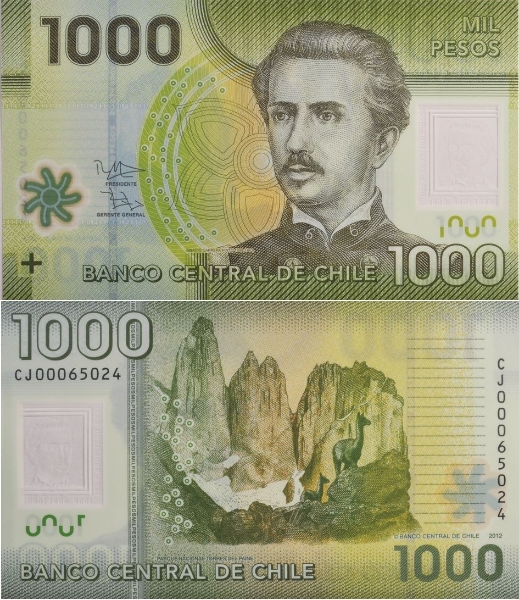
Picture Source of Chile Pesos Featuring Ignacio Carrera Pinto (1848–1882): Wikipedia
Ignacio Carrera Pinto: The Martyr of La Concepción and Face of Chile's 1,000-Peso Note
Ignacio Carrera Pinto stands as one of the most revered military figures in the history of Chile. As a captain during the War of the Pacific (1879–1884), his ultimate sacrifice at the Battle of La Concepción in the Peruvian highlands permanently etched his name into the bedrock of Chilean national identity. Alongside the seventy-six soldiers of his company, Carrera Pinto’s refusal to surrender against overwhelming odds transformed a tactical defeat into a legendary symbol of patriotic devotion. Today, his legacy is woven into the daily lives of millions of Chileans, celebrated annually on National Flag Day and immortalized on the country’s green 1,000-peso polymer banknote.
Key Facts
Feature | Details |
|---|---|
Full Name | Ignacio José Carrera Pinto |
Born | February 5, 1848 (Santiago, Chile) |
Died | July 9, 1882 (Concepción, Junín Department, Peru) |
Allegiance | Republic of Chile |
Rank | Captain (Capitán) |
Unit | 4th Company, "Chacabuco" 6th Line Infantry Battalion |
Key Conflict | War of the Pacific (Sierra Campaign / Campaña de la Sierra) |
Major Honors | Portrait featured on the 1,000 Chilean Pesos banknote; Chile's National Flag Day (Día de la Bandera) celebrated on the anniversary of his final battle (July 9) |
Key Takeaways
Aristocratic Patriot: Despite hailing from one of Chile's most politically influential and wealthy founding families, Carrera Pinto voluntarily enlisted as a common soldier at the outbreak of war, choosing to earn his rank through merit.
The Andes Trap: He was tasked with holding the remote highland outpost of La Concepción during the brutal Sierra Campaign, a counter-insurgency effort marked by guerrilla warfare, harsh altitude, and deep hostility from the local population.
A Legendary Stand: Surrounded by a combined force of over 1,300 Peruvian regular soldiers and indigenous guerrillas, Carrera Pinto and his 77-man company fought continuously for 27 hours, refusing multiple offers of honorable surrender.
National Martyrdom: The annihilation of his company became Chile's equivalent of the Alamo or Thermopylae, serving as a unifying national myth that galvanized public support and military resolve.
Early Life and Aristocratic Lineage
Ignacio José Carrera Pinto was born into the upper echelons of Chilean political aristocracy in Santiago on February 5, 1848 (Kiddle, 2026). His father, José Miguel Carrera Fontecilla, was a prominent citizen, and his mother, Emilia Pinto Benavente, belonged to a family of immense political influence.
Indeed, Carrera Pinto’s lineage was a virtual directory of Chile’s founding fathers and heads of state:
Paternal Grandfather: José Miguel Carrera Verdugo, the military general and revolutionary leader widely considered one of the principal founding fathers (Padre de la Patria) of Chile.
Maternal Great-Grandfather: Francisco Antonio Pinto, who served as the President of Chile from 1827 to 1829.
Maternal Great-Uncle: Aníbal Pinto Garmendia, the President of Chile who would ultimately lead the nation during the first years of the War of the Pacific.
Despite these elite family connections, Carrera Pinto did not seek an easy path through politics or diplomacy. In his youth and early adulthood, he lived a relatively quiet life as an agricultural clerk and merchant in the rural town of Peñaflor, near Santiago (FamilySearch, 2026). He was described by contemporaries as a modest, hardworking, and deeply patriotic man who preferred the company of common laborers to the high-society salons of the capital.
Enlistment and the War of the Pacific
When the War of the Pacific erupted in 1879—pitting Chile against a combined alliance of Peru and Bolivia over rich mineral deposits in the Atacama Desert—Carrera Pinto felt a profound familial and patriotic duty to serve. Rather than leveraging his uncle (President Aníbal Pinto) to secure an immediate, comfortable officer's commission in Santiago, the 31-year-old Carrera Pinto voluntarily enlisted as a sergeant in the newly mobilized "Esmeralda" 7th Infantry Battalion (Sater, 2007).
He quickly distinguished himself on the battlefield through a combination of level-headed leadership and personal bravery. Over the next three years, he participated in the grueling desert campaigns, the capture of Tacna and Arica, and the eventual amphibious invasion and capture of the Peruvian capital, Lima, in January 1881. His exemplary service did not go unnoticed, earning him rapid promotions: he was commissioned as a lieutenant in 1881 and promoted to Captain of the 4th Company of the "Chacabuco" 6th Line Infantry Battalion in early 1882 (Military Wiki, 2026).
The Sierra Campaign: The Andes Trap
Following the fall of Lima, many believed the war was effectively over. However, the conflict entered its bloodiest and most challenging phase: the Sierra Campaign (Campaña de la Breña). Peruvian General Andrés Avelino Cáceres retreated deep into the central Andes mountains, mobilizing local indigenous peasant communities and launching a highly effective guerrilla war against the Chilean occupying forces (Farcau, 2000).
The Chilean military commander, Admiral Patricio Lynch, dispatched divisions into the mountains to secure the towns, hunt down Cáceres, and pacify the region. Among these forces was the division led by Colonel Estanislao del Canto, which established small garrisons in several towns along the Mantaro Valley (Sater, 2007).
In July 1882, Captain Ignacio Carrera Pinto and the 4th Company of the Chacabuco Battalion—consisting of 77 soldiers, including three young sub-lieutenants: Julio Montt Salamanca, Arturo Pérez Canto, and Luis Cruz Martínez—were garrisoned in the picturesque mountain town of Concepción (Wikipedia, 2026). The garrison was isolated, suffering from typhus, and desperately low on ammunition.
The Siege of La Concepción: 27 Hours of Defiance
On Sunday afternoon, July 9, 1882, the hills surrounding Concepción suddenly swarmed with hostile forces. A massive contingent of over 1,300 fighters—comprising approximately 300 to 400 regular Peruvian soldiers under Colonel Juan Gastó and hundreds of local indigenous guerrillas led by Ambrosio Salazar—swept down toward the town (Sater, 2007).
Recognizing that a retreat through the narrow mountain passes would result in his unit being easily surrounded and slaughtered in the open, Carrera Pinto made the strategic decision to fortify his men inside the town’s small parish church and adjacent municipal buildings.
┌─────────────────────────────────────────────────────────────┐
│             THE SIEGE OF LA CONCEPCIÓN (July 9–10, 1882)    │
│                                                             │
│  [Peruvian Force: ~1,300 Regulars & Guerrillas]              │
│                     │                                       │
│                     ▼ (Laid continuous siege for 27 hours)  │
│                                                             │
│  [Chilean Garrison: 77 Men (Chacabuco 4th Company)]        │
│  - Fortified in parish church and municipal buildings       │
│  - Refused surrender; ran completely out of ammunition      │
│  - Hand-to-hand combat ending in a final bayonet charge     │
└─────────────────────────────────────────────────────────────┘
Peruvian Colonel Juan Gastó, wishing to avoid unnecessary bloodshed, sent a messenger with a formal note demanding Carrera Pinto’s surrender, offering honorable treatment and guaranteed safety for his men. Carrera Pinto famously scribbled his refusal on the back of the note, stating:
"In the town of Heras, on the road to glory, Chilean soldiers do not surrender! Given the heritage of my ancestors and the honor of my country, I will fight to the end." (Vicuña Mackenna, 1883).
The battle began at 2:30 PM. The 77 Chilean soldiers held their perimeter, using their Comblain rifles to hold back the waves of attackers. As night fell, the Peruvians set fire to the thatched roofs of the church and municipal buildings to force the defenders out.
Through the smoke, heat, and darkness, the Chilean line held. Sometime during the brutal fighting on the night of July 9, Carrera Pinto was struck by a bullet and killed. Command passed sequentially to the surviving young officers: first to Lieutenant Julio Montt, then to Arturo Pérez Canto, and finally to the 15-year-old sub-lieutenant Luis Cruz Martínez (Vicuña Mackenna, 1883).
By the morning of July 10, the Chilean defenders were entirely out of ammunition. Rather than raising a white flag, the final five surviving soldiers, led by Cruz Martínez, stepped out of the burning church ruins and executed a desperate, final bayonet charge directly into the ranks of the Peruvian forces. They were killed instantly.
Legacy and the National Flag
The ultimate sacrifice of Ignacio Carrera Pinto and his 77 men deeply shook Chile. When reinforcements arrived in Concepción later on July 10, they found the town deserted and the bodies of the garrison stripped. The hearts of the four officers—Carrera Pinto, Montt, Pérez Canto, and Cruz Martínez—were extracted and preserved in bronze urns, which now reside in the Santiago Metropolitan Cathedral.
In Chile, the battle is viewed as the ultimate example of military valor. In 1974, the Chilean government officially declared July 9 as the National Flag Day (Día de la Bandera) (Anglo-Chilean Society, 2021). Every year on this date, new military recruits across Chile take their sacred oath to the flag (Juramento a la Bandera), directly invoking the memory of the "Heroes of La Concepción."
Preserving a Hero: The 1,000-Peso Banknote
In 2011, the Central Bank of Chile (Banco Central de Chile) rolled out its modernized polymer banknote series. Ignacio Carrera Pinto was chosen to remain the face of the 1,000 Pesos banknote (the Mil Pesos), Chile's most widely circulated paper currency.
The Obverse (Heads): Features a detailed portrait of Carrera Pinto in his military uniform, based on historical 19th-century photographs. Next to his portrait is a stylized "Antu"—a mapuche symbol representing the sun and life.
The Reverse (Tails): Showcases the pristine, rugged peaks of Torres del Paine National Park in Chilean Patagonia, accompanied by a pair of native guanacos.
By pairing the image of Carrera Pinto with one of the nation's most breathtaking natural landmarks, the banknote serves as a physical representation of Chile’s historical courage and geographical beauty.
Frequently Asked Questions (FAQs)
Was Ignacio Carrera Pinto related to the President of Chile during the war?
Yes. He was the great-nephew of Aníbal Pinto Garmendia, who served as the President of Chile from 1876 to 1881 and oversaw the early, critical naval and desert phases of the War of the Pacific.
Why did Carrera Pinto refuse to surrender when he was so heavily outnumbered?
Military culture in 19th-century Chile placed an immense, absolute premium on honor, heavily influenced by the sacrifice of naval hero Arturo Prat at the Battle of Iquique in 1879. Additionally, Carrera Pinto carried the weight of his grandfather's (José Miguel Carrera) historic legacy and believed that surrendering would permanently tarnish his family name and the reputation of the Chilean army.
Are there any survivors of the Battle of La Concepción?
No. All 77 Chilean soldiers of the 4th Company of the Chacabuco Battalion died during the 27-hour battle. This included several civilian women who had accompanied the soldiers as field nurses and cooks, as well as a newborn infant born during the siege.
Where can tourists visit memorials dedicated to Carrera Pinto?
The most prominent memorial is the monument to the "Heroes of La Concepción" located on the Alameda (Avenida Libertador General Bernardo O'Higgins) in downtown Santiago. Visitors can also view the bronze urns containing the hearts of the fallen officers inside the Santiago Metropolitan Cathedral.
Bibliography
Anglo-Chilean Society. (2021). Chilean Flag Day and the Legacy of La Concepción. Anglo-Chilean Historical Archives. Available at: https://www.anglochileansociety.org/single-post/chilean-flag-day
Farcau, B. B. (2000). The Ten Cents War: Chile, Peru, and Bolivia in the War of the Pacific, 1879-1884. Westport: Praeger Publishers.
Kiddle Encyclopedia. (2026). Ignacio Carrera Pinto Facts for Kids. Kiddle Educational Resources. Available at: https://kids.kiddle.co/Ignacio_Carrera_Pinto
Sater, W. F. (2007). Andean Tragedy: Fighting the War of the Pacific, 1879-1884. Lincoln: University of Nebraska Press.
Vicuña Mackenna, B. (1883). El álbum de la gloria de Chile: Homenaje a los defensores de la patria. Santiago: Imprenta Cervantes.
Wikipedia Contributors. (2026). Battle of La Concepción. In Wikipedia, The Free Encyclopedia. https://en.wikipedia.org/wiki/Battle_of_La_Concepci%C3%B3n