. - WBO0766.jpg)
Picture Source of Juana Azurduy de Padilla: Wikipedia
Juana Azurduy de Padilla: The Lioness of the Andes
Often overshadowed by figures like Simón Bolívar and José de San Martín, Juana Azurduy de Padilla stands as one of the most formidable and uncompromising military leaders of the South American Wars of Independence. A woman of mestizo heritage, she defied the strict patriarchal norms of the 19th-century Spanish colonial empire to lead armies, organize guerrilla factions, and fight on the front lines for the liberation of Alto Perú (modern-day Bolivia) and the United Provinces of the Río de la Plata (modern-day Argentina).
Her life is a testament to the crucial, yet frequently marginalized, role that women and Indigenous populations played in dismantling the Spanish Empire in the Americas.
Key Facts
Born: July 12, 1780, Chuquisaca, Viceroyalty of the Río de la Plata (modern Sucre, Bolivia).
Died: May 25, 1862, Sucre, Bolivia.
Spouse: Manuel Ascencio Padilla (married 1805; died 1816).
Military Rank: Lieutenant Colonel (during her life); General of the Argentine Army (posthumous, 2009); Marshal of the Bolivian Army (posthumous, 2011).
Key Battles: Cerro Carretas, Battle of El Villar, Defense of Salta.
Alliances: Commanded indigenous forces; allied with General Manuel Belgrano and General Martín Miguel de Güemes.
Key Takeaways
Women in Combat: Juana Azurduy proves that women played active, front-line combat and leadership roles during the South American independence movements, contrary to traditional male-centric historical narratives.
Indigenous Mobilization: The success of the guerrilla campaigns in Alto Perú relied heavily on Juana’s ability to bridge the cultural gap and recruit thousands of Quechua and Aymara fighters.
The Brutal Cost of War: Her life highlights the immense personal sacrifices made by revolutionaries; she lost her wealth, her husband, and four of her children to the cause of independence.
Historical Erasure and Reclamation: Despite her heroism, she died in absolute poverty and was forgotten for a century. Her modern reclamation highlights how nations choose to revise and honor their history over time.
Early Life and Rebellion
Juana Azurduy was born on July 12, 1880, in the region of Chuquisaca (now Sucre, Bolivia), within the Viceroyalty of the Río de la Plata. She was of mestizo descent; her father was a Spanish landowner, and her mother was Indigenous. Growing up, Juana learned to speak both Spanish and the Indigenous languages of Quechua and Aymara fluently. This linguistic ability and her deep understanding of the local culture would later become her greatest asset as a military recruiter and commander.
Orphaned at a relatively young age, Juana was sent to a convent to become a nun. However, her rebellious spirit and fiercely independent nature led to her expulsion at the age of 17. In 1805, she married Manuel Ascencio Padilla, a man who shared her deep-seated resentment toward the oppressive Spanish colonial administration. Together, they would forge one of the most formidable military partnerships of the independence era.
The spark of revolution ignited in 1809 with the Chuquisaca Revolution, one of the earliest uprisings against Spanish rule in the Americas. Both Juana and her husband immediately joined the insurgent cause. When the Spanish royalists cracked down on the rebellion, the Padillas were forced to flee, abandoning their properties and adopting the life of guerrilla fighters.
The Republiqueta de La Laguna
Following the initial uprisings, Alto Perú became a brutal theater of war. The region was divided into several Republiquetas—zones controlled by independent guerrilla factions that fought asymmetrical warfare against the heavily armed Spanish royalist forces. Juana and Manuel established and led the Republiqueta de La Laguna.
Juana was not a commander who directed troops from the safety of the rear. She rode into battle on horseback, wielding a sword and a pistol. Utilizing her fluency in Quechua and Aymara, she successfully recruited thousands of Indigenous fighters to the patriot cause. She organized a specialized cavalry unit known as the "Leales" (The Loyal Ones), which included a fearsome contingent of female fighters dubbed the "Amazons".
Her guerrilla tactics were devastating to the Royalists. Juana and her forces ambushed supply lines, captured enemy arsenals, and launched surprise attacks on royalist garrisons. In 1816, during the Battle of El Villar, she personally led a cavalry charge that broke the enemy lines and resulted in the capture of the royalist standard.
Her bravery did not go unnoticed by the high command of the Argentine patriot forces. General Manuel Belgrano, deeply impressed by her tactical brilliance and raw courage, famously presented her with his own ceremonial sword. Furthermore, the Supreme Director of the United Provinces, Juan Martín de Pueyrredón, officially promoted her to the rank of Lieutenant Colonel, a virtually unprecedented achievement for a woman at that time.
Tragedy and Exile
The cost of Juana Azurduy’s dedication to the revolution was unimaginably high. The guerrilla lifestyle was brutal, characterized by constant movement, harsh weather, and near-starvation. Tragically, Juana and Manuel lost four of their children to malaria and malnutrition while hiding from Spanish forces in the jungles and mountains of the Andes.
In late 1816, disaster struck. During the Battle of La Laguna, Manuel Ascencio Padilla was killed while attempting to rescue Juana from royalist forces. Widowed, grieving, and pregnant with her fifth child, Juana refused to surrender. She successfully led a counter-attack to recover her husband's body, preventing the Spanish from desecrating it as a trophy.
Following her husband's death, the Republiqueta de La Laguna collapsed under the weight of royalist reinforcements. Forced to retreat, Juana journeyed south into Northern Argentina, where she aligned herself with the forces of General Martín Miguel de Güemes. She continued to fight fiercely in the defense of Salta and Jujuy against royalist incursions until Güemes's assassination in 1821.
Later Life and Poverty
In 1825, the Spanish were finally defeated, and Alto Perú was liberated, officially becoming the Republic of Bolivia. Simón Bolívar, the great liberator, visited Juana Azurduy upon his arrival in the newly formed country. Acknowledging her immense sacrifices, Bolívar reportedly stated, "This country should not be named Bolivia in my honor, but Padilla or Azurduy, because it was they who made it free". Bolívar granted her a modest military pension.
However, political instability soon gripped the new nation. Successive governments stripped Juana of her pension, and the hero of the revolution was largely forgotten by the state she helped create. She spent her final decades living in extreme poverty in Sucre.
On May 25, 1862—ironically, the anniversary of the May Revolution that sparked the independence movement—Juana Azurduy de Padilla died in obscurity at the age of 81. She was buried in a communal, unmarked grave.
Posthumous Legacy
It took over a century for history to properly vindicate Juana Azurduy. In recent decades, she has been reclaimed as a monumental figure of feminist, Indigenous, and nationalistic pride in both Bolivia and Argentina.
Her legacy is now cemented in the physical and cultural landscapes of South America:
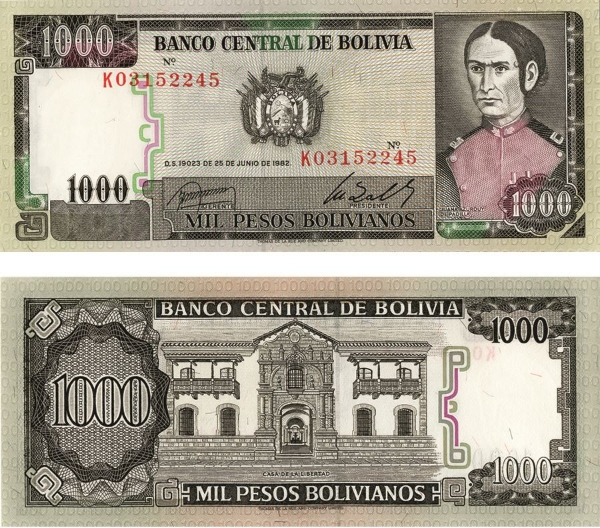
Currency: As you noted from the banknote, she was featured on the 1000 Pesos Bolivianos note. More recently, in 2015, Argentina featured her on their 10-peso banknote, making her the first woman to appear on Argentine paper currency.
Military Honors: In 2009, Argentine President Cristina Fernández de Kirchner posthumously promoted her to General of the Argentine Army. In 2011, Bolivian President Evo Morales named her Marshal of the State, the highest military rank in the nation.
Monuments: A massive 52-foot, 25-ton bronze statue of Juana Azurduy was erected behind the Casa Rosada (the presidential palace) in Buenos Aires in 2015, replacing a statue of Christopher Columbus.
Juana Azurduy de Padilla remains a symbol of relentless resistance. She shattered the boundaries of her gender and her era, proving that the liberation of a continent was fought and won not just by wealthy statesmen in capital cities, but by indigenous armies led by fiercely dedicated women on the mountainous frontiers.
FAQs
Q: Did Juana Azurduy fight alongside Simón Bolívar? A: No, she never fought directly alongside Bolívar. Juana fought primarily in the earlier stages of the war in Alto Perú and northern Argentina (1809–1821). Bolívar arrived in the region later, after the main royalist forces had been worn down. However, Bolívar did visit her in 1825 to pay his respects.
Q: Why was she stripped of her pension? A: Following independence, the new South American republics were highly unstable, facing constant coups and changing administrations. Many of the new political leaders viewed the old guerrilla commanders as political threats or simply refused to honor financial commitments made by previous governments. As a woman and a mestiza without political connections, Juana was easily marginalized.
Q: What is a Republiqueta? A: A Republiqueta was an independent territory controlled by patriot guerrilla forces in Alto Perú during the wars of independence. Surrounded by Spanish royalist strongholds, these zones operated as autonomous mini-republics that continuously harassed enemy supply lines and troops.
Q: Why is she celebrated in both Bolivia and Argentina? A: The borders we know today did not exist during the revolution. She fought to liberate the Viceroyalty of the Río de la Plata, which encompassed both modern nations. She fought in Alto Perú (Bolivia) but also defended the northern borders of what became Argentina under the command of Argentine generals like Belgrano and Güemes.
References
Davies, C. (2006). South American Independence: Gender, Politics, Text. (Highlights her military ranks and recognition by Pueyrredón and Bolívar).
Chasteen, J. C. (2008). Americanos: Latin America's Struggle for Independence. (Details her indigenous recruiting and the formation of the "Leales").
Cajías de la Vega, F. (2005). Oruro 1781: Sublevación de indios y rebelión criolla. (Provides context on the Republiquetas and her later life in poverty).
Government of Argentina (2009). Decree of Posthumous Promotion to General of the Argentine Army. (Confirms her official military recognitions and interactions with Belgrano/Güemes).