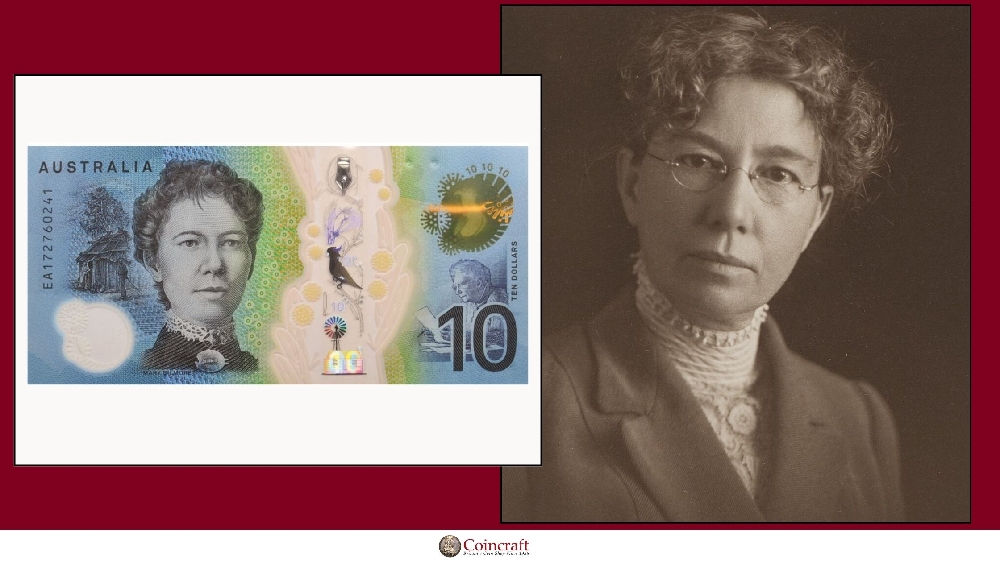
Picture Source of Dame Mary Jean Gilmore: Wikipedia
Dame Mary Jean Gilmore: The Radical Voice of Australian Literature and Social Reform
To most modern Australians, Dame Mary Jean Gilmore is recognized primarily as the stern, dignified face peering out from the nation’s ten-dollar note. Yet, behind this currency portrait lies the story of one of Australia’s most formidable, complex, and enduring cultural figures. Living to the age of 97, Gilmore was a poet, journalist, teacher, utopian pioneer, and fierce advocate for the marginalized. Spanning the colonial era of the 19th century through to the modern anxieties of the Cold War, her life was a testament to the power of the pen in the pursuit of social justice. She campaigned for women’s rights, workers' protections, and Indigenous welfare long before such causes entered the political mainstream, earning her the unofficial title of the "grand old lady of Australian letters."
Early Life and Political Awakening
Mary Jean Cameron was born on August 16, 1865, at Cotta Walla (near Goulburn) in New South Wales. Her father, Donald Cameron, was a Scottish-born farmer and itinerant building contractor, and her mother, Mary Ann Beattie, came from an Irish background. Because her father frequently moved the family across rural New South Wales to build homesteads on various properties, Mary’s formal education was spasmodic. However, this itinerant bush upbringing provided her with a profound, firsthand understanding of the hardships of rural life and a deep connection to the Australian landscape—themes that would later permeate her poetry and prose.
Despite her disjointed schooling, Mary was a brilliant student. By 1883, at just 16 years old, she became a pupil-teacher at a school in Wagga Wagga. Over the next decade, she taught at various small country schools across New South Wales, including Beaconsfield, Illabo, and Silverton.
It was during her time teaching in the remote mining town of Silverton, near Broken Hill, that Mary’s political consciousness was truly awakened. She witnessed the brutal working conditions of the miners and the ensuing industrial strikes of the early 1890s. Exposed to the harsh realities of class inequality, she embraced the burgeoning socialist and radical labor movements of the era. She became a fervent supporter of the worker and made history by becoming the first female executive member of the Australian Workers' Union (AWU). Sensitive to the conservative conventions of the education department, Mary protected her teaching career by writing early radical poetry and political commentary under various pseudonyms, such as "Em Jaycey" and "Rudione Calvert."
In Sydney, she assimilated into the radical literary circles of the 1890s, heavily influenced by the Bulletin school of writers. She befriended, and was reportedly briefly, unofficially engaged to, the legendary Australian poet Henry Lawson. Though their romantic relationship did not last, their shared commitment to socialist ideals and Australian nationalism profoundly shaped her intellectual trajectory.
The Paraguayan Utopia: A Dream Mislaid
As the 1890s progressed, the Australian labor movement suffered crushing defeats in the maritime and shearers' strikes. Disillusioned by these losses and the severe economic depression gripping the country, many radicals looked for solutions outside of Australia. One such visionary was William Lane, a prominent unionist and journalist who dreamed of establishing a socialist utopia where equality, sobriety, and communal ownership would reign supreme.
Deeply inspired by Lane’s utopian socialist ideals, Mary Cameron resigned from teaching in 1895 and joined the "New Australia Movement." In November of that year, she sailed for South America to join Lane’s breakaway settlement, known as "Cosme," located deep in the jungles of Paraguay.
Life in the Cosme colony was remarkably challenging. The settlers faced backbreaking labor to clear the heavy timber for agriculture, severe poverty, and the persistent internal friction that naturally arose from strict, puritanical rules—including a total ban on alcohol and socialization with the local Indigenous Guaraní people. Despite these hardships, Mary threw herself into the communal effort, editing the daily settlement journal, the Cosme Evening Notes.
It was in Paraguay that she met and married William Alexander Gilmore, a Victorian shearer and fellow utopian colonist, in 1897. A year later, they welcomed their only child, William Dysart Cameron Gilmore.
By 1899, the utopian dream had fractured. Plagued by Lane's autocratic leadership, internal dissension, and severe economic struggles, the Cosme settlement began to collapse. Disillusioned and practically destitute, the Gilmores left the colony. After a brief period living in Patagonia—where Mary taught English in Rio Gallegos—they managed to earn enough money to sail back to Australia via London, arriving in 1902. While the socialist experiment had failed, the resilience she forged in the South American jungle provided her with a wealth of material for her subsequent literary career.
The Worker and Social Advocacy
Returning to Australia, the Gilmores settled on a farm in Casterton, in western Victoria. Though geographically isolated from the bustling literary hubs of Sydney and Melbourne, Mary maintained her connections with the literary world via correspondence, having her poetry published in The Bulletin.
In 1908, her career took a momentous turn. Following a request she made to the editor of The Australian Worker for a dedicated women's page, she was invited to edit the section herself. Mary accepted, and for the next 23 years, she utilized this influential platform to launch formidable campaigns for social and economic reform.
Gilmore was a visionary advocate. Through her column, she championed causes that were highly progressive for the time, including voting rights for women, child endowment, pensions for the elderly, invalids, and returned servicemen, and the relief of the poor. Crucially, she was a vocal, lifelong defender of Indigenous Australians, utilizing her platform to demand just treatment and highlight the atrocities committed against First Nations peoples—a stance that was highly unusual and courageous during the era of the White Australia Policy.
By 1912, Mary and her son moved to Sydney to be closer to the literary and political epicenter of the country, while her husband William established a property in North Queensland. Though geographically separated, they remained married. In Sydney, Mary became the doyenne of the literary scene, a tireless mentor to young writers, and a founding member of the Fellowship of Australian Writers.
A Literary Giant and National Icon
Alongside her journalism, Mary Gilmore cultivated a prolific career as a poet and author. Her first collection of verse, Marri'd, and Other Verses, was published in 1910. It was followed by a slew of highly successful poetry collections and prose works, including The Passionate Heart (1918), The Tilted Cart (1925), The Wild Swan (1930), and her prose memoirs Old Days, Old Ways (1934).
Her literary work frequently romanticized the pioneer spirit of colonial Australia while simultaneously lamenting the destruction of the natural environment and the displacement of Aboriginal peoples. She wrote with deep empathy about motherhood, the struggles of the working class, and the futility of war. Royalties from The Passionate Heart were notably donated to soldiers blinded during the Great War.
In 1937, her immense contribution to Australian literature and social reform was formally recognized when she became the first person to be appointed a Dame Commander of the Order of the British Empire (DBE) specifically for services to literature.
Despite her establishment honors, Gilmore never lost her radical fire. During World War II, at the age of 74, she penned the stirring patriotic poem "No Foe Shall Gather Our Harvest," which became a massive morale booster for the Australian public under the threat of Japanese invasion. Yet, in 1952, at the age of 87, she began writing a regular column called "Arrows" for the Tribune—the official newspaper of the Australian Communist Party. While she never officially joined the party, her association with the publication reflected her lifelong pacifism and egalitarian convictions, enduring right up until her final days.
Final Years and Enduring Legacy
Dame Mary Gilmore maintained a prodigious literary output well into her old age, publishing her final volume of poetry, Fourteen Men, in 1954 when she was almost 90 years old. In her final years, she lived in an apartment in Sydney's Kings Cross, where she continued to receive visitors, write fiercely worded letters to editors, and make television and radio appearances. She became an undisputed national icon, with her birthday celebrated annually by the Sydney literati.
Dame Mary Gilmore passed away on December 3, 1962, at the age of 97. In a testament to her towering cultural significance, she was accorded a state funeral—the first granted to an Australian writer since Henry Lawson forty years prior.
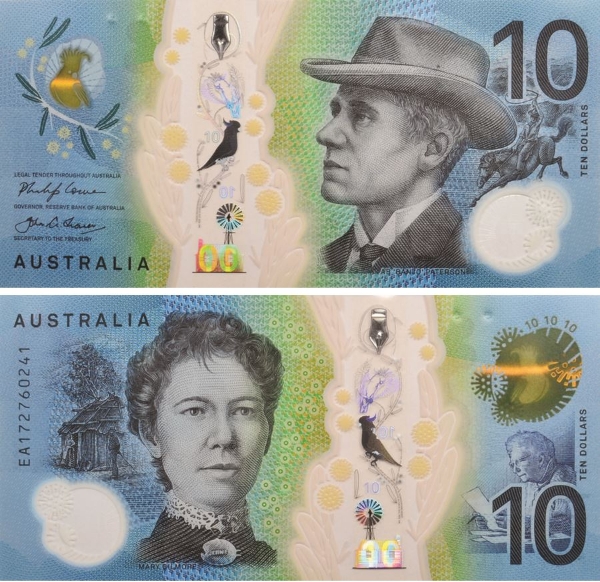
Today, her legacy is enshrined not just in her extensive bibliography, but in the very fabric of Australian society. In 1993, she was immortalized on the Australian ten-dollar note. The banknote features her portrait, drawn from a photograph taken in her later years, alongside a depiction of a rural horse and cart. If one looks closely at the copy-protection microprint on the note, they will find the text of her defiant wartime poem, No Foe Shall Gather Our Harvest. It is a fitting tribute to a woman whose life was dedicated to harvesting a fairer, more compassionate, and culturally rich Australia.
References
Reserve Bank of Australia (RBA). "Dame Mary Gilmore (1865–1962) - People on the Banknotes." RBA Banknotes. Available at: https://banknotes.rba.gov.au/australias-banknotes/people-on-the-banknotes/dame-mary-gilmore/
Wilde, W.H. (1983). "Gilmore, Dame Mary Jean (1865–1962)". Australian Dictionary of Biography, National Centre of Biography, Australian National University.
Souter, Gavin (1968). A Peculiar People: The Australians in Paraguay. Sydney: Angus & Robertson. (Referenced for details on the New Australia and Cosme utopian settlements).
National Library of Australia. "Papers of Dame Mary Gilmore." Finding Aid (MS 8766). Available at: https://nla.gov.au/nla.obj-343572766/findingaid
Visit Broken Hill. "Heroes, Larrikins, Visionaries Trail: Dame Mary Gilmore." Available at: https://www.visitbrokenhill.com/Discover/Heroes-Larrikins-Visionaries-Trail/Diverse-Eclectic/Dame-Mary-Gilmore