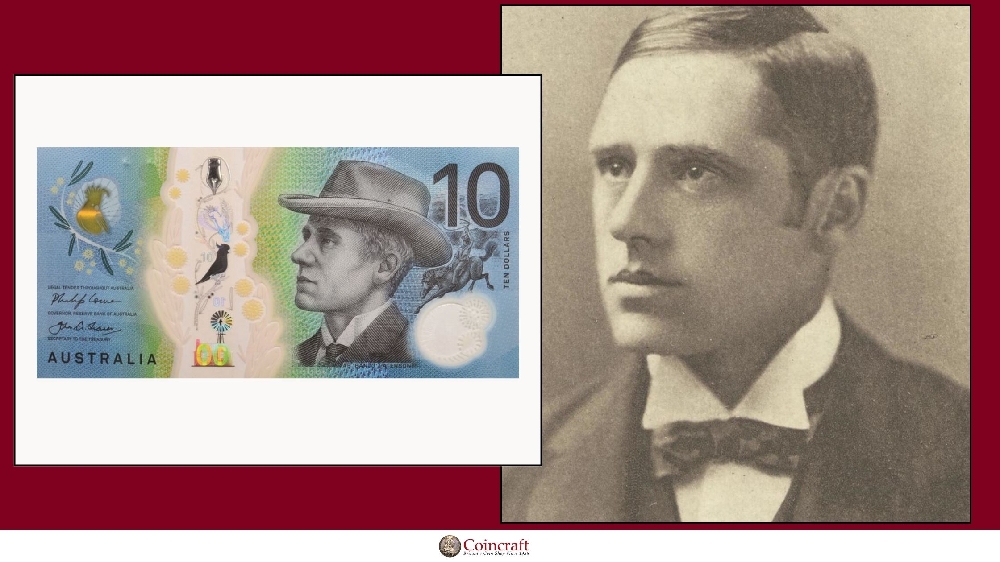
Picture Source of Andrew Barton Paterson: Wikipedia
Andrew Barton "Banjo" Paterson: Architect of the Australian Legend
Andrew Barton Paterson (17 February 1864 – 5 February 1941), widely known as "Banjo" Paterson, was an Australian bush poet, journalist, author, and solicitor. He is one of the most influential figures in Australian literature, primarily responsible for cementing the romanticized image of the Australian bush and its inhabitants into the national consciousness.[1]
Early Life and Education
Paterson was born in Narrambla, near Orange, New South Wales. He spent his early childhood on his family's rural property in the Yass district, where he developed a lifelong affinity for the Australian outback, horses, and the culture of drovers and shearers.
He attended Sydney Grammar School and subsequently matriculated at the University of Sydney. In 1886, Paterson was admitted as a solicitor and formed a legal partnership, practicing law for the next decade while writing in his spare time.
Literary Career and "The Banjo"
Paterson began submitting poetry to The Bulletin, a highly influential Australian literary magazine, in 1889. He used the pseudonym "The Banjo," the name of a favorite racehorse owned by his family.[1]
His writing sharply contrasted with the gloomy, melancholic views of the Australian landscape often depicted by his contemporaries (such as Henry Lawson). Paterson wrote optimistic, rhythmic ballads celebrating the resilience, humor, and freedom of rural Australians.
Major Works:
"Clancy of the Overflow" (1889): A poem contrasting the freedom of a drover's life with the drudgery of city office work.
"The Man from Snowy River" (1890): An epic bush ballad detailing a perilous horseback pursuit of a runaway colt. When published as a collection in 1895 (The Man from Snowy River and Other Verses), the book was an immediate commercial success, outselling any previous Australian literary work.[1]
"Waltzing Matilda" (1895): Paterson wrote the lyrics to what would become Australia's most famous folk song and unofficial national anthem.
Journalism and Military Service
In 1899, Paterson left his law practice to work as a war correspondent. He covered the Second Boer War in South Africa for the Sydney Morning Herald and The Age, where he embedded with cavalry units and met international figures like Winston Churchill and Rudyard Kipling. He later traveled to China to cover the Boxer Rebellion.
During World War I, Paterson volunteered for service. Utilizing his extensive knowledge of horses, he was commissioned into the Australian Remount Service, operating in Egypt. He commanded a unit responsible for training and managing horses for the Australian Light Horse regiments, eventually rising to the rank of Major.[2]
Later Life and Legacy
Following WWI, Paterson returned to Australia and resumed his career in journalism, taking on various editorial roles for Sydney newspapers. He continued to write essays, short stories, and verse until his death from a heart attack in Sydney on 5 February 1941.
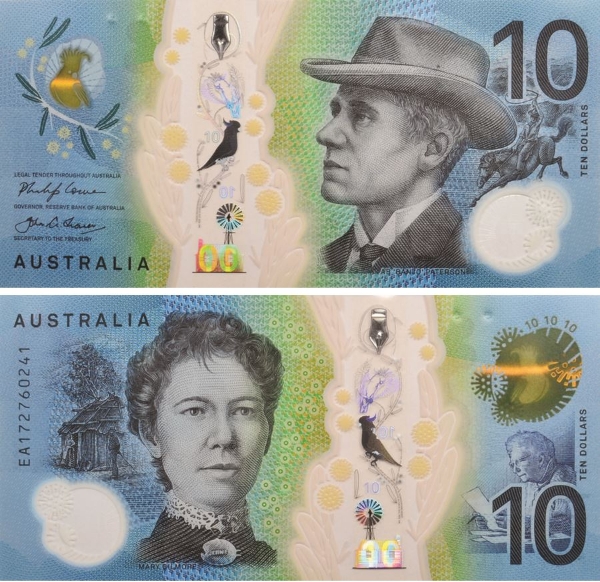
Andrew Barton Paterson's cultural impact on Australia is permanent. His work defined the archetype of the quintessential Australian—resourceful, egalitarian, and deeply connected to the land. His legacy is formally recognized by his inclusion on the Australian ten-dollar note, which features his portrait alongside the text of "The Man from Snowy River."[3]
References
[^1]: Semmler, Clement. "Paterson, Andrew Barton (Banjo) (1864–1941)." Australian Dictionary of Biography, National Centre of Biography, Australian National University, published first in hardcopy 1988, accessed online.
[^2]: Australian War Memorial. "Major Andrew Barton 'Banjo' Paterson." Profiles/People, awm.gov.au.
[^3]: Reserve Bank of Australia. "$10 Banknote." Banknotes in Circulation, rba.gov.au.