.jpg)
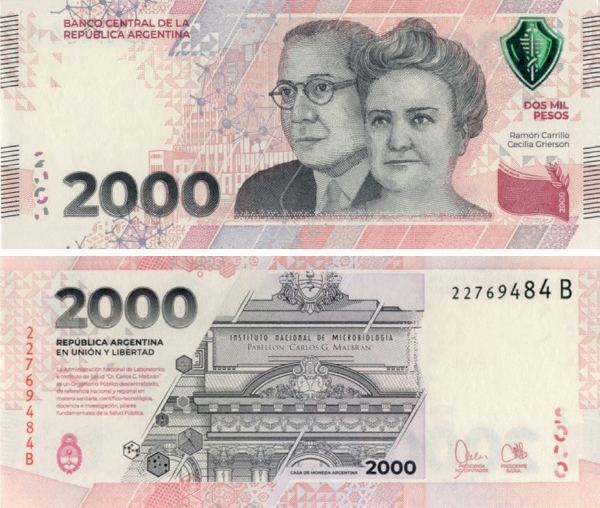
Picture Source of Ramon Carillo & Cecilia Grierson: Pagina 12
Ramón Carrillo: Argentina's First Minister of Health
Ramón Carrillo (March 7, 1906 - December 20, 1956) was an Argentine neurosurgeon, neurobiologist, physician, and public health advocate who became Argentina's first Minister of Public Health, serving from 1949 to 1954 under President Juan Perón.
Born in Santiago del Estero, Argentina, Carrillo studied at the University of Buenos Aires School of Medical Sciences, graduating in 1929. He furthered his education in Europe, studying in Paris and Berlin before returning to Argentina. By 1942, at just 36 years old, he became Chair of Neurosurgery at the University of Buenos Aires School of Medicine despite significant opposition from conservative colleagues.
Carrillo's career took a political turn when he met Colonel Juan Domingo Perón while working as Head of the Neurology and Neurosurgery Service at the Central Military Hospital. Their discussions about national health policy led to Carrillo's appointment as head of the State Secretary of Public Health following Perón's election to the presidency in 1946. When this office was elevated to a cabinet-level ministry, Carrillo became Argentina's first Minister of Public Health on March 11, 1949.
His tenure as Health Minister brought unprecedented advances in Argentine public health:
- Doubled the number of hospital beds from 66,300 in 1946 to 132,000 in 1954
- Built 234 free, public hospitals and policlinics
- Eradicated endemic diseases like malaria in just two years through aggressive vector control campaigns
- Dramatically reduced the tuberculosis mortality rate from 130 to 36 per 100,000
- Decreased infant mortality from 90 to 56 per thousand live births
- Virtually eliminated syphilis and other venereal diseases
- Carrillo is remembered for his dedication to preventive medicine and his belief that "there cannot be an effective social policy without an economy organized to benefit the greater part of the population. In the field of health, scientific achievements are only useful when they reach the whole population."
Despite his achievements, Carrillo's legacy was somewhat forgotten after his resignation in 1954. He died two years later in Belém, Brazil at the age of 50. In 2005, the Argentine government declared 2006 as the "Year of Honor to Ramón Carrillo," finally recognizing his monumental contributions to public health.
Cecilia Grierson: Argentina's First Female Physician
Cecilia Grierson (November 22, 1859 - April 10, 1934) was a pioneering Argentine physician, reformer, nurse educator, and feminist who made history as the first woman to receive a Medical Degree in Argentina.
Born in Buenos Aires, Grierson began her career as a teacher before entering medical school in her late twenties. She faced tremendous obstacles in her pursuit of medical education. Women were barred from the Faculty of Medicine at the nation's universities, and she was required to provide written justifications for her motivation to become a doctor. Despite these barriers, she persevered and graduated in 1889 with her thesis on gynecology, becoming Argentina's first female physician.
Throughout her career, Grierson made remarkable contributions across numerous fields:
- Founded Argentina's first nursing school at Hospital Británico de Buenos Aires in 1890
- Established the Argentine First Aid Society in 1892 after attending the Third International Conference of the Red Cross
- Became a founding member of the Argentine Medical Association in 1891
- Created the National Obstetrics Association in 1901 and its journal, Revista Obstétrica
- Founded the Society for Domestic Economy in 1902, which later became the Technical School for Home Management
- Pioneered kinesiology in Argentina, introducing massage therapy courses at the Faculty of Medicine
- Authored several important textbooks including "The Education of the Blind," "Patient Care," and the "First National Nursing Textbook"
Beyond her medical achievements, Grierson was a champion for women's rights and education. She founded the Argentine Women's Council in 1900 and co-founded the Association of Argentine University Women, which campaigned against women's inferior legal status. She advocated for better social welfare programs for working-class women and provided free consultations for children with special needs, particularly those who were blind or deaf.
Grierson retired from academia in 1916 but continued to work as a family physician and teacher until her death in 1934 at the age of 74. Her legacy as a pioneering feminist who advocated for health, social benefits, and equality for women continues to inspire. In recognition of her historical importance, the Argentine government featured Grierson alongside Ramón Carrillo on a new 2,000 peso banknote.