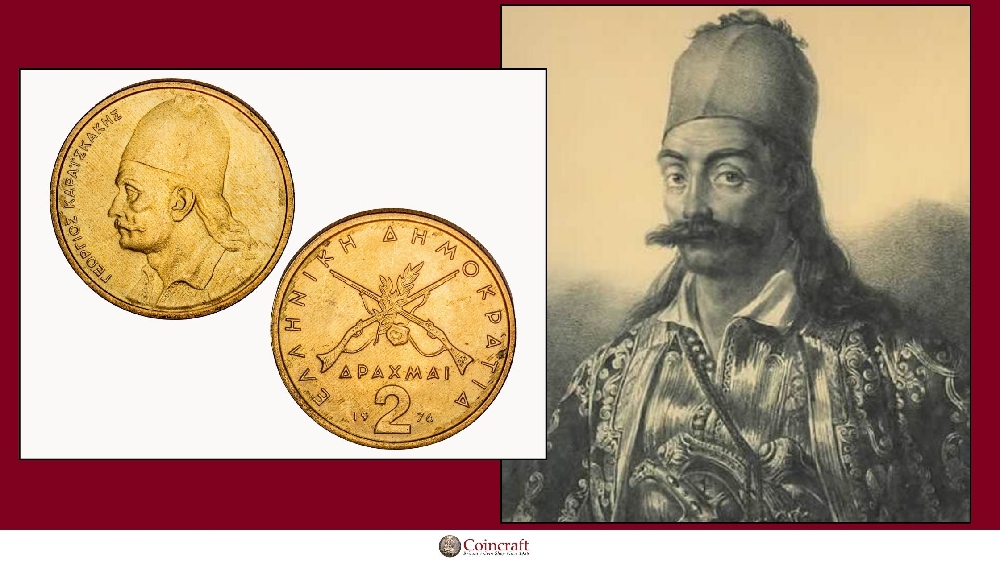
Picture Source of Georgios Karaiskakis: Wikipedia
The Nun's Son Who Became a Legend: Meeting Georgios Karaiskakis
If you were to picture the ultimate rebel—someone with zero respect for authority, a mouth like a sailor, and the tactical genius of a grandmaster—you’d be picturing Georgios Karaiskakis. In the pantheon of Greek revolutionary heroes, he stands out not just for his bravery, but for being completely, unapologetically wild.
Known as "The Nun's Son" (O Yios tis Kalogrias), Karaiskakis rose from being an illegitimate outcast to becoming the Commander-in-Chief of the Greek forces in Central Greece. He was a man who could charm a warlord one minute and insult a Sultan the next. Let’s dive into the life of the man who terrified the Ottoman Empire and helped birth modern Greece.
Key Takeaways
A Rough Start: Born illegitimate and poor, Karaiskakis survived a harsh childhood to become one of Greece's most celebrated military commanders.
Tactical Genius: His victory at the Battle of Arachova is considered one of the most brilliant strategic moves of the entire Greek War of Independence.
A Complex Character: Known for his crude humor and shifting allegiances early on, he eventually matured into a committed patriot who died for the cause.
The "Nun's Son": His famous nickname came from his mother, Zoe Dimiski, who was a nun when she gave birth to him¹.
The Early Days: Born in the Shadows
Georgios was born around 1780 or 1782 in a cave near the village of Mavrommati (though some sources argue Skoulikaria). His start in life wasn't easy. He was the illegitimate son of Zoe Dimiski, a nun, and the armatolos (militia captain) Dimitris Iskos². Because of this scandal, he was known throughout his life simply as "The Nun's Son."
Growing up ostracized and poor, Georgios didn't have time for self-pity. Instead, he became tough. Really tough. As a teenager, he joined a band of klephts (mountain bandits/rebels) led by the famous captain Katsantonis³. It was here, in the rugged mountains, that he learned the art of guerilla warfare—ambushes, lightning-fast raids, and survival.
The University of Ali Pasha
In a twist of fate that sounds like a movie script, the 15-year-old Karaiskakis was captured by the troops of Ali Pasha, the fearsome Ottoman ruler of Ioannina. But instead of executing the young rebel, Ali Pasha was impressed. He saw a spark in Georgios—a mix of recklessness and intelligence.
Ali Pasha released him and actually hired him as a personal bodyguard⁴. For over a decade, Karaiskakis served in Ali Pasha's court. This wasn't just a job; it was an education. He learned Albanian, studied Ottoman military tactics from the inside, and honed his fighting skills. However, true to his rebellious nature, he eventually lost favor and fled back to the mountains to resume his life as a klepht when the Greek Revolution began to stir⁵.
A traditional depiction of the fierce commander.
The Revolution and The Eagle of Roumeli
When the Greek War of Independence broke out in 1821, Karaiskakis didn't immediately become the saintly hero we see on statues today. Like many armatoloi of the time, he was pragmatic, sometimes making temporary truces (kapakia) with the Ottomans to protect his territory⁶.
But as the war dragged on, something changed. He realized that a free Greece needed a stable government and a unified army. Despite suffering from advanced tuberculosis—which often left him bedridden—he fought with ferocious intensity.
His defining moment came in November 1826 at the Battle of Arachova.
It was a masterclass in strategy. Karaiskakis and his men trapped a massive force of Turkish and Albanian troops in the freezing mountains. In the snowy terrain, the Greeks crushed the enemy, killing over 2,000 soldiers, including their commanders⁷. This victory wasn't just a military win; it was a massive morale booster for the revolution when hope was running thin. By this time, he was effectively the Commander-in-Chief of the revolutionary forces in Roumeli (Central Greece).
A Personality Larger Than Life
We can't talk about Karaiskakis without mentioning his... colorful vocabulary. He was famous for his "profane" letters to Ottoman commanders. In one legendary exchange with an Ottoman emissary who asked him to surrender, Karaiskakis reportedly replied with a barrage of insults so creative and vulgar that they are still quoted in Greece today (usually with a lot of bleeping!)⁸.
He was known to be foul-mouthed, impulsive, and skinny from illness, yet he commanded absolute loyalty from his men because he led from the front.
The Final Battle
In April 1827, the Greek forces were attempting to lift the siege of the Acropolis in Athens. On his name day, April 23rd, Karaiskakis—ill and feverish—rode out to check on a minor skirmish in Faliro.
Tragedy struck. He was hit by a rifle bullet in the belly. Knowing the wound was fatal, he was carried to his ship. Legend says his last words to his compatriots were to stick together and save the country. He died the next day, on April 24, 1827⁹.
His death was a devastating blow. The Greeks lost the subsequent Battle of Phaleron, and the Acropolis surrendered shortly after. However, his legacy was already cemented. He had proven that a ragtag group of rebels could defeat an empire.
FAQs
1. Why was he called "The Nun's Son"? He was given the nickname O Yios tis Kalogrias because his mother, Zoe Dimiski, was a nun at a local monastery when she gave birth to him. It was a mark of his illegitimate status, which he wore as a badge of toughness throughout his life¹.
2. Is it true he was sick during his battles? Yes. For much of his later military career, Karaiskakis suffered from severe tuberculosis. There were times he had to be carried on a stretcher, yet he continued to plan battles and command his troops from his sickbed⁵.
3. Where is he buried? According to his wishes, he was buried on the island of Salamis, at the Church of Saint Dimitrios. He wanted to rest in the soil of the place that had served as a base for his operations in Attica⁹.
References
Britannica, T. Editors of Encyclopaedia (2024). Georgios Karaiskakis. [online] Encyclopedia Britannica. Available at: https://www.britannica.com/biography/Georgios-Karaiskakis [Accessed 20 Nov. 2025].
The National Herald (2023). Georgios Karaiskakis – One of the Heroes of the Greek War of Independence. [online] Available at: https://www.thenationalherald.com/georgios-karaiskakis-one-of-the-heroes-of-the-greek-war-of-independence/ [Accessed 20 Nov. 2025].
Kiddle Encyclopedia (2024). Georgios Karaiskakis Facts for Kids. [online] Available at: https://kids.kiddle.co/Georgios_Karaiskakis [Accessed 20 Nov. 2025].
Greek Military (n.d.). Karaiskakis Georgios. [online] Available at: http://greekmilitary.net/konstantinoupoli/1821/fort1821/karaiskakis.html [Accessed 20 Nov. 2025].
Razos Windmill (n.d.). Karaiskakis (1821 Hero) House – Kioni Village. [online] Available at: https://www.razoswindmill.gr/index.php/karaiskaki_home/?lang=en [Accessed 20 Nov. 2025].
ResearchGate (2016). Cursing with a Message: the Case of Georgios Karaiskakis in 1823. [online] Available at: https://www.researchgate.net/publication/270610049_Cursing_with_a_Message_the_Case_of_Georgios_Karaiskakis_in_1823 [Accessed 20 Nov. 2025].
Discover Arta (n.d.). Georgios Karaiskakis. [online] Available at: https://discoverarta.gr/en/personalities/georgios-karaiskakis/ [Accessed 20 Nov. 2025].
Greece High Definition (2021). The insults and curses of the 1821 Revolutionaries - Studying Georgios Karaiskakis. [online] Available at: https://www.greecehighdefinition.com/blog/the-insults-and-curses-of-the-1821-revolutionaries-georgios-karaiskakis [Accessed 20 Nov. 2025].
Hellenica World (n.d.). Georgios Karaiskakis. [online] Available at: https://www.hellenicaworld.com/Greece/Person/en/GeorgiosKaraiskakis.html [Accessed 20 Nov. 2025].