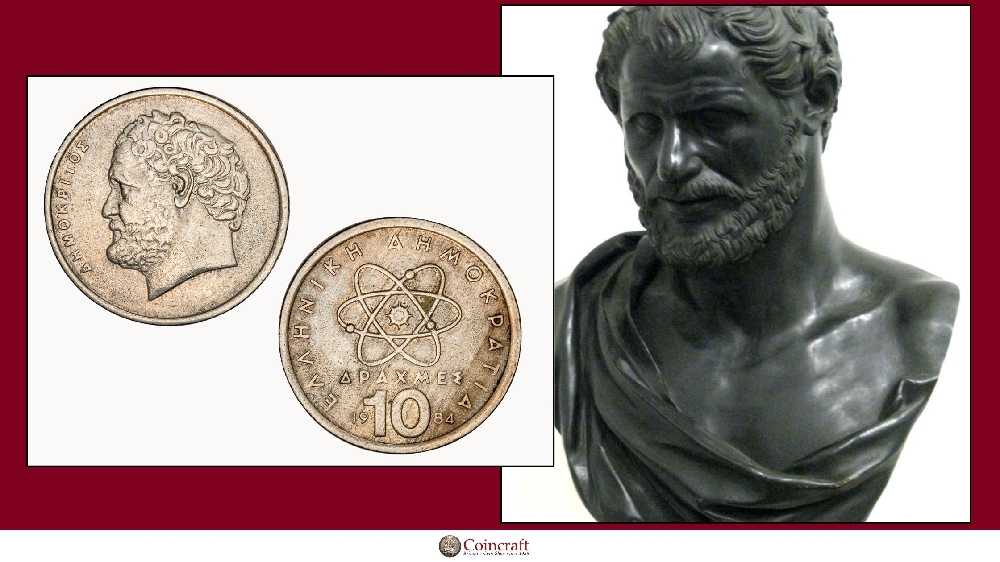
Picture Source of Democritus: Wikipedia
The Laughing Philosopher Who Invented the Atom
Ever heard of someone being called the "laughing philosopher"? It sounds like a pretty great nickname, and it belonged to a man who, around 400 B.C., came up with an idea that would change the world—though he wouldn't live to see it.
His name was Democritus, and he’s one of the most fascinating and forward-thinking minds of ancient Greece. While his contemporaries Plato and Aristotle were getting a lot of the limelight (and their work would dominate Western thought for centuries), Democritus was proposing a theory that sounds shockingly modern.
Who Was This Guy?
Democritus was born in Abdera, Thrace, around 460 B.C. He came from a wealthy family, and after his father passed, he took his inheritance and spent it all on one thing: travel.
And I don't mean a quick trip to the next island over. Democritus traveled everywhere. Ancient accounts (like those from the biographer Diogenes Laërtius, who wrote Lives of the Eminent Philosophers) [1] say he went to Egypt, Ethiopia, Persia, and maybe even India. He wasn't a tourist; he was a student of the world, soaking up knowledge from mathematicians, astronomers, and thinkers from totally different cultures.
When he finally returned to his hometown, he was (predictably) broke, but his mind was overflowing with ideas.
Why "Laughing"?
This is the best part. Democritus earned his nickname because he was apparently always cheerful and often seen laughing. The Roman poet Horace even mentioned him, writing about "the laughing Democritus." [2] But he wasn't laughing at people. He was laughing at the absurdity and silliness of human behavior—our petty ambitions, our anxieties, our self-importance.
He believed the goal of life was "cheerfulness" (or euthymia), a concept detailed in his surviving ethical fragments. [3] He defined this as a calm, content state of mind, free from fear and superstition. While everyone else was stressing about angry gods and the afterlife, Democritus was busy being amused by the universe and finding joy in understanding it.
The Big Idea: "Atomos"
Here's his claim to fame. Democritus (building on the ideas of his mostly unknown teacher, Leucippus) looked at the world and asked a simple question: If you cut something in half, and then cut that half in half, and keep going... can you do that forever?
His answer was no.
He reasoned that eventually, you must hit a particle so incredibly tiny that it cannot be cut any further. He called this particle "atomos," which literally means "uncuttable."
This was the birth of atomic theory. His idea was simple but profound:
Everything is made of atoms. You, me, this screen, the air, everything.
These atoms are eternal. They are indivisible, indestructible, and have always existed.
They move in a void. Between the atoms is just empty space (the "void"), which allows them to move, collide, and link up.
Atoms make up everything. The differences we see in the world—a rock being hard, water being wet—are just different combinations, shapes, and arrangements of these atoms.
Think about how wild this was. He proposed this 2,400 years ago, with no microscopes, no particle accelerators, just pure logic. He was suggesting that the entire universe, in all its complexity, was just tiny particles bouncing in the dark. As you can imagine, this idea didn't sit well with thinkers like Plato, who (according to Diogenes Laërtius) [1] disliked his ideas so much he wanted his books burned.
So... Was He Right?
Yes and no.
Where he was wrong: Democritus's atoms aren't our atoms. We now know that modern atoms are very much "cuttable" into protons, neutrons, and electrons (and those into even smaller quarks). He also didn't have any experimental evidence; it was a brilliant philosophical guess.
Where he was stunningly right: The core concept. The idea that all matter is composed of fundamental building blocks. The belief that the universe operates on natural, mechanical laws rather than the whims of the gods. It was this seed of an idea that was rediscovered during the Renaissance and set the stage for scientists like John Dalton, who (over 2,000 years later) would lay the foundation for modern, scientific atomic theory.
Democritus was a man so far ahead of his time that his ideas had to wait millennia for humanity to catch up. He saw the world not as a magical stage, but as a fascinating, explainable machine. And best of all, he found that whole thing incredibly amusing.
Key Takeaways
He's the "Laughing Philosopher": Democritus was known for his cheerful outlook and his tendency to laugh at the absurdities of human life, a trait noted by ancient writers like Horace. [2]
He Invented Atomic Theory: He proposed that everything is made of tiny, indivisible, and indestructible particles called "atomos" (uncuttable), an idea he developed from his teacher Leucippus.
He Believed in the Void: He was one of the first to argue for the existence of empty space, which he called "the void," allowing atoms to move.
He Was a Materialist: He believed that everything, including the human soul, was made of atoms—a purely physical explanation for the universe, as detailed in testimonies from Aristotle. [4]
He Was Way Ahead of His Time: His ideas were largely dismissed in favor of Aristotle's but were revived over 2,000 years later to form the basis of modern chemistry and physics.
Frequently Asked Questions (FAQs)
Q: Did people believe Democritus's atomic theory at the time? A: Not really. His ideas were overshadowed by the much more influential philosophers Plato and Aristotle. Aristotle, for example, argued extensively against atomism in his works like On Generation and Corruption. [4] He rejected the idea of a void and instead favored his own concept of the four elements (earth, air, fire, water), and his view dominated science and philosophy for nearly two thousand years.
Q: Why is he less famous than Plato or Aristotle? A: A few reasons. First, Plato and Aristotle's philosophies were more complete systems that covered ethics, politics, and purpose, which appealed to later Christian and Islamic thinkers. Democritus's stark materialism (no gods, no afterlife, just atoms) was less popular. Also, very few of his original writings survived. We mostly know about him from what other people (like Aristotle, who often argued against him [4], or the later biographer Diogenes Laërtius) [1] wrote about his ideas.
Q: Did he write about anything besides atoms? A: Oh, yes! Ancient sources, particularly the list provided by Diogenes Laërtius, [1] say he was a polymath who wrote over 70 books on everything from ethics and mathematics to music, astronomy, and even biology. Sadly, almost none of them survived the centuries intact.
References
[1] Laërtius, D. (c. 3rd Century AD). Lives of the Eminent Philosophers, Book IX, "Democritus."
[2] Horace. (c. 20 BC). Epistles, Book II, Epistle I, line 194.
[3] Democritus. (c. 5th-4th Century BC). Ethical Fragments. (Surviving fragments discussed at Internet Encyclopedia of Philosophy).
[4] Aristotle. (c. 4th Century BC). On Generation and Corruption (De Generatione et Corruptione).