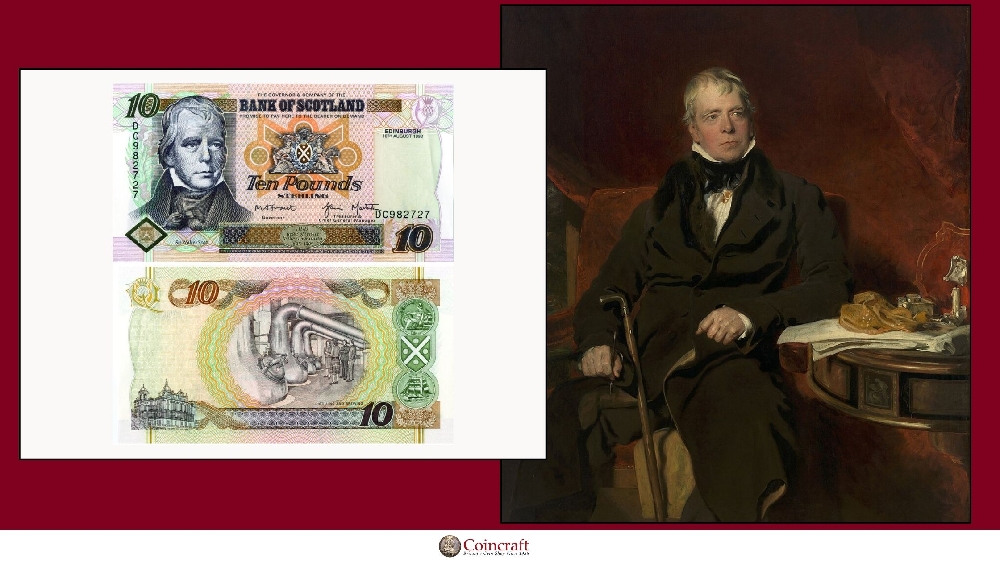
Picture Source of Sir Walter Scott: Wikipedia
The Wizard of the North: The Life and Legend of Sir Walter Scott
When you think of Scotland, what comes to mind? Misty highlands, tartan kilts, perhaps the romantic tragedies of the Jacobite risings? Well, you might be surprised to learn that much of this iconic Scottish imagery was popularized, and in some cases, single-handedly revived, by one man: Sir Walter Scott.
He wasn't just a writer; he was a literary rockstar of the 19th century, the first true international bestseller, and a man whose personal life was as dramatic and noble as any of the heroes in his novels. Whether you've slogged through Ivanhoe in school or just walked past his towering gothic monument in Edinburgh, there is so much more to this man than dusty old books. Let’s dive into the incredible life of the "Wizard of the North."
Key Takeaways
Inventor of the Historical Novel: Scott is widely credited with creating the modern historical novel, blending fictional characters with real historical events to make history feel alive and immediate.
A Man of Honour: When faced with a financial debt equivalent to millions today, he refused bankruptcy and literally worked himself to death to pay back every penny.
Saviour of the Crown Jewels: He was responsible for rediscovering the "Honours of Scotland" (the Scottish Crown Jewels), which had been lost and locked away for over a century.
The "Great Unknown": For years, he published his wildly popular novels anonymously, becoming the subject of intense public speculation before finally revealing his identity.
Architect of Scottish Identity: Through his writing and his orchestration of King George IV's visit to Scotland, he helped popularize tartan and the highland culture that is now synonymous with Scotland worldwide.
From Edinburgh Wynds to Border Ballads
Born on August 15, 1771, in a cramped third-floor flat in Edinburgh's College Wynd, Walter Scott didn't have the easiest start.^1^ As a toddler, he contracted polio, which left him with a permanent limp. To help his health, his parents sent him away from the smoggy city to his grandparents' farm in the Scottish Borders.
This twist of fate turned out to be the making of him. Sitting at the feet of his grandmother and aunt, young Walter soaked up oral histories, legends of border raids, and tragic ballads like a sponge.^2^ These stories of moonlight rides and clan feuds became the DNA of his future work.
Portrait of Sir Walter Scott by Sir Henry Raeburn, 1822.
The Lawyer Who Loved Poetry
Scott followed in his father's footsteps and became a lawyer (an advocate), donning the wig and gown in Edinburgh. But while he was a competent legal mind, his heart belonged to storytelling. He spent his court holidays roaming the countryside, collecting old songs.
He first found fame not as a novelist, but as a poet. Works like The Lay of the Last Minstrel and The Lady of the Lake were massive hits. In fact, The Lady of the Lake was so popular that it single-handedly launched the tourism industry in the Trossachs, with crowds flocking to see the landscapes he described.^3^
The "Great Unknown"
By the 1810s, poetry was getting a new, flashy star named Lord Byron, and Scott saw his sales dipping. So, he made a pivot that changed literature forever. He rummaged through his desk, found an unfinished manuscript, and published Waverley in 1814.
But here's the kicker: he didn't put his name on it.
Waverley was an instant smash. It was arguably the world's first historical novel, treating the past not just as a backdrop, but as a dynamic force affecting the characters.^4^ He followed it up with hit after hit—Rob Roy, Ivanhoe, The Heart of Midlothian—all published as being by "The Author of Waverley." The public went wild trying to guess who this "Great Unknown" was, even though many locals in Edinburgh had a pretty good idea!
The Crash: A Heroic Struggle
If Scott's life was a novel, this would be the tragic plot twist. In 1825, a banking crisis swept through Britain. Scott was a silent partner in the printing and publishing firms that produced his books, and when they collapsed, they took him down with them.
He was left with a debt of roughly £130,000. In today's money, that is an eye-watering sum—estimates suggest it would be over £13 million.^5^
Most people would have declared bankruptcy and walked away. Scott refused. He viewed it as a debt of honour. He famously vowed, "My own right hand shall do it," meaning he would write his way out of debt. And he did. He spent the last years of his life writing furiously, churning out pages despite suffering from strokes and failing health. It was a heroic, if heartbreaking, end to his life. He died in 1832, his body exhausted, but his honour intact.
"Oh! what a tangled web we weave / When first we practise to deceive!" — Sir Walter Scott, Marmion^6^
Rediscovering the Honours
One of my favourite anecdotes about Scott isn't even about his books—it's about his Indiana Jones moment. The "Honours of Scotland" (the crown, sceptre, and sword of state) had been locked away in a chest in Edinburgh Castle after the Act of Union in 1707 and essentially forgotten. Rumours swirled that they had been secretly taken to England.
In 1818, Scott convinced the Prince Regent (later George IV) to let him search the castle. With a team of officials, they broke open the sealed room and the great oak chest. There, amidst the dust, lay the Honours, safe and sound. Scott was so overcome with emotion that he reportedly threatened to fight anyone who touched them disrespectfully!^7^
FAQs
Q: Did Sir Walter Scott really invent the historical novel? A: Most literary scholars agree that he did. Before Scott, novels set in the past were often just modern stories in fancy dress (Gothic romances). Scott was the first to seriously explore how social and historical forces shape individuals, influencing everyone from Charles Dickens to Tolstoy.^4^
Q: What is his connection to the word "glamour"? A: We use the word "glamour" today to mean beauty or style, but Scott introduced it into the English literary vocabulary. He took an old Scots word, gramarye, which meant a magic spell or enchantment that altered how things appeared, and popularized it as "glamour."^8^
Q: Why is there a massive monument to him in Edinburgh? A: The Scott Monument on Princes Street is the second-largest monument to a writer in the world! It was built by a grateful nation not just for his books, but because he gave Scotland a renewed sense of pride and identity after decades of cultural suppression following the Jacobite rebellions.
References
Historic UK (n.d.) Sir Walter Scott, his Life and Works. Available at: https://www.historic-uk.com/HistoryUK/HistoryofScotland/Sir-Walter-Scott/ (Accessed: 19 December 2025).
Scottish Tours (n.d.) The Amazing Life of Walter Scott Blog. Available at: https://www.scottishtours.co.uk/blog/the-amazing-life-of-walter-scott/ (Accessed: 19 December 2025).
Britannica (2025) Sir Walter Scott | Biography & Facts. Available at: https://www.britannica.com/biography/Walter-Scott (Accessed: 19 December 2025).
TheCollector (2025) How Sir Walter Scott Turned History into Fiction. Available at: https://www.thecollector.com/sir-walter-scott-history-fiction/ (Accessed: 19 December 2025).
The Walter Scott Club (2021) The Financial Ruin of Sir Walter Scott. Available at: https://www.walterscottclub.com/blog/ray-perman-the-financial-ruin-of-sir-walter-scott-and-how-he-got-out-of-it (Accessed: 19 December 2025).
Historic UK (n.d.) Sir Walter Scott, his Life and Works. Available at: https://www.historic-uk.com/HistoryUK/HistoryofScotland/Sir-Walter-Scott/ (Accessed: 19 December 2025).
Airhouses (2020) Five Amazing Facts about Sir Walter Scott. Available at: https://airhouses.com/five-amazing-facts-about-sir-walter-scott/ (Accessed: 19 December 2025).
The Scots Magazine (n.d.) Scottish History In Minutes – The Life Of Sir Walter Scott. Available at: https://www.scotsmagazine.com/articles/scottish-history-sir-walter-scott/ (Accessed: 19 December 2025).