
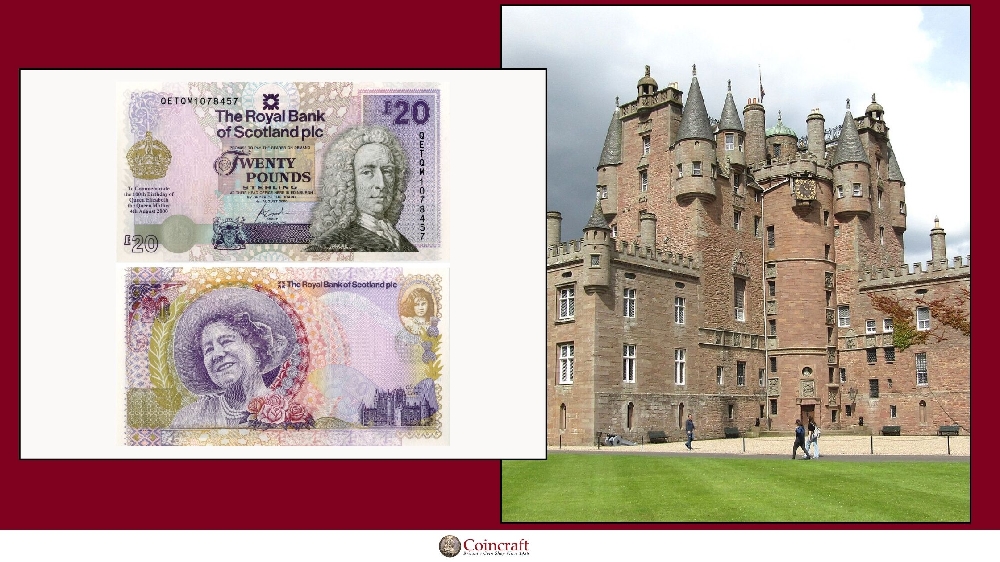
Picture Source of Glamis Castle: Wikipedia
The Dark Fairy Tale of Glamis Castle: Royals, Witches, and Secret Rooms
If you were to close your eyes and picture the ultimate storybook castle, you’d probably imagine something very much like Glamis Castle. With its soaring turrets, red sandstone walls, and sweeping lawns, it looks like it was plucked straight out of a Disney movie. But don’t let that fairy-tale façade fool you. Behind those majestic walls lies a history teeming with dark secrets, royal intrigue, and enough ghost stories to keep you up for a week.
Located in the heart of Angus, Scotland, Glamis (pronounced Glahms) isn't just a dusty old monument; it’s a living, breathing home that has witnessed over 600 years of Scottish history. It’s the childhood playground of the Queen Mother, the legendary setting of Shakespeare’s Macbeth, and—if the rumors are true—the hiding place of a terrible secret that was kept for generations.
So, grab a cup of tea (or maybe something stronger to steady your nerves), and let’s explore the fascinating, beautiful, and slightly terrifying world of Glamis Castle.
Key Takeaways
A Royal Sanctuary: Glamis was the beloved childhood home of Queen Elizabeth The Queen Mother and the birthplace of Princess Margaret.
The Macbeth Connection: While Shakespeare set his famous tragedy here, the real King Macbeth had no actual connection to the castle.
Scotland’s Most Haunted: With at least nine reported ghosts, including the famous "Grey Lady" and "Earl Beardie," it holds the title of Scotland’s most haunted castle.
The Secret Room: Legend says a hideously deformed heir was bricked up alive in a secret chamber, sparking the mystery of the "Monster of Glamis."
Architectural Marvel: The castle is a stunning example of Scottish Baronial architecture, modeled on the style of a French château.
A Stonebook of History
The land around Glamis has been a royal hunting ground for over a thousand years, but the castle as we know it began its journey in 1372. That year, King Robert II granted the land to Sir John Lyon, and the estate has remained in the Lyon (later Bowes-Lyon) family ever since. That’s over six centuries of the same family drama playing out in the same halls!
While the original structure was a simple L-plan tower house, it underwent a massive makeover in the 17th and 18th centuries. Patrick Lyon, the 3rd Earl of Strathmore, decided the castle needed a bit more je ne sais quoi and remodeled it in the style of a French château^1^. The result is the breathtaking skyline of turrets and towers we see today.
The Royal Connection
For many, Glamis is synonymous with the British Royal Family. It was here that Lady Elizabeth Bowes-Lyon—better known to the world as the Queen Mother—spent her happy childhood. She was the youngest daughter of the 14th Earl, and by all accounts, she was a mischievous child who loved sliding down the banisters and playing pranks on guests.
During World War I, the castle was transformed into a military hospital. A teenage Lady Elizabeth helped care for the wounded soldiers, showcasing the warmth and resilience that would later define her time as Queen during the Blitz^2^.
In 1930, the castle made headlines again when Princess Margaret was born there. She was the first royal baby born in Scotland since King Charles I in 1600. The castle’s archives are still packed with letters and photographs offering an intimate glimpse into the private lives of the royals who saw Glamis not as a monument, but as home.
The Macbeth Myth
"All hail, Macbeth! Hail to thee, Thane of Glamis!"
It’s one of the most famous lines in English literature. William Shakespeare chose Glamis Castle as the home of his tragic anti-hero, Macbeth. In the play, Duncan is murdered here, and the castle becomes a place of blood and madness.
But here’s the reality check: The historical King Macbeth (who died in 1057) had absolutely nothing to do with Glamis Castle^3^. The castle wasn’t even built during his lifetime! Shakespeare, ever the dramatist, likely used the location to flatter King James VI of Scotland (later James I of England), who had ancestors connected to the area. While you won't find Macbeth’s ghost, you can walk the "Macbeth Trail" in the gardens, which features sculptures depicting scenes from the play.
Shadows and Whispers: The Ghosts of Glamis
Now, let’s get to the spooky stuff. Glamis is widely cited as the most haunted castle in Scotland, and honestly, the stories are enough to make your hair stand on end.
The Monster of Glamis
This is the big one. The legend dates back to 1821, when the first son of the 11th Earl was born. Records say the baby died within hours, but local rumors painted a darker picture. The story goes that the child—Thomas Bowes-Lyon—was born with severe deformities. Rather than accept him, the family allegedly bricked him up in a secret chamber within the 16-foot-thick walls, where he was kept alive for decades^4^.
It is said that only the Earl, his heir, and the estate factor knew the secret. Old guests reported hearing strange shuffling noises in the walls. In one famous story, a group of guests tried to find the hidden room by hanging towels from every window in the castle. When they went outside to look, they found one window—high up in the tower—had no towel.
The Grey Lady
The most frequently sighted ghost is the Grey Lady, believed to be the spirit of Lady Janet Douglas. Her story is a tragedy of game-of-thrones proportions. In 1537, King James V, who hated her family (the Douglases), accused her of witchcraft and plotting to poison him. Despite a lack of evidence, she was burned at the stake at Edinburgh Castle. Her hollow-eyed ghost is said to haunt the family chapel at Glamis, where a seat is always left empty for her.
Earl Beardie
If you hear swearing and the rattle of dice late at night, you might be hearing Earl Beardie. Legend has it that a nobleman (often identified as the Earl of Crawford) demanded a game of cards on the Sabbath. When his hosts refused, he flew into a rage and declared he would play with the Devil himself. A stranger in black appeared, offered to play, and eventually claimed the Earl's soul. He is now condemned to play cards in a sealed room until Doomsday^5^.
Visiting Glamis Today
Despite its grim legends, Glamis Castle today is a welcoming and vibrant place. You can take guided tours through the opulent dining room, the crypt, and the royal apartments. The grounds are equally stunning, featuring an Italian Garden, a Walled Garden, and nature trails that are perfect for a less terrifying walk.
Opening Times: Generally open daily from mid-March to October (10:00 AM – 5:00 PM).
Tickets: Adult admission is around £19.50, which includes the castle and gardens.
FAQs
1. Is Glamis Castle really haunted? While there is no scientific proof of ghosts, Glamis has a reputation as one of the most active paranormal sites in Scotland. Staff and visitors frequently report strange atmospheres, noises, and sightings of figures like the Grey Lady and the Tongueless Woman.
2. Can I visit the secret room where the "Monster" was kept? No. The location of the alleged secret room remains a mystery. While guests in the Victorian era tried to find it, no publicly accessible room has ever been confirmed as the "Monster's" prison, though the castle's thick walls contain many hollow spaces.
3. Was the Queen Mother really born at Glamis? This is actually a subject of debate! While Glamis was her childhood home, some biographers believe she was actually born in London or in a horse-drawn ambulance on the way to the hospital. However, her birth was registered at Glamis, and she always considered it her true home.
References
Historic Environment Scotland. (n.d.). Glamis Castle (Garden and Designed Landscape). [Online]. Available at: http://portal.historicenvironment.scot/designation/GDL00189 [Accessed 17 February 2026].
Glamis Castle. (2025). Queen Elizabeth The Queen Mother. [Online]. Available at: https://www.glamis-castle.co.uk/castle-gardens/about-glamis-castle/the-queen-mother/ [Accessed 17 February 2026].
Dorman, C. (2022). Macbeth: Shakespeare versus Scottish History. Moonfish Writing. [Online]. Available at: https://www.moonfishwriting.com/post/macbeth-shakespeare-versus-scottish-history [Accessed 17 February 2026].
Dash, M. (2013). The Monster of Glamis. Smithsonian Magazine. [Online]. Available at: https://www.smithsonianmag.com/history/the-monster-of-glamis-92015626/ [Accessed 17 February 2026].
Haunted Rooms. (2025). The Ghosts of Glamis Castle. [Online]. Available at: https://www.hauntedrooms.co.uk/glamis-castle-angus-scotland [Accessed 17 February 2026].