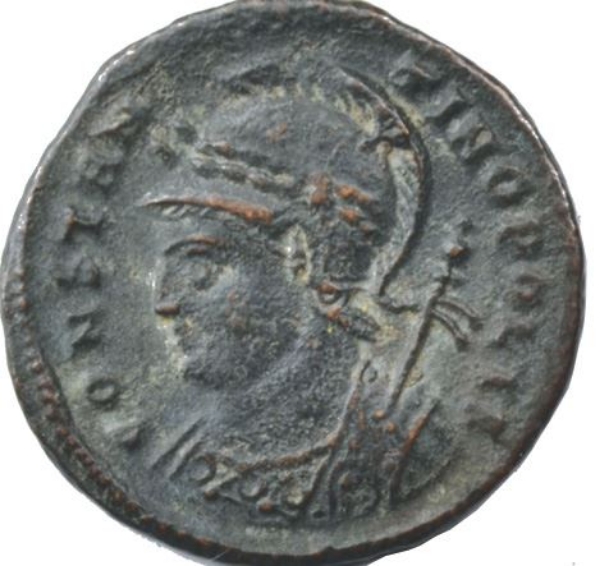
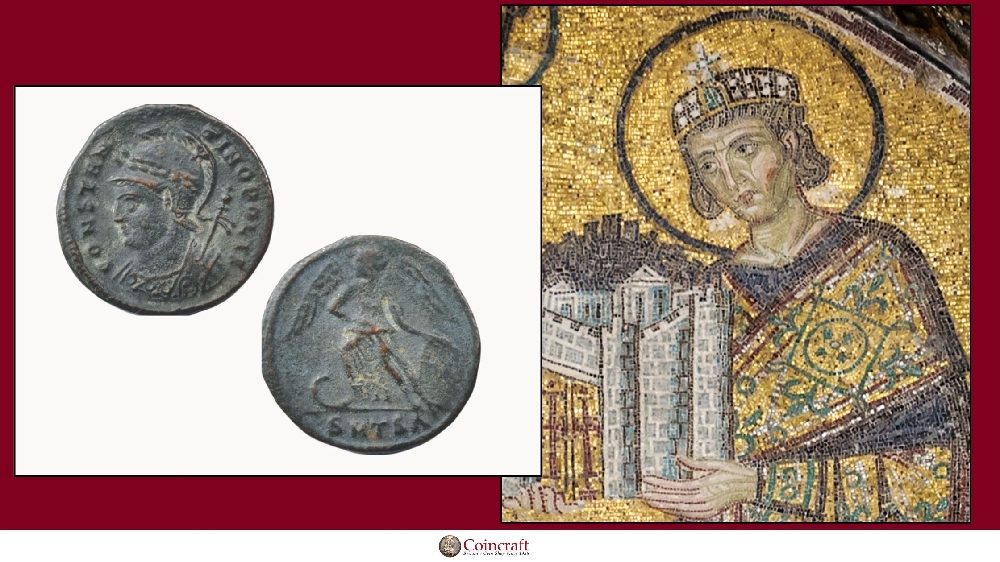
Picture Source of Emperor Constantine I presents a representation of the city of Constantinople as tribute to an enthroned Mary and Christ Child in this church mosaic. Hagia Sophia, c. 1000.
The Queen of Cities: The Epic Biography of Constantinople
Today, we are doing something a little bit different. Usually, we dive into the lives of fascinating men and women who shaped our world. But today? We are looking at the biography of a place. And not just any place—we are exploring the epic, tumultuous, and utterly awe-inspiring life story of a city that literally bridged two continents and two eras of human history.
Grab your favorite warm beverage, get comfortable, and let’s travel back in time to meet the legendary city of Constantinople. Whether you know it as Byzantium, the "New Rome," or modern-day Istanbul, this city has a life story filled with imperial drama, impenetrable walls, architectural marvels, and a final, heroic stand that changed the world forever. Let's dive in!
Key Takeaways
A Strategic Masterpiece: Founded as "New Rome" by Constantine the Great in 330 AD, the city's geographical position between Europe and Asia made it the ultimate powerhouse of trade and military strategy.
The Impregnable Fortress: Thanks to the legendary Theodosian Walls, Constantinople survived dozens of sieges over a millennium, protecting the Christian Byzantine Empire from total collapse.
Architectural Wonder: It was home to the Hagia Sophia, an engineering marvel commissioned by Emperor Justinian in 537 AD that remained the world's largest cathedral for nearly a thousand years.
The End of an Era: The city's dramatic fall to the Ottoman Empire in 1453 didn't just end the Roman Empire; it sparked the European Renaissance as fleeing scholars brought ancient knowledge to the West.
A Humble Beginning: From Byzantium to "New Rome"
Like all great legends, our city had a humble, somewhat mythical beginning. Long before emperors in purple robes walked its streets, the area was a modest Greek colony called Byzantium. Founded around the 7th century BC by a man named Byzas (hence the name), the settlement sat perfectly on the Bosphorus Strait—the narrow strip of water separating Europe from Asia, and the Mediterranean Sea from the Black Sea(1).
But the city's real story—its rise to global superstardom—didn't begin until the 4th century AD. The mighty Roman Empire was in a bit of a slump. Rome itself was overcrowded, politically toxic, and uncomfortably far from the wealthy eastern provinces. Enter Emperor Constantine the Great. In 324 AD, Constantine took one look at Byzantium and realized he had found the perfect real estate(2).
Constantine dramatically expanded the city, building new streets, a massive hippodrome for chariot races, and a forum centered around a towering column dedicated to himself. On May 11, 330 AD, he officially dedicated the city as Nova Roma (New Rome), though it almost immediately became known as Constantinople—the City of Constantine(1). He didn't just build a city; he birthed the Byzantine Empire.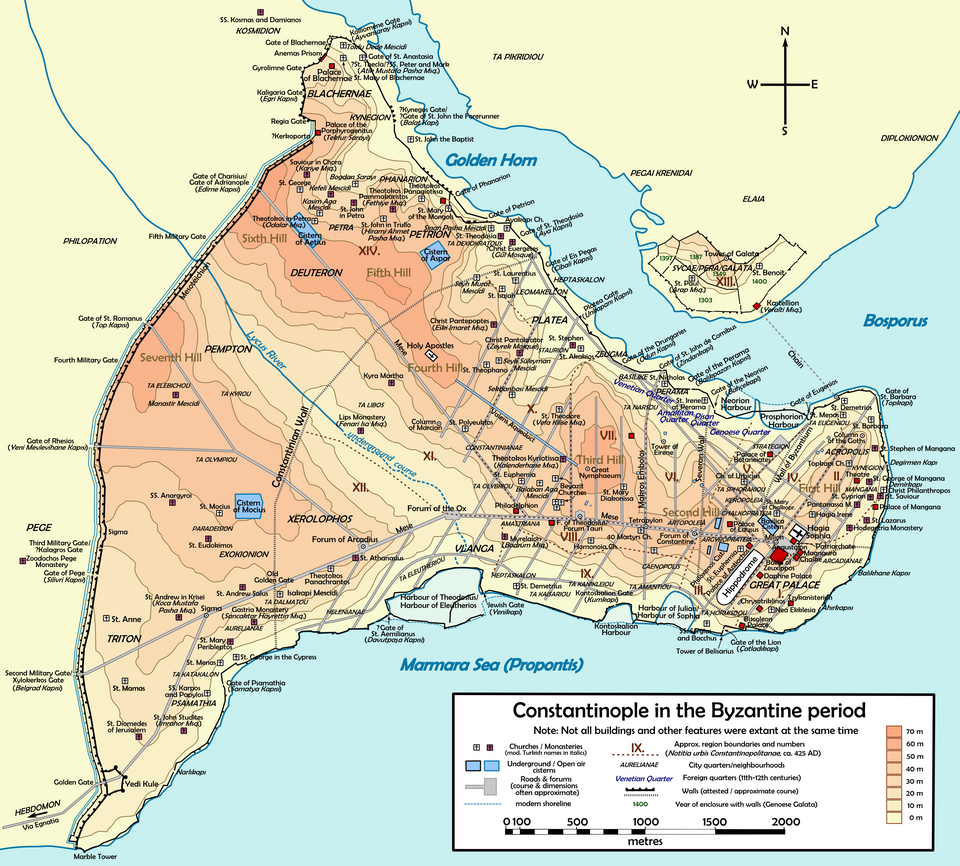
A map showing the strategic peninsula of Constantinople and its formidable defensive walls. Source: Wikipedia
The Crown Jewel of the World: Wealth, Walls, and Water
If you were a traveler in the Middle Ages, walking into Constantinople would have been like stepping onto another planet. While Western Europe was fractured and struggling through the "Dark Ages," Constantinople was a glittering metropolis of gold, marble, and spices. It was the wealthy, sophisticated beating heart of the medieval world.
How did it survive while the rest of the Roman Empire crumbled? Two words: The Theodosian Walls.
Constructed in the 5th century under Emperor Theodosius II, this triple-layered defensive system was a masterpiece of military engineering. Stretching for four miles across the peninsula, it featured a deep moat, an outer wall, and a massive inner wall studded with 96 towers(3). For a thousand years, armies of Avars, Arabs, Bulgars, and Rus threw themselves against these walls, and for a thousand years, they failed. The city was an impenetrable vault, protecting the knowledge, art, and culture of the ancient world.
Justinian, Riots, and the Holy Wisdom
Every great biography has a chapter of intense drama, and for Constantinople, that chapter was written by Emperor Justinian I in the 6th century.
In 532 AD, Constantinople was almost entirely destroyed by its own citizens. A massive chariot racing rivalry spiraled completely out of control, resulting in the Nika Riots. Half the city burned to the ground, and tens of thousands of people were killed. It was a terrifying moment that nearly toppled the empire.
But from the ashes of destruction came the city’s crowning glory. Justinian used the cleared land to build a church so magnificent that it defies belief even today: the Hagia Sophia (Holy Wisdom)(4) Completed in just over five years (532–537 AD), its massive central dome seemed to hover in the air, a trick of light and architecture that left visitors weeping in awe. When Justinian first stepped inside his completed masterpiece, he reportedly cried out, "Solomon, I have outdone thee!"(4). For almost a millennium, it was the largest cathedral on Earth.
Betrayal and the First Great Fall
Constantinople was tough, but it wasn't invincible. The most heartbreaking moment in the city’s life didn't come from a foreign enemy, but from fellow Christians.
In 1204 AD, the knights of the Fourth Crusade—who were supposed to be heading to the Holy Land—got sidetracked by political intrigue and unpaid debts. In a shocking twist of fate, they turned their weapons on Constantinople(5). The crusaders breached the sea walls and subjected the Queen of Cities to a horrifying three-day sack. They looted the gold, smashed holy relics, and burned libraries.
Though the Byzantines eventually reclaimed their city in 1261, Constantinople was never the same. It was deeply wounded, financially ruined, and surrounded by increasingly powerful enemies.
1453: The Final Stand
We now arrive at the final, tragic, yet epic chapter of Constantinople's life as the Byzantine capital. By 1453, the mighty empire had shrunk to just the city limits and a few scattered territories. The population had dwindled from over half a million to barely 50,000.
Waiting outside the ancient, crumbling walls was a young, incredibly ambitious Ottoman Sultan named Mehmed II, leading an army of nearly 100,000 men. Inside? Emperor Constantine XI possessed barely 7,000 defenders(6).
The siege lasted for 53 agonizing days. Mehmed brought a terrifying new weapon to the fight: massive gunpowder cannons, including an absolute monster called the "Basilica" that fired boulders the size of small cars, shattering the legendary walls that had stood for a millennium.^7^ In a stroke of military genius, when the Byzantines blocked the harbor with a massive iron chain, Mehmed literally ordered his men to roll 70 of his ships over a greasy wooden path across the hills to bypass the chain and attack the city from the water(7).
On May 29, 1453, the walls finally gave way. Emperor Constantine XI tore off his imperial insignia and charged into the fray, dying alongside his men(6). The city fell.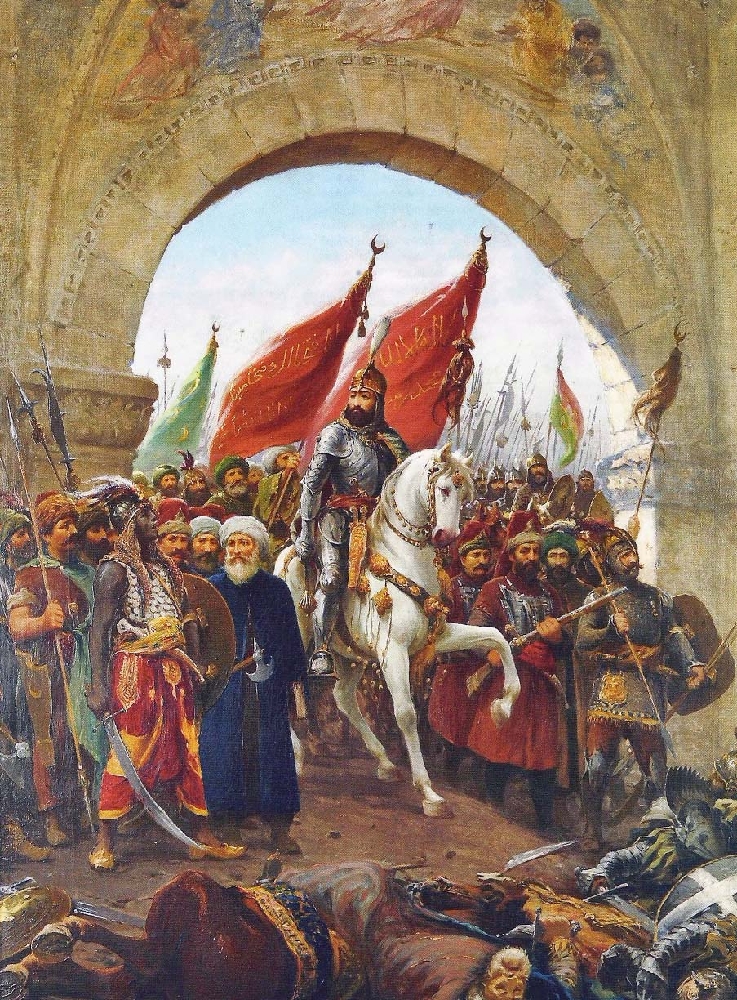
Mehmed the Conqueror enters Constantinople. Painting by Fausto Zonaro. Source: Wikipedia
A Legacy That Birthed a New World
The fall of Constantinople sent shockwaves of terror through Europe. But the death of the Byzantine capital was not the end of the city's story. Mehmed the Conqueror didn't want to destroy the city; he wanted it to be his new capital. He transformed the Hagia Sophia into a mosque, rebuilt the infrastructure, and breathed new life into the streets. The city was reborn as the heart of the Ottoman Empire, eventually becoming the bustling, vibrant city of Istanbul that we know today(6).
Furthermore, as the city was falling, Byzantine scholars grabbed whatever ancient Greek and Roman texts they could carry and fled westward to Italy(7). They brought with them lost knowledge of philosophy, mathematics, and art. This sudden influx of classical wisdom is widely considered the match that lit the fire of the European Renaissance.
Constantinople may have died as a Roman city, but in its final breath, it gave birth to the modern world.
Frequently Asked Questions (FAQs)
Why was the city's name changed to Istanbul? While the Ottomans conquered the city in 1453, it was actually still officially referred to as Constantinople (or Kostantiniyye in Ottoman Turkish) for centuries. The name "Istanbul" (derived from a Greek phrase meaning "to the city") only became the official, internationally recognized name in 1930 under the newly formed Republic of Turkey.
What happened to the Hagia Sophia after the city fell? Immediately after conquering the city, Sultan Mehmed II converted the Hagia Sophia from an Orthodox cathedral into a mosque, covering its Christian mosaics and adding Islamic features like minarets. In 1935, it was secularized and turned into a museum, but as of 2020, it has been reclassified and is functioning as a mosque once again.
Can you still see the original walls of Constantinople today? Yes! Despite centuries of earthquakes, sieges, and modern urban development, significant portions of the legendary Theodosian Walls still stand in Istanbul today. You can walk alongside them and touch the stones that protected the Roman Empire for a thousand years.
References
Wikipedia, 2026. Constantinople. [online] Available at: https://en.wikipedia.org/wiki/Constantinople
Study.com, n.d. Constantinople | History, Trade & Architecture. [online] Available at: https://study.com/learn/lesson/constantinople-history-importance.html
The Byzantine Legacy, n.d. Constantinople. [online] Available at: https://www.thebyzantinelegacy.com/constantinople
World Monuments Fund, n.d. Hagia Sophia. [online] Available at: https://www.wmf.org/projects/hagia-sophia
Byzantine Tradition, n.d. Major Events & Figures. [online] Available at: https://www.byzantinetradition.org/historical-development/major-events-figures
Britannica, n.d. Fall of Constantinople. [online] Available at: https://www.britannica.com/event/Fall-of-Constantinople-1453
World Atlas, 2025. How The Ottomans Conquered Constantinople In 1453. [online] Available at: https://www.worldatlas.com/history/how-the-ottomans-conquered-constantinople-in-1453.html