
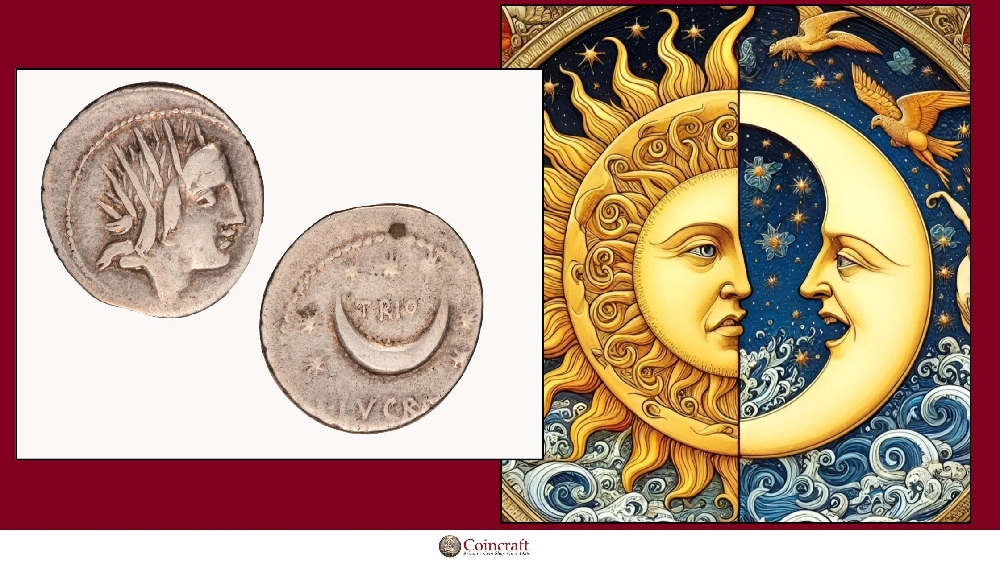
Picture Source Sol and Luna: Wikipedia
Sol and Luna: The Biography of the Sky’s Greatest Duo
Introduction: The Oldest Story Ever Told
Long before the days of Hollywood stars, pop icons, or internet influencers, humanity was absolutely obsessed with two shining figures in the sky: Sol and Luna. If the universe is a grand stage, the Sun and the Moon are undeniably its lead actors. They don't grant interviews, and they certainly don't have public relations teams, but their "biography" has been written in the myths, calendars, and cultures of every civilization to ever exist on Earth.
Whether you view them as powerful deities driving chariots across the heavens, profound symbols of the delicate balance of life, or simply the magnificent celestial bodies that dictate our days and nights, Sol and Luna have a story that is nothing short of epic. So, grab a comfy seat and your favorite beverage, and let’s dive into the fascinating, illuminating, and sometimes shadowy lives of the original power couple of the cosmos.
Key Takeaways
A Universal Presence: Sol (the Sun) and Luna (the Moon) have been personified and worshipped by nearly every ancient culture, most notably taking their familiar names from ancient Roman mythology.
The Ultimate Duality: They represent the most fundamental balances in the human experience: light and dark, day and night, conscious action and unconscious intuition.
Cultural Powerhouses: Sol eventually evolved into "Sol Invictus" (the Unconquered Sun), a deity so popular he deeply influenced the late Roman Empire, while Luna's phases became the foundational basis for how humanity measures time.
An Eternal Dance: Through astronomical events like eclipses, the mythical "relationship" between Sol and Luna continues to captivate us, proving that our fascination with the sky is timeless.
Meet Sol: The Brilliant Showman of the Day
Let’s start with the guy who literally lights up the room. In ancient Roman religion, Sol was the divine personification of the Sun. But to really understand Sol's biography, we have to look at his evolution, because he went through quite the "rebrand" during his time at the top of the pantheon.
Initially, the Romans worshipped him as Sol Indiges—a relatively minor, agricultural deity who made sure the crops grew and the seasons turned. He was important, sure, but he wasn't exactly the main event. However, as the Roman Empire expanded and absorbed the vibrant cultures of the East, Sol got a massive promotion. He merged with the Greek god Helios, who was famously known for driving a blazing, four-horse chariot across the sky every single day(1).
By the 3rd century AD, Sol had evolved into Sol Invictus—the "Unconquered Sun." This wasn't just a minor myth; this was an imperial cult. Picture the biggest rockstar of the ancient world. Emperor Aurelian made Sol Invictus an official, premier deity of the Roman Empire in 274 AD. Sol was stamped on coins, dedicated grand temples, and celebrated with massive festivals. He represented unwavering power, ultimate victory, and the radiant authority of the emperors themselves. Sol was loud, he was proud, and he demanded to be seen.
Enter Luna: The Quiet, Intuitive Force of the Night
If Sol is the booming, extroverted superstar, Luna is the enigmatic, soulful artist. Luna is the ancient Roman goddess of the Moon, corresponding closely to the Greek goddess Selene. While Sol drove a blindingly bright chariot, Luna was said to glide across the night sky in a silver chariot pulled by two horses (or sometimes, rather fittingly, two slow-moving oxen)(2).
Her biography is much more intimate and mysterious than Sol's. Luna didn't demand roaring crowds; she ruled over the quiet hours, the tides of the ocean, and the cyclical nature of time itself. In Rome, she had a beautiful, ancient temple situated on the Aventine Hill, which was tragically destroyed during the Great Fire of Rome in 64 AD.
One of the most famous (and slightly scandalous) stories from her Greek counterpart's life is the tale of Endymion. According to the myth, the Moon goddess fell so deeply in love with a beautiful mortal shepherd named Endymion that she couldn't bear the thought of him aging and dying. So, she asked the supreme god Jupiter (or Zeus) to grant him eternal youth. The catch? Endymion was placed into an eternal, enchanted sleep. Every night, Luna would drive her silver chariot across the sky, slipping down to visit her sleeping lover in a hidden cave(3). It’s a beautifully melancholic story that perfectly captures the wistful, longing energy humanity has always associated with the moonlight.
The Ultimate Celestial Dance: Duality and Eclipses
You can't write a biography of Sol without Luna, or Luna without Sol. They are the ultimate cosmic foils. Throughout history, philosophers and storytellers have used them to explain the concept of duality. Sol represents the masculine, the conscious mind, logic, fire, and the active principle of life. Luna represents the feminine, the subconscious, intuition, water, and the passive, receptive principle.
But what happens when these two distinct personalities cross paths? You get an eclipse.
For ancient people, a solar eclipse—when Luna briefly steps in front of Sol, plunging the day into sudden, eerie darkness—was terrifying and awe-inspiring. It was often viewed as a cosmic battle or a passionate embrace, depending on the culture you asked. Today, we know the exact science behind eclipses, but that doesn't make their meeting any less magical. When an eclipse happens, millions of people still drop what they are doing, look up to the sky (with protective glasses, of course!), and marvel at the interaction between these two celestial titans. It is the one moment where the King of the Day and the Queen of the Night share the exact same stage.
Sol and Luna in the Modern World
So, what are Sol and Luna up to these days? While we may no longer build stone temples to them or sacrifice animals in their honor, their influence is literally woven into the fabric of our daily lives.
Take a look at your calendar. The word "month" stems directly from the cycles of the moon, a system of timekeeping derived from Luna's phases. Sunday is, quite literally, Sol's day—a holdover from the days of Sol Invictus. In modern astrology, the Sun and Moon are known as the "luminaries," representing the core ego and the emotional inner self, respectively. We write songs about walking on sunshine and dancing in the moonlight. We name our space missions after them (hello, Apollo and Artemis—their mythological twins!).
Ultimately, the biography of Sol and Luna is the biography of us. As long as humans have been walking the earth, we have looked up at the sky to find meaning, rhythm, and beauty. The Sun will always rise to warm our faces, and the Moon will always return to light our way in the dark.
FAQs
1. Are Sol and Luna considered siblings or lovers in mythology? It actually depends on the culture! In some mythologies (like certain aspects of Greek myth with Apollo and Artemis, who later absorbed solar and lunar traits), they are considered twin siblings. In other alchemical and poetic traditions, they are viewed as a cosmic "husband and wife" whose union represents perfect balance.
2. What are the Greek equivalents of the Roman Sol and Luna? The direct Greek equivalent to Sol is Helios, the Titan god of the Sun. The direct Greek equivalent to Luna is Selene, the Titan goddess of the Moon. Later on, the Greeks and Romans also heavily associated the Sun and Moon with the Olympian gods Apollo and Diana (Artemis).
3. Why was "Sol Invictus" so important to the Roman Empire? Sol Invictus (the Unconquered Sun) was used by later Roman Emperors as a unifying figure. Because the empire was so vast and fractured, Emperor Aurelian promoted the cult of Sol Invictus as a single, supreme god that all citizens, regardless of their local traditions, could look up to and rally behind, thereby strengthening the Emperor's own authority.
References
Britannica, The Editors of Encyclopaedia. (2023) Sol: Roman mythology. Encyclopedia Britannica. Available at: https://www.britannica.com/topic/Sol-Roman-mythology (Accessed: 13 March 2026).
Cartwright, M. (2012) Selene. World History Encyclopedia. Available at: https://www.worldhistory.org/Selene/ (Accessed: 13 March 2026).
Atsma, A. J. (2017) Selene: Greek Goddess of the Moon. Theoi Project. Available at: https://www.theoi.com/Titan/Selene.html (Accessed: 13 March 2026).

