 - ACG0003.jpg)
The Parthian Prince Who Almost Broke Rome: The Life of Pacorus I
History is often written by the victors, which is why we hear so much about Roman generals like Crassus, Antony, and Caesar. But what about the formidable figures who stood against them? Enter Pacorus I (died 38 BC), the Parthian crown prince who didn't just defend his empire but took the fight right to Rome's doorstep.
Imagine a time when the Roman Republic was crumbling under civil wars. In steps a charismatic, capable prince from the East, teaming up with a renegade Roman general to sweep across the Middle East. Pacorus wasn't just a warrior; he was a beloved leader whose death reportedly broke his father's heart and changed the course of Parthian history. If you love stories of ancient power struggles, "what-if" scenarios, and dramatic battles, you are going to want to stick around for this one.
Key Takeaways
A Formidable Commander: Pacorus I was one of the most effective Parthian military leaders, spearheading invasions that captured nearly all of Roman Syria and the Levant.
The Roman Alliance: He famously allied with Quintus Labienus, a Roman republican general, creating a unique joint force that capitalized on Rome's internal chaos.
Kingmaker in Judea: Pacorus was instrumental in overthrowing the Roman-backed Hyrcanus II and installing Antigonus II Mattathias as the King of Judea.
A Tragic End: His promising life was cut short at the Battle of Mount Gindarus, a defeat that halted Parthian expansion and led to a succession crisis in the empire.
The Prince of the Arsacid Dynasty
Pacorus was born into the Arsacid dynasty, the ruling family of the Parthian Empire (centered in modern-day Iran). He was the eldest son of King Orodes II and the designated heir to the throne. While we don't have his exact birth date, we know he grew up during a time of immense tension between Parthia and Rome.
His father, Orodes II, was a shrewd politician who had already crushed the Roman triumvir Crassus at the Battle of Carrhae in 53 BC—a victory that sent shockwaves through the ancient world. To solidify his power, Orodes arranged a strategic marriage for Pacorus to an Armenian princess, the sister of King Artavasdes II. This wasn't just a wedding; it was a geopolitical masterstroke that secured Parthia's northern flank.^1^
Early Campaigns and The Roman Civil Wars
Pacorus didn't wait long to earn his stripes. In 51 BC, while likely still quite young, he led his first invasion into Roman Syria. Although this early attempt was repulsed by Cassius (one of the future assassins of Julius Caesar), it gave Pacorus a taste of Roman tactics.^2^
But Pacorus's real opportunity came when Rome started eating itself alive. The Roman Civil Wars—first between Pompey and Caesar, and later between the Second Triumvirate (Octavian and Antony) and the Liberators (Brutus and Cassius)—left Rome's eastern provinces vulnerable.
In a twist that sounds like fiction, Quintus Labienus, a Roman general loyal to the Assassin faction, fled to the Parthian court for safety. Instead of treating him as a prisoner, Orodes and Pacorus treated him as an ally. In 40 BC, they launched a massive joint invasion. Labienus took the northern route into Asia Minor, while Pacorus swept south into the Levant.^3^
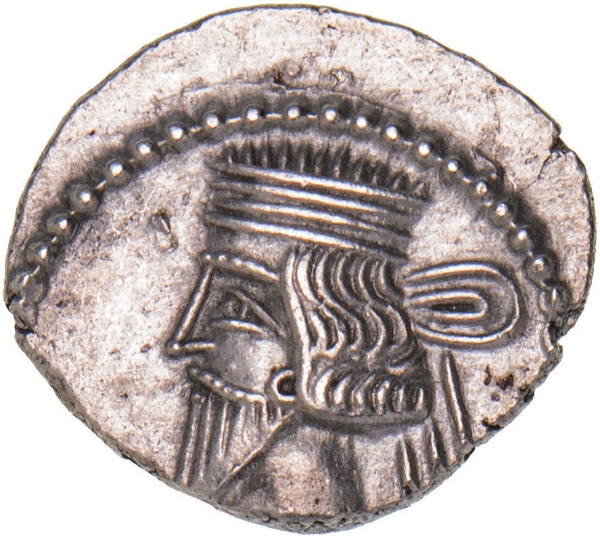
A silver drachm of Pacorus I, minted at Ecbatana. Note the distinct Parthian hairstyle and diadem.
The Conqueror of the Levant
The year 40 BC was Pacorus's "annus mirabilis" (miraculous year). His campaign was a stunning success. He marched down the Phoenician coast, and cities opened their gates to him—some out of fear, but many because they were tired of heavy Roman taxation.
His most famous intervention occurred in Judea. The region was currently under the thumb of the Roman client Hyrcanus II and his advisor Antipater (father of Herod the Great). The local Jewish population was deeply divided, and the anti-Roman faction approached Pacorus for help.
Always the opportunist, Pacorus sent his commander, Barzapharnes, and a troop of famous Parthian horse archers to support the claimant Antigonus II Mattathias. The operation was a complete success:
Hyrcanus II was deposed and captured.
Phasael (Herod's brother) was captured and committed suicide.
Herod fled to his fortress at Masada and eventually to Rome.
Antigonus was installed as King and High Priest, restoring Hasmonean rule under Parthian protection.^4^
For a brief moment, the Parthian Empire had restored its borders to nearly the extent of the old Achaemenid Persian Empire. Pacorus was celebrated not just as a conqueror, but as a just and moderate ruler, earning popularity even among the Greeks in Syria.^5^
The Battle of Mount Gindarus: A Tragic Turn
Unfortunately for Pacorus, Rome had a habit of bouncing back. Mark Antony sent his top general, Publius Ventidius Bassus, to clean up the mess in the East. Ventidius was a brilliant strategist who knew how to counter the deadly Parthian cavalry.
First, Ventidius defeated and killed Labienus in Asia Minor. Then, in 38 BC, he set a trap for Pacorus.
Ventidius lured the Parthian army across the Euphrates River and into the district of Cyrrhestica, specifically to a location known as Mount Gindarus. By seizing the high ground, Ventidius nullified the advantage of the Parthian heavy cavalry (cataphracts). When the Parthians charged uphill, they were met with a storm of sling stones and heavy infantry cohorts.^6^
In the chaos of the battle, Pacorus fought bravely at the front lines—perhaps too bravely. He was slain in the melee. Once their beloved prince fell, the Parthian army collapsed. It was a crushing defeat that effectively ended Parthia's western expansion.
Legacy of the Lost Prince
The death of Pacorus was more than just a military loss; it was a dynastic tragedy. When King Orodes II heard the news, he was reportedly so overcome with grief that he refused to speak or eat for days. He had lost his favorite son and his most capable heir.^7^
In his grief, Orodes eventually appointed his other son, Phraates IV, as successor. This turned out to be a disaster, as Phraates IV promptly murdered his father and several brothers to secure his throne.
Historians often wonder "what if" Pacorus had survived. He was described by contemporaries as having the talent and temperament to be a great king. Had he lived, the relationship between Rome and Parthia—and the history of the Middle East—might have looked very different.
Frequently Asked Questions (FAQs)
1. Was Pacorus I ever officially the King of Kings? Most historians consider him a crown prince and general. However, numismatic evidence (coins) suggests he may have ruled as a co-regent with his father Orodes II for a brief period around 39 BC, just before his death.^8^
2. How did Pacorus I die? He died in battle against the Roman general Publius Ventidius Bassus at the Battle of Mount Gindarus in 38 BC. He was killed while leading a charge of heavy cavalry up a hill against fortified Roman positions.
3. Why did Pacorus invade Judea? He invaded Judea to weaken Roman influence in the region and to install a friendly ruler. By supporting Antigonus II Mattathias against the Roman-backed Herod and Hyrcanus, he secured a loyal buffer state and gained significant financial tribute.^9^
References
Bivar, A.D.H. (1983) 'The Political History of Iran Under the Arsacids', in Yarshater, E. (ed.) The Cambridge History of Iran, Vol. 3(1). Cambridge: Cambridge University Press, pp. 21–99.
Dio Cassius (n.d.) Roman History, Book 40, Chapters 28-30. Available online
Vagi, D.L. (2000) Coinage and History of the Roman Empire, c. 82 B.C.– A.D. 480. Routledge.
Josephus, F. (n.d.) Antiquities of the Jews, Book 14, Chapter 13. Available online
Plutarch (n.d.) Life of Crassus. Available online
Sheldon, R.M. (2010) Rome's Wars in Parthia: Blood in the Sand. London: Vallentine Mitchell.
Justin (n.d.) Epitome of the Philippic History of Pompeius Trogus, Book 42, Chapter 4. Available online
Sellwood, D. (1980) An Introduction to the Coinage of Parthia. London: Spink & Son.
Smallwood, E.M. (1976) The Jews Under Roman Rule: From Pompey to Diocletian. Brill.