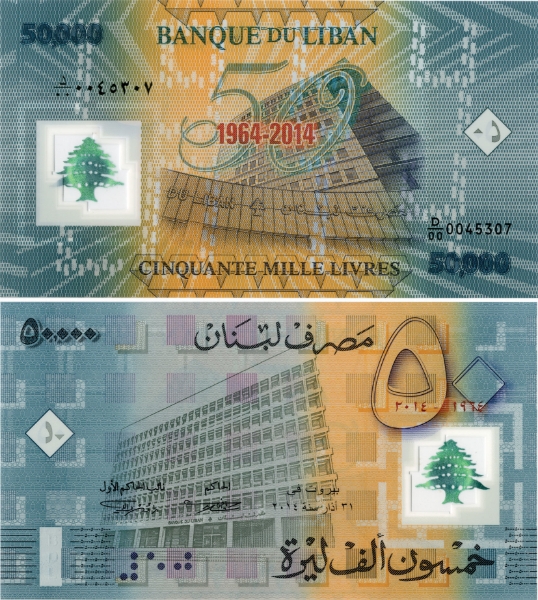
 - WLE0397.jpg)
Picture Source of the National Bank of Lebanon (Banque du Liban): Wikipedia
The Guardian of the Lira: The Life and Times of the Banque du Liban
If you’ve ever held a Lebanese pound in your hand, you’ve seen the signature of the "Banque du Liban" (BDL). But this isn’t just any central bank. For decades, it was hailed as the "Switzerland of the Middle East's" financial bedrock, led by a man once considered a financial wizard. Today, however, it stands at one of the most difficult crossroads in its 60-year history. Let’s pull back the curtain on the institution that manages Lebanon’s money, its gold, and—arguably—its future.
Key Takeaways
Established in 1963: The BDL became operational in 1964, taking over currency duties from the French-controlled Banque de Syrie et du Liban¹.
Golden Safety Net: Lebanon holds one of the world's largest gold reserves relative to its size, much of it stored securely at the BDL and the New York Fed².
A Decade of Crisis: Since 2019, the bank has faced immense scrutiny over its "financial engineering" and its role in the country’s sovereign debt default³.
A New Era: With the departure of long-time governor Riad Salameh in 2023, the bank is currently undergoing major forensic audits and leadership shifts aimed at reform⁴.
From Colonial Roots to Financial Autonomy
The story of the Banque du Liban doesn't actually start with Lebanon's independence in 1943. For years after the French Mandate began, Lebanon shared its currency and central banking services with Syria through the Banque de Syrie et du Liban (BSL)⁵. It wasn’t until August 1, 1963, that the "Code of Money and Credit" was promulgated, officially birthing the BDL as a legal public entity with financial and administrative autonomy⁶.
When the bank opened its doors on April 1, 1964, it had a clear mission: safeguard the national currency to ensure social and economic growth. For a long time, it did exactly that. During the "Golden Age" of the 60s and 70s, the BDL helped Lebanon become a regional hub for trade and banking, earning Beirut its famous nickname.
The Salameh Years: Magic or Mirage?
You cannot talk about the BDL without talking about Riad Salameh. Appointed in 1993, Salameh served as Governor for a staggering 30 years. For much of that time, he was the darling of the international financial world, credited with keeping the Lebanese Pound pegged at 1,507.5 to the US Dollar despite wars and political assassinations⁷.
However, the "miracle" began to unravel in late 2019. To maintain that peg, the BDL engaged in what became known as "financial engineering"—paying high interest rates to local banks to attract US Dollars, which were then used to fund government spending⁸. Critics, and eventually the World Bank, later described this as a state-sponsored Ponzi scheme⁹. When the flow of dollars stopped, the system collapsed, leading to the current hyperinflation and the "freezing" of people's life savings in commercial banks¹⁰.
Life at the Bank Today: Reform and Recovery
Since August 2023, the BDL has been led by Interim Governor Wassim Mansouri. The atmosphere has shifted from "business as usual" to "emergency repair." The bank is now under the microscope of international forensic auditors like Alvarez & Marsal, who identified serious "weak points" in how decisions were made during the crisis years¹¹.
Today, the BDL's main challenge is stabilizing the exchange rate, which has plummeted from the old 1,507 peg to nearly 90,000 pounds per dollar¹². The bank is also navigating the "gray list" status from the Financial Action Task Force (FATF), working hard to prove that Lebanon can implement the transparency and anti-money laundering reforms required by the IMF¹³.
A Glittering Reserve: The Gold Question
Despite the empty ATMs and the falling currency, the BDL sits on a treasure chest: roughly 286 tons of gold¹⁴. Valued at over $30 billion, this gold is protected by a 1986 law that prevents its sale without parliamentary approval. For many Lebanese, this gold is the "final insurance policy" for the nation’s eventual recovery¹⁵.
FAQs
Who currently runs the Banque du Liban? Since Riad Salameh’s term ended in July 2023, Wassim Mansouri has been serving as the Interim Governor, supported by the bank's four vice-governors¹⁶.
Why can't I withdraw my money if the BDL has gold? The gold is legally protected and cannot be used to pay back depositors without a change in the law. Furthermore, the "gap" in Lebanon's financial system (the difference between what is owed to depositors and what the banks actually have) is far larger than the value of the gold¹⁷.
Is the BDL independent from the government? Technically, yes. The Code of Money and Credit grants it administrative autonomy. However, in practice, the BDL has historically been heavily involved in financing the Lebanese state's budget deficits, which created the current debt crisis¹⁸.
References
Banque du Liban. (1964). The Code of Money and Credit. Official BDL Website
World Bank. (2021). Lebanon Economic Monitor: The Great Denial. World Bank Documents
Reuters. (2023). Lebanon’s Salameh leaves central bank with legacy of ruins. Reuters News
Alvarez & Marsal. (2023). Forensic Audit Report of Banque du Liban. Ministry of Finance Lebanon
Wikipedia. (2024). Banque du Liban. Wikipedia Entry
Middle East Institute. (2025). Lebanon's monetary crisis and the future of the Central Bank. MEI Publication
The Washington Institute. (2025). The IMF's Lebanon Framework. Washington Institute
Majalla. (2025). A state in crisis: Lebanon's struggle to restore financial stability. En Majalla
Financial Times. (2022). The 'Ponzi scheme' that broke Lebanon. FT Archive
L'Orient Today. (2023). The post-Salameh era: What to expect? L'Orient Today
Al Jazeera. (2023). Lebanon: Riad Salameh’s 30-year term ends. Al Jazeera News
Central Banking News. (2024). Wassim Mansouri and the BDL Reform Path. Central Banking
FATF. (2024). Jurisdictions under Increased Monitoring - June 2024. FATF-GAFI
World Gold Council. (2024). Central Bank Gold Reserves. Gold.org
Middle East Transparent. (2026). A Second Devaluation Looms Over Lebanon. ME Transparent
This Is Beirut. (2025). BDL Issues Statement on Transparency. This Is Beirut
JHU Institute for Applied Economics. (2020). Analysis of the Banque de Syrie et du Liban. Johns Hopkins University
IMF. (2022). Lebanon: Staff-Level Agreement. IMF.org