Picture Source of Ariarathes X of Cappadocia: Wikipedia
Ariarathes X of Cappadocia: The Tragic Tale of the Brother-Loving King
Picture this: you've just inherited a kingdom, but instead of celebrating with feasts and gold, you're immediately caught in the crossfire of the biggest superpower brawl in history. For the kings of the ancient Near East, surviving the death throes of the Roman Republic required more than just royal blood—it required serious survival skills. In today's post, we are exploring the intense, chaotic, and ultimately tragic story of Ariarathes X of Cappadocia.
Ruling from roughly 42 BC to 36 BC, Ariarathes X stepped into power during one of the most chaotic periods in ancient history. Surrounded by Roman civil wars, shifting alliances, and ruthless generals, he tried his best to keep his kingdom afloat. So, grab a cup of coffee, settle in, and let's unravel the fascinating biography of the king they called "The Pious and Brother-Loving."
Key Takeaways
A Crown Forged in Chaos: Ariarathes X became king of Cappadocia in 42 BC only after his older brother, Ariobarzanes III, was executed by the Roman assassin Cassius Longinus.
The "Brother-Loving" Monarch: He took the title Eusebes Philadelphos (Pious, Brother-Loving) to legitimize his rule and honor his tragically murdered sibling.
A Pawn in Rome's Game: His six-year reign was entirely dictated by the shifting tides of the Roman civil wars, highlighting the perilous reality of "client kings" in antiquity.
A Tragic End: In 36 BC, Roman triumvir Mark Antony deposed and executed Ariarathes X to place a more compliant ally, Archelaus, on the Cappadocian throne.
The Cappadocian Chessboard: A Background
To truly understand Ariarathes X, we have to look at the board he was playing on. Cappadocia, located in the heart of modern-day Turkey (Anatolia), was a vast, rugged, and strategically vital kingdom. It acted as a buffer state between the ever-expanding Roman Republic to the west and the formidable Parthian Empire to the east.
By the 1st century BC, Cappadocia wasn't entirely independent. It was what historians call a "client kingdom." This meant that while Cappadocian kings got to wear the royal diadem and mint their own coins, they essentially answered to Rome. If Rome said "jump," a Cappadocian king had to ask, "how high?" Or, more accurately, "how many legions do you need?"(1)
It was a delicate balancing act. Lean too far toward Rome, and your own people (or neighboring empires) might rebel. Show too much independence, and Rome would swiftly replace you.
Bloodlines and Brotherly Love
Ariarathes X was born into the Ariobarzanid dynasty, a noble house boasting a rich blend of Persian and Greek ancestry. His father was King Ariobarzanes II, and his mother was Queen Athenais Philostorgos II. Growing up in the royal court at the capital city of Eusebeia-Mazaca, young Ariarathes would have been immersed in Hellenistic culture, speaking Greek while observing traditions that traced back to the old Persian satraps.(2)
But royal family life in antiquity was rarely a picturesque affair. His older brother, Ariobarzanes III, had inherited the throne and immediately found himself in a geopolitical nightmare. The Roman Republic was tearing itself apart. First, Julius Caesar fought Pompey the Great. Ariobarzanes III initially backed Pompey, but when Caesar won, the Cappadocian king quickly switched sides to save his skin (and his kingdom).(3)
However, the drama didn't end with Caesar's victory. After Caesar's assassination in 44 BC, the Roman world was thrown back into chaos. Cassius Longinus, one of Caesar’s lead assassins, fled to the East to build an army. When Ariobarzanes III refused to drain his kingdom's resources to fund Cassius's war efforts, Cassius had him ruthlessly executed in 42 BC.(3)
And just like that, the throne was empty. It was time for our subject, Ariarathes X, to step up.
A Crown Forged in Chaos
You have to feel a little sorry for Ariarathes X. Inheriting a kingdom directly after an invading Roman general murders your brother is hardly the ideal start to a new job.
To consolidate his power and mourn his sibling, he officially took the regnal name Ariarathes X Eusebes Philadelphos. Translated from Ancient Greek, this means "The Pious, Brother-Loving."(4) It was a brilliant, if melancholic, piece of political branding. By emphasizing his love for his brother, he signaled to his subjects that he was the rightful, loyal heir, providing a sense of stability to a kingdom deeply traumatized by Roman interference.
The Reign of the "Brother-Loving" King
During his brief reign from 42 BC to 36 BC, Ariarathes X did what he could to be a traditional Hellenistic monarch. Much of what we know about him today actually comes from the coins he left behind.
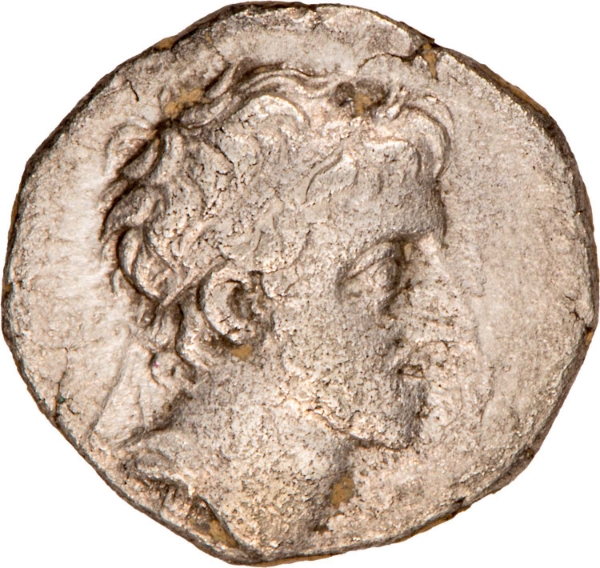
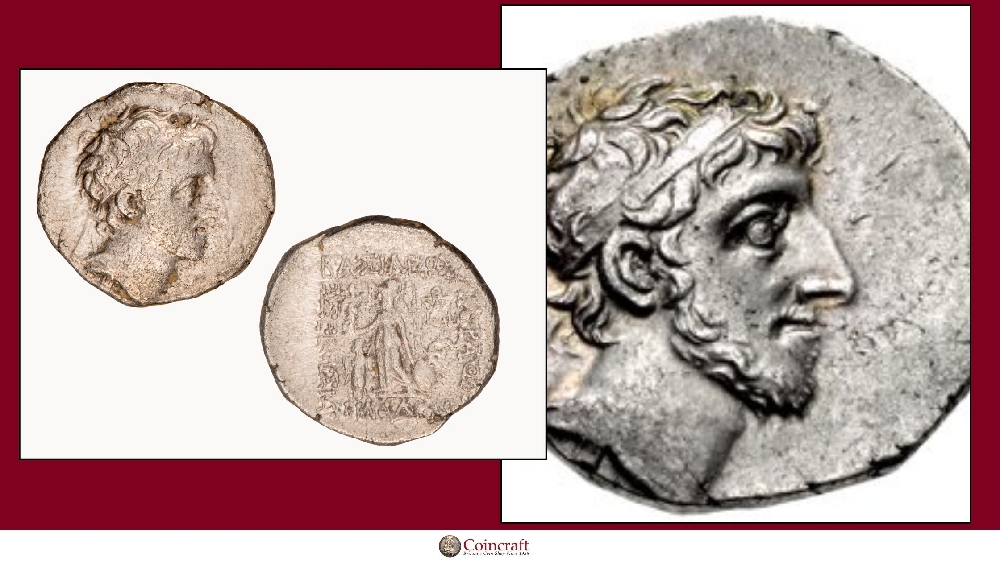
If you are a coin collector or numismatist, you might have seen his surviving silver drachmas. They were minted in Eusebeia-Mazaca and feature a beautifully detailed, diademed portrait of Ariarathes looking to the right. On the reverse, he featured Athena Nikephoros (Athena bringing victory) standing with a spear and shield, holding a small figure of Nike.(2) It was a classic display of power, culture, and religious piety. He also issued bronze coins depicting Artemis and majestic stags, further tying his rule to recognizable Hellenistic iconography.
But while Ariarathes was busy minting coins and trying to rule his people, the Roman civil war raged on. Cassius and Brutus were defeated by Mark Antony and Octavian at the Battle of Philippi in 42 BC. Following the victory, Mark Antony took control of Rome's eastern provinces.
Suddenly, Ariarathes X had a new, highly demanding boss.
Enter Mark Antony: The Tragic Finale
Mark Antony was a man with massive ambitions. He dreamed of launching a glorious campaign against the Parthian Empire to outdo Julius Caesar's legacy. To pull off a logistical nightmare of that scale, he needed the eastern client kingdoms to be completely subservient, incredibly wealthy, and led by men he personally trusted.
Unfortunately for Ariarathes X, he simply didn't fit the bill.
Perhaps Antony felt Ariarathes wasn't loyal enough, or maybe he simply preferred someone else for the job. Enter Sisines, a Cappadocian nobleman whose family had long rivaled the Ariobarzanids. Sisines was cunning, ambitious, and most importantly, he had curried deep, personal favor with Mark Antony.
In 36 BC, Antony made his move. He didn't just ask Ariarathes X to step down; in the brutal fashion of Roman politics, Antony had the king violently deposed and executed.(1) It was a swift, tragic end for the "Brother-Loving" king who had simply tried to survive the Roman meat grinder.
Mark Antony immediately placed Sisines on the throne, who changed his name to Archelaus. Archelaus would go on to be the last independent King of Cappadocia before the territory was fully absorbed as a Roman province decades later.
A Legacy Left in Silver
Ariarathes X of Cappadocia might not be a household name today, but his life perfectly encapsulates the sheer terror and drama of the 1st century BC. He wasn't a world-conqueror or a mad tyrant; he was simply a man caught between the crushing gears of the Roman war machine. Today, his legacy survives primarily in the beautiful silver and bronze coins that occasionally emerge from the earth—tiny, quiet reminders of the brother-loving king who tried to hold back the tide.
FAQs
Why was Ariarathes X called "Eusebes Philadelphos"? "Eusebes Philadelphos" translates from Ancient Greek as "The Pious, Brother-Loving." He adopted this title to honor his older brother, King Ariobarzanes III, who was unjustly executed by the Romans. It was a strategic move to legitimize his own sudden ascension to the throne and show family solidarity.
What happened to his brother, Ariobarzanes III? Ariobarzanes III was executed in 42 BC by Cassius Longinus (one of the assassins of Julius Caesar). Cassius demanded money and troops for his civil war against Mark Antony and Octavian. When Ariobarzanes refused to comply and bleed his kingdom dry, Cassius had him killed.
Why did Mark Antony execute Ariarathes X? Mark Antony was reorganizing the eastern Roman territories in preparation for a massive invasion of Parthia. He wanted client kings on the thrones who were entirely dependent on him and unquestioningly loyal. He deposed and executed Ariarathes X in 36 BC to replace him with his own favored candidate, a rival Cappadocian nobleman named Archelaus.
References
Hornblower, S. and Spawforth, A., 1996. The Oxford Classical Dictionary. 3rd ed. Oxford: Oxford University Press. Available via Oxford Reference
Simonetta, B., 2007. The Coins of the Cappadocian Kings. Parthica, 9, pp. 45-48. (See also numismatic databases for Ariarathes X at Nomisma.org).
Chisholm, H. ed., 1911. Ariobarzanes. Encyclopædia Britannica. 11th ed. Cambridge: Cambridge University Press, pp. 491–492. Available online.
Hazel, J., 2001. Who's Who in the Roman World. London: Routledge.