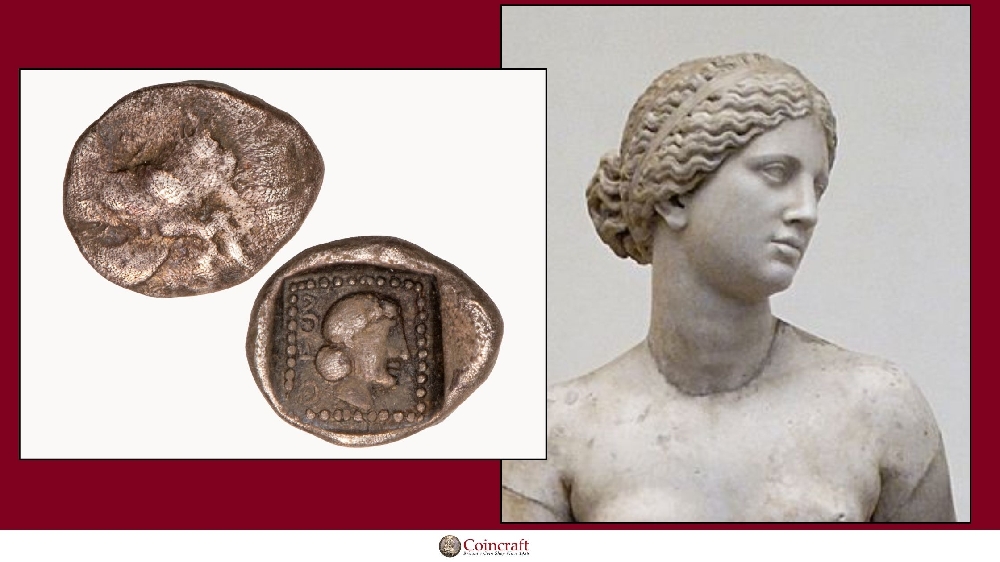
Picture Source of Aphrodite: Wikipedia
The Eternal Allure: A Deep Dive into Aphrodite, the Original Icon
When we think of "love," our modern minds might jump to Hallmark cards or romantic comedies. But to the ancient Greeks, love wasn't just a feeling; it was a force of nature—beautiful, terrifying, and often completely chaotic. At the center of that storm stood Aphrodite. She wasn't just a "pretty face" in the pantheon; she was a powerhouse of desire, a diplomat of beauty, and a goddess who could bring kings to their knees or start world wars with a single Apple of Discord.
Born from the sea foam and destined to rule the hearts of gods and mortals alike, Aphrodite's story is much more than a collection of romances. It’s a study in the human condition, our deepest desires, and the messy, glorious reality of attraction.
Key Takeaways
Complex Origins: Aphrodite has two primary birth myths—rising from the sea foam (Aphrodite Ourania) or being the daughter of Zeus and Dione (Aphrodite Pandemos).
More Than Romance: She wasn't just the goddess of love; she governed beauty, pleasure, procreation, and even held roles related to the sea and war in certain regions.
The Power of the Girdle: Her "magical girdle" was her most famous attribute, possessing the power to make anyone fall in love with the wearer.
Agent of Chaos: Her involvement in the "Judgement of Paris" was the primary catalyst for the Trojan War, proving that her influence could change the course of history.
The Mystery of Her Birth: Foam and Family
Aphrodite’s entry into the world is perhaps the most famous "main character" moment in all of mythology. Depending on which ancient poet you ask, her origin story changes significantly. The most iconic version comes from Hesiod, who tells us she was born from the "aphros" (sea foam) after Cronus castrated his father, Uranus, and threw his remains into the sea near Cyprus.1 This version gives us "Aphrodite Ourania"—the celestial, high-minded goddess.
However, Homer (the writer of the Iliad) offers a slightly more domestic take. He suggests she was the daughter of Zeus and a titaness named Dione.(2) This version is often called "Aphrodite Pandemos," or "Aphrodite of all the people," representing the more common, physical side of love. Whether she’s a daughter of the cosmos or a daughter of the King of the Gods, she arrived on the shores of Cyprus already fully formed and breathtakingly beautiful, immediately catching the eye of every deity on Mount Olympus.
A Marriage of Opposites: Hephaestus and Ares
If you think celebrity dating lives are complicated today, they’ve got nothing on Aphrodite. To prevent the gods from fighting over her, Zeus married her off to Hephaestus, the god of fire and smithing.(3) He was hardworking, talented, and—according to the standards of the time—the "ugliest" of the gods. It was a classic "beauty and the beast" dynamic, but without the fairy-tale ending.
Aphrodite’s heart (and interest) belonged elsewhere—specifically to Ares, the god of war. Their affair is one of the most legendary "open secrets" in myth. It’s a fascinating symbolic pairing: Love and War, joined together. From their union came children who represent the spectrum of human emotion, including Eros (Desire), Phobos (Fear), and Deimos (Terror).(4)
The Girdle, the Swan, and the Rose
Aphrodite didn't just walk around looking pretty; she had the ultimate "cheat code" for attraction: her magical girdle (the cestus). When she wore it, she became irresistibly alluring to everyone—man, woman, god, or beast.(5) Even Hera, the Queen of the Gods, famously borrowed it when she needed to distract Zeus.
Her symbols reflect her dual nature. The dove and the swan represent her grace and purity, while the rose and the myrtle speak to her association with blooming beauty. But let’s not forget the sea shell—a nod to her maritime origins, which led sailors to pray to her as Aphrodite Euploia (Goddess of Fair Sailing) for safe passage.(6)
The Judgement of Paris: Starting a World War
Aphrodite's most impactful moment in history—mythologically speaking—was a beauty contest. When Eris, the goddess of discord, threw a golden apple inscribed "For the Fairest" into a wedding party, Hera, Athena, and Aphrodite all claimed it. They asked a mortal prince, Paris, to decide the winner.
While Hera offered him power and Athena offered him wisdom, Aphrodite went for the jugular: she offered him the love of the most beautiful woman in the world, Helen of Sparta.(7) Paris chose Aphrodite, took Helen, and triggered the decade-long Trojan War. It’s a stark reminder that in the Greek world, the "gift" of love often came with a heavy price.
Aphrodite’s Human Side: Anchises and Adonis
Unlike many other gods who viewed mortals as mere playthings, Aphrodite frequently found herself genuinely entangled with them. Her love for the mortal hunter Adonis was so profound that when he was killed by a wild boar, her tears mixed with his blood to create the anemone flower.(8)
She also fell for the Trojan prince Anchises, with whom she had a son, Aeneas. Aeneas would go on to become the legendary founder of the Roman people, linking the Greek Aphrodite to the Roman Venus and ensuring her legacy lived on through the rise of the Roman Empire.(9)
FAQs
1. Was Aphrodite actually a "nice" goddess? In mythology, "nice" isn't really the right word. She was incredibly generous to those who honored her (like Pygmalion, whose statue she brought to life), but she could be vindictive if she felt slighted. She was a force of nature—unpredictable and powerful.
2. How did the Romans change her? The Romans adopted her as Venus. While Aphrodite was often portrayed as a bit of a troublemaker, Venus was elevated to a mother-figure of the Roman state, emphasizing her role as the mother of Aeneas and a symbol of victory and domestic harmony.
3. Why is she often associated with Cyprus? According to the most popular myths, Aphrodite first stepped onto land at Paphos, Cyprus, after her birth in the sea. The island became the center of her cult, and many of her epithets, like "The Cyprian," refer to this connection.
References (Harvard Style)
Hesiod (1914) Theogony. Translated by H.G. Evelyn-White. London: William Heinemann Ltd. Available at: https://www.theoi.com/Library/HesiodTheogony.html
Homer (1924) The Iliad. Translated by A.T. Murray. Cambridge, MA: Harvard University Press. Available at: https://www.perseus.tufts.edu/hopper/text?doc=Perseus:text:1999.01.0134
Odyssey (1919) The Odyssey. Translated by A.T. Murray. London: William Heinemann Ltd. (Book VIII describes the marriage and affair).
Hard, R. (2004) The Routledge Handbook of Greek Mythology. London: Routledge.
Graves, R. (1955) The Greek Myths. London: Penguin Books.
Burkert, W. (1985) Greek Religion. Oxford: Blackwell Publishing.
Stasinus of Cyprus (c. 7th Century BC) Cypria. Fragment 1. Available at: https://www.theoi.com/Olympios/AphroditeMyths2.html#Paris
Ovid (1922) Metamorphoses. Translated by B. More. Boston: Cornhill Publishing Co. (Book X).
Virgil (1916) Aeneid. Translated by H.R. Fairclough. Cambridge, MA: Harvard University Press.


