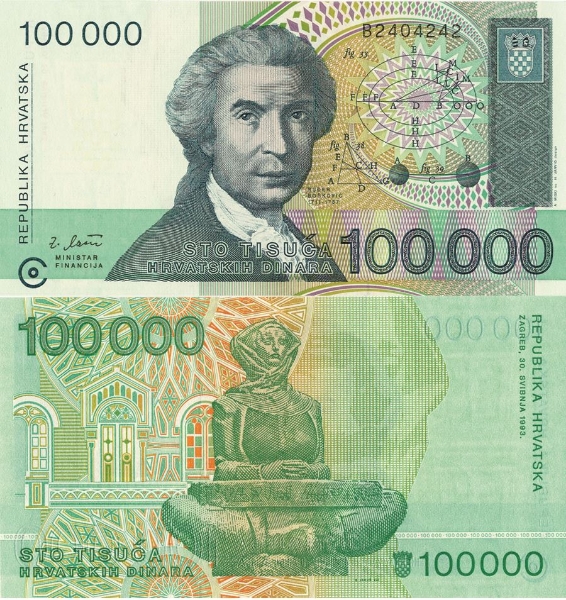
Picture Source of Ruđer Bošković (1711 – 1787): Wikipedia
 - WCR1600 .jpg)
Ruđer Bošković: The Universal Polymath of Dubrovnik
The 100,000 Croatian Dinara banknote, pictured features the distinguished portrait of Ruđer Josip Bošković (often Anglicised as Roger Joseph Boscovich). Far from being just a national symbol, Bošković was one of the most brilliant and universal minds of the 18th-century European Enlightenment. As a physicist, astronomer, mathematician, philosopher, diplomat, and poet, his conceptual breakthroughs in atomic theory and relativity paved the way for modern quantum mechanics and field theory.
At a time when science was deeply divided between the mechanical universe of Isaac Newton and the metaphysical monads of Gottfried Wilhelm Leibniz, Bošković stepped forward to bridge the gap. His unified theory of forces remains a masterpiece of visionary science, earning him praise from giants like Michael Faraday, Lord Kelvin, and Nikola Tesla (Dubrovnik Travel, n.d.).
Key Takeaways
Precursor to Atomic Theory: Bošković formulated the first unified theory of physical forces, postulating that matter consists of indivisible, non-extended "point-atoms" acting under alternating attractive and repulsive forces.
Engineering Savior of Rome: He saved the dome of St. Peter's Basilica from collapse in 1742 by developing the first structural static calculations in engineering history.
Visionary of Relativity: Centuries before Albert Einstein, Bošković proposed a system of relative space, time, and motion, arguing that absolute measurements are impossible.
Astronomical Pioneer: He was the first to mathematically prove the Moon lacks an atmosphere, invented several optical instruments, and pioneered the study of systematic errors in scientific observation.
Key Facts
Feature | Detail |
|---|---|
Full Name | Ruđer Josip Bošković (Roger Joseph Boscovich) |
Birth Date & Place | May 18, 1711 – Dubrovnik, Republic of Ragusa (now Croatia) |
Death Date & Place | February 13, 1787 – Milan, Duchy of Milan (now Italy) |
Key Associations | Jesuit Order (Society of Jesus), Royal Society of London, French Academy of Sciences, Brera Observatory |
Most Famous Work | Theoria philosophiae naturalis (Theory of Natural Philosophy, 1758) |
Fields of Study | Physics, Astronomy, Mathematics, Geodesy, Philosophy, Diplomacy, Architecture |
Early Life and Jesuit Education
Ruđer Bošković was born in the maritime Republic of Ragusa (modern-day Dubrovnik, Croatia) to Nikola Bošković, a merchant, and Paola Bettera, the daughter of a prominent local family of Italian origin (Ninković & Lisov, 2023). Recognized early on for his exceptional memory and intellectual capacity, he was enrolled in the local Jesuit College of Ragusa.
In 1725, at the age of fourteen, Bošković moved to Rome to enter the Society of Jesus. He was educated at the prestigious Collegio Romano, where his passion for mathematics, geometry, and physics blossomed. By 1740, before even completing his theology coursework, his brilliance was so pronounced that he was appointed Professor of Mathematics at his alma mater (Renaissance Mathematicus, 2011).
Major Scientific Contributions
1. Boscovich's Unified Theory of Forces and Atomic Structure
Bošković’s crowning achievement is his seminal work, Theoria philosophiae naturalis ad unicam legem virium in natura existentium (Theory of Natural Philosophy Derived to the Single Law of Forces Which Exist in Nature), published in 1758.
       Force (F)
          ^
Repulsive |       /\
          |      /  \
----------|-----/----\--------- Distance (r)
          |    /      \    /
Attractive|   /        \  /
          v  V          \/
To resolve the collision mechanics of hard bodies without violating the "law of continuity"—which states that a physical quantity cannot jump instantaneously from one state to another—Bošković rejected the idea of hard, physical spheres. Instead, he argued that the fundamental elements of matter are indivisible, extensionless, mathematical points (Boscovich, 1758).
These "point-atoms" interact through a unique, alternating force (F) that varies with the distance (r) between them:
At subatomic distances (r → 0): The force is infinitely repulsive, ensuring that two particles can never occupy the exact same space. This naturally explains the impenetrability of matter.
At intermediate distances: The force alternates between being attractive and repulsive, creating multiple stable zones of equilibrium where particles bond together. This anticipated the concept of chemical bonding, electron shells, and quantum orbits.
At macroscopic distances (r → ∞): The force conforms to Newton's classic inverse-square law of gravitation:
This mathematical framework provided the first cohesive physical model for modern concepts like quark confinement and atomic shell models (Ruđer Bošković Institute, n.d.).
2. Space, Time, and the Foundations of Relativity
Bošković held that absolute space and absolute time do not exist. He recognized that since we must always observe the universe from within a moving reference frame, our instruments scale proportionally to their surroundings. He argued that if the entire universe were to expand or contract overnight, we would have no physical way of detecting the change (Boscovich, 1758).
This early formulation of the relativity of motion led Nikola Tesla to famously state that Albert Einstein's Theory of Relativity was heavily pre-empted by the work of his fellow countryman, who "dealt with relativity, including the so-called time-space continuum" (Renaissance Mathematicus, 2011).
3. Astronomy and Optical Innovations
As an observer of the cosmos, Bošković established the Brera Observatory in Milan (1764) and filled it with cutting-edge instruments of his own design. His contributions include:
The Atmosphere of the Moon: In 1753, he proved that the Moon lacks an atmosphere by observing the sharp, instantaneous occultation of stars behind the lunar limb (Dubrovnik Travel, n.d.).
Achromatic Telescopes: He designed the first water-filled telescope to test the refraction of light through liquid media, refining optical theory for astronomical observation.
Orbital Mechanics: He formulated the first geometric procedure for calculating a planet's equator and computing its orbit based on only three distinct observations of its celestial position.
4. Structural Civil Engineering: St. Peter's Basilica
In 1742, structural fissures threatened the monumental dome of St. Peter's Basilica in Rome. Pope Benedict XIV called upon Bošković to devise a solution. Rejecting guesswork, Bošković treated the problem as a purely mechanical and mathematical puzzle, establishing a quantitative static analysis of the dome.
He determined that the dome's lateral outward thrust was causing the cracks. His recommended remedy—binding the dome with five concentric, high-tension iron bands—was implemented successfully. This historic intervention saved Michelangelo's architectural masterpiece and is widely considered the birth of modern civil engineering (ZIS, 2022).
Diplomatic Career and Later Life
Beyond his research, Bošković was a brilliant diplomat. When a dispute arose between the Republic of Lucca and the Grand Duchy of Tuscany over water rights, he successfully negotiated a settlement in Vienna in 1757. His diplomatic missions often aligned with his scientific voyages; for instance, while traveling to Constantinople to observe the 1761 transit of Venus, he gathered intelligence and surveyed archeological ruins, identifying the correct site of ancient Troy (Ninković & Lisov, 2023).
Following the political suppression of the Jesuit Order in 1773, Bošković accepted an invitation from King Louis XV to move to Paris. There, he became a French citizen and was appointed Director of Optics for the French Navy. He returned to Italy in 1783 to oversee the printing of his collected works in optics and astronomy (Opera pertinentia ad opticam et astronomiam). He passed away in Milan in 1787.
Frequently Asked Questions
Why is Ruđer Bošković on a Croatian banknote?
During the early 1990s, Croatia issued the "Croatian Dinara" as a transitional currency. Bošković was chosen for the obverse of almost all denominations (including the 100,000 Dinara banknote shown in image_889f22.jpg) because he represents the pinnacle of Croatian intellectual, scientific, and cultural history.
Did Bošković invent the concept of the atom?
While ancient philosophers like Democritus first suggested the existence of "atoms" (uncuttable spheres), Bošković revolutionized this concept. He was the first to replace the physical, "hard-ball" atom with a mathematical point-force, laying the direct theoretical foundation for modern atomic physics and field theory.
What was Bošković’s relationship with Isaac Newton’s theories?
Bošković was a major proponent of Newton's gravitational mechanics, but he realized they failed at micro-distances (where gravity would imply infinite attraction and collapse). He expanded Newton's work by introducing a repulsive force at short ranges, create a more complete physical model.
Bibliography
Boscovich, R. J. (1758). Theoria philosophiae naturalis ad unicam legem virium in natura existentium. Vienna.
Dubrovnik Travel. (n.d.). Rudjer Boskovic - Dubrovnik's Shining Example of the Enlightenment. Retrieved July 14, 2026, from https://www.dubrovnik-travel.net/rudjer-boskovic-dubrovniks-shining-example-of-the-enlightement/
Ninković, S., & Lisov, M. (2023). On Life and Scientific Activity of Ruđer Bošković. Serbian Astronomical Journal / CeON. Retrieved from https://scindeks-clanci.ceon.rs/data/pdf/1820-0206/2023/1820-02062301003N.pdf
Renaissance Mathematicus. (2011, May 18). A Croatian Polymath. WordPress. Retrieved from https://thonyc.wordpress.com/2011/05/18/a-croatian-polymath/
Ruđer Bošković Institute (IRB). (n.d.). Ruđer Josip Bošković: Biography and Scientific Legacy. Retrieved July 14, 2026, from https://www.irb.hr/eng/Education/Ruder-Josip-Boskovic
ZIS (Intellectual Property Office of Serbia). (2022). Ruđer Bošković: The Precursor to Modern Science. Belgrade. Retrieved from https://www.zis.gov.rs/en/prava/patenti/pronalazaci/boskovic-rudjer/