 - WCH1446.jpg)
Picture source of Gabriela Mistral: Wikipedia
Gabriela Mistral: The Voice of Latin America and the Face of Chile's 5,000-Peso Note
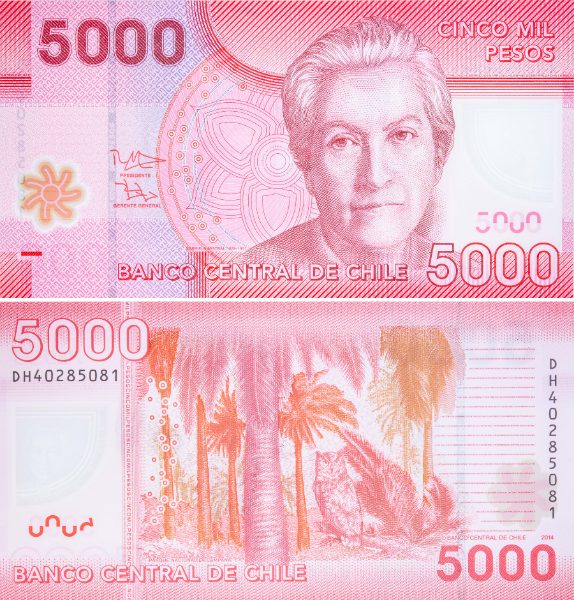
Gabriela Mistral was a woman of extraordinary firsts. As a poet, educator, diplomat, and humanist, she became the first Latin American writer to receive the Nobel Prize in Literature in 1945. Her lyrical poetry—deeply marked by themes of love, tragic loss, maternal instinct, and a fierce defense of the marginalized—elevated her from a self-taught teacher in Chile's rural valleys to one of the most prominent intellectual figures of the twentieth century (Scarpa, 1977). Today, her profound legacy is woven into the daily commerce of her homeland, where her portrait graces Chile's violet 5,000-peso polymer banknote, celebrating both her literary genius and her deep connection to the Chilean landscape.
Key Facts
Feature | Details |
|---|---|
Full Name | Lucila de María del Perpetuo Socorro Godoy Alcayaga (Pseudonym: Gabriela Mistral) |
Born | April 7, 1889 (Vicuña, Elqui Valley, Chile) |
Died | January 10, 1957 (Hempstead, New York, United States) |
Occupations | Poet, Educator, Diplomat, Humanist |
Major Literary Works | Desolación (1922), Tala (1938), Lagar (1954), Sonetos de la Muerte (1914) |
Major Honors | Nobel Prize in Literature (1945); Chilean National Literature Prize (1951) |
Banknote Representation | Obverse portrait on the 5,000 Chilean Pesos banknote (polymer series) |
Key Takeaways
A Voice for the Oppressed: Mistral used her global literary platform to advocate tirelessly for the rights of children, women, indigenous populations, and the rural poor across Latin America.
Revolutionary Educator: Beyond her poetry, she was a pioneering educational reformer who restructured Mexico's national school system in the 1920s and championed secular, accessible public education for all.
Trailblazing Diplomat: She served as a Chilean consul in major global cultural hubs, including Madrid, Lisbon, Nice, Naples, and New York, representing her country on the world stage at a time when women were largely excluded from diplomatic corps.
The Soul of the Elqui Valley: Her deep spiritual connection to the rugged valleys of northern Chile shaped her raw, rustic poetic voice and remains beautifully honored on the national currency that bears her likeness.
Early Life and the Crucible of Sorrow
Mistral was born Lucila Godoy Alcayaga on April 7, 1889, in Vicuña, a small town nestled in the dramatic, arid Elqui Valley of northern Chile (Taylor, 1975). Raised in poverty by her mother after her schoolmaster father abandoned the family when she was just three years old, she spent her childhood in the rural village of Montegrande. The towering Andean mountains and dry, sun-baked earth of the Elqui Valley would forever serve as the primary geographical anchor for her creative soul.
Her path to becoming a writer was forged in deep personal tragedy. In 1906, while working as a teacher's assistant, she met a young railway worker named Romelio Ureta. The two shared a profound, tragic bond that ended abruptly in 1909 when Ureta died by suicide (Fiol-Matta, 2002).
Grief-stricken, she channeled her raw, agonizing sorrow into poetry. Under the pseudonym Gabriela Mistral—constructed as a tribute to her two favorite poets, Gabriele D'Annunzio and Frédéric Mistral—she published Sonetos de la Muerte ("Sonnets of Death") in 1914. The collection won first prize in Chile’s prestigious Juegos Florales literary contest in Santiago, instantly catapulting her into national prominence.
The Teacher-Poet and Mexican Educational Reform
Despite her growing literary fame, Mistral's primary passion remained education. Lacking a formal university degree, she managed to pass the demanding state exams to earn her official teacher's credential. She dedicated herself to teaching in the most remote, impoverished rural regions of Chile, from the scorching Atacama Desert in the north to the wind-swept plains of Patagonia in the south (Taylor, 1975).
Her reputation as an innovative, compassionate educator spread far beyond Chile's borders. In 1922, the Mexican Minister of Education, José Vasconcelos, invited Mistral to Mexico to help rebuild the country's public education system following the devastating Mexican Revolution (Santandreu, 1989).
[Rural Chilean Classrooms] ──> [Mexican Educational Reform (1922)] ──> [League of Nations Envoy] ──> [Global Consular Service]
In Mexico, Mistral pioneered:
Rural Schools (Escuelas de la Patria): Designing libraries and schools specifically tailored for indigenous and rural farming communities.
Access to Literature: Editing a landmark anthology of literature specifically curated for children and mothers, ensuring classics were translated and made available for free in public libraries.
Vocational and Evening Education: Establishing night schools for adult laborers and technical training schools for women to foster economic independence.
Her work in Mexico solidified her philosophy that education was not merely about rote memorization, but a sacred, spiritual act of elevating the human soul (Mistral, 1923).
Literary Masterpieces: From Despair to Maternity
In 1922, while working in Mexico, Mistral published her first major book of poetry, Desolación ("Desolation"), printed in New York through the efforts of Spanish-American scholars (Scarpa, 1977). Desolación is a raw, emotional landscape of pain, chronicling her grief over Ureta's suicide and her unfulfilled maternal desires.
As Mistral traveled and matured, her poetic focus shifted from intensely personal sorrow to a broader, maternal embrace of humanity. This evolution is beautifully captured in her subsequent major works:
Tala (1938): Published to raise funds for children orphaned by the Spanish Civil War. The title refers to "felling" or "devastating" the earth, representing a sacrificial clearing of personal grief to celebrate the landscapes, myths, and indigenous peoples of the Americas (Fiol-Matta, 2002).
Lagar (1954): Her final major poetry collection published during her lifetime. Literally translating to "winepress," Lagar explores themes of spiritual transformation, the tragedies of World War II, and the deep, silent strength of women suffering in the shadows of global conflict.
The Nobel Stage and Diplomatic Career
In the mid-1920s, Mistral’s expanding international prestige led to diplomatic appointments. She served as Chile’s representative to the League of Nations Institute of Intellectual Cooperation in Paris, before being named a consul for life by the Chilean government (Santandreu, 1989).
She spent the next three decades traveling the world as a cultural ambassador and consul. She developed close friendships with global literary figures, including the Austrian writer Stefan Zweig and the French philosopher Henri Bergson.
On December 10, 1945, Gabriela Mistral stood before King Gustaf V of Sweden to receive the Nobel Prize in Literature. The Swedish Academy honored her:
"For her lyric poetry which, inspired by powerful emotions, has made her name a symbol of the idealistic aspirations of the entire Latin American world." (Nobel Foundation, 1945).
During her emotional acceptance speech, she famously declared herself the "daughter of Chilean democracy," choosing to accept the award on behalf of the forgotten writers, teachers, and indigenous peoples of the American continent.
       GABRIELA MISTRAL'S POETIC EVOLUTION
┌─────────────────────────────────────────────────────────────┐
│ 1. PERSONAL GRIEF (1914)  ─> "Sonetos de la Muerte"         │
├─────────────────────────────────────────────────────────────┤
│ 2. DESPAIR & FAITH (1922) ─> "Desolación"                   │
├─────────────────────────────────────────────────────────────┤
│ 3. MATERNITY & MYTH (1938)─> "Tala"                         │
├─────────────────────────────────────────────────────────────┤
│ 4. GLOBAL COMPASSION(1954)─> "Lagar"                        │
└─────────────────────────────────────────────────────────────┘
Preserving the Poet: The 5,000-Peso Banknote
In 2009, the Central Bank of Chile (Banco Central de Chile) introduced its modern polymer banknote series. Gabriela Mistral was selected to remain the face of the 5,000 Pesos banknote (the Cinco Mil Pesos), honoring her status as Chile's premier literary ambassador.
The Obverse (Heads): Features a magnificent, dignified portrait of Mistral in her later years, reflecting her wisdom, strength, and serene gaze. Adjacent to her portrait is a stylized "Antu" (Mapuche sun symbol) and a transparent security window showcasing her image in miniature.
The Reverse (Tails): Showcases the breathtaking, sun-kissed ridges of her beloved Elqui Valley in northern Chile, complete with a majestic Andean Condor soaring over the peaks.
By combining her image with the condor and the valley that birthed her, the banknote physically connects Mistral's literary genius directly to the geological heart of Chile.
Frequently Asked Questions (FAQs)
What was the inspiration behind Lucila Godoy's pen name, Gabriela Mistral?
She created her pen name by combining the names of two of her greatest literary influences: the Italian poet and novelist Gabriele D'Annunzio and the Occitan poet Frédéric Mistral, who won the Nobel Prize in Literature in 1904.
Did Gabriela Mistral ever have children of her own?
No, Mistral never married or had biological children, a source of profound sorrow that heavily influenced her poetic themes of maternal longing and maternal instinct. However, she took in and raised her young nephew, Juan Miguel Godoy (whom she affectionately called "Yin Yin"), as her own son. Tragically, Yin Yin died by suicide at the age of 18 in Brazil, plunging Mistral into a deep, second wave of profound grief that shadowed her later collections.
Why is she considered so important to the history of education?
Mistral believed education was a fundamental human right rather than a privilege. Her work reforming rural schools in Chile and restructuring the national educational framework of Mexico prioritized indigenous integration, secular teaching, and establishing free access to classical literature for rural, impoverished families.
Where can tourists and literary enthusiasts visit memorials dedicated to her?
The most famous site is the Gabriela Mistral Museum located in her childhood home of Montegrande in the Elqui Valley, where her remains are buried in a peaceful mausoleum overlooking the mountains. Visitors can also explore the Gabriela Mistral National Library and the GAM Cultural Center in downtown Santiago.
Bibliography
Fiol-Matta, L. (2002). A Queer Mother for the Nation: The State and Gabriela Mistral. Minneapolis: University of Minnesota Press.
Mistral, G. (1923). Lecturas para Mujeres. Mexico City: Secretaría de Educación Pública.
Nobel Foundation. (1945). Gabriela Mistral: Biographical and Acceptance Speech. Nobel Prize Outreach. Stockholm. Available at: NobelPrize.org
Biblioteca Nacional de Chile. (2026). Gabriela Mistral (1889-1957). Memoria Chilena: Portal de la Cultura de Chile. Available at: Memoria Chilena
Santandreu, A. (1989). Gabriela Mistral: Obra y Vida. Santiago: Ediciones Andrés Bello.
Scarpa, R. E. (1977). Una Mujer Llamada Gabriela. Santiago: Editorial Nascimento.
Taylor, M. C. (1975). Sensibilidad y Estilo en la Poesía de Gabriela Mistral. Madrid: Editorial Gredos.