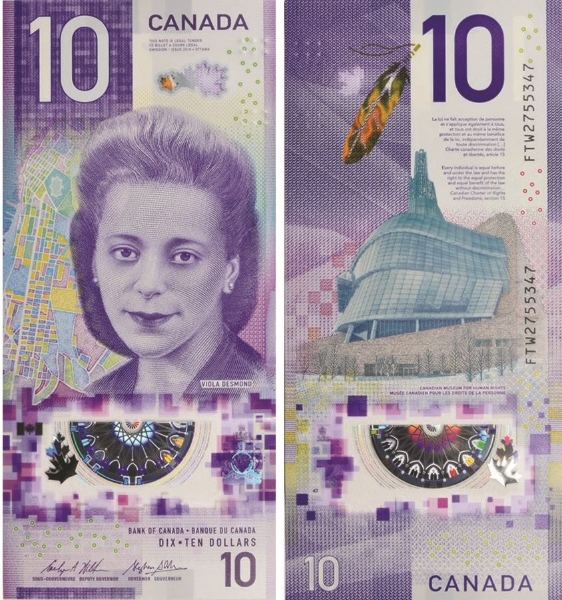
 - WCA3126.jpg)
Picture Source of Viola Desmond: Wikipedia
Viola Desmond: The Courageous Entrepreneur Who Sparked Canada's Civil Rights Movement
Viola Irene Desmond was a pioneering Black Canadian businesswoman, beautician, and civil libertarian who became a towering figure in Canada's struggle for human rights. Long before her historic stand made her a household name, Desmond was a highly successful entrepreneur who built a cosmetics empire and mentored young Black women across Atlantic Canada.
On November 8, 1946, her life changed forever when she refused to accept racial discrimination at a movie theatre in New Glasgow, Nova Scotia. Her subsequent arrest and legal challenge galvanized the Black community of Nova Scotia and laid the groundwork for the dismantling of legal segregation in Canada. Today, her legacy is celebrated nationwide, most visibly through her portrait on Canada's vertically oriented ten-dollar banknote, making her the first Canadian-born woman to appear on a regularly circulating Canadian bill.
Key Facts
Fact Category | Details |
|---|---|
Birth Date & Place | July 6, 1914 |
Death Date & Place | February 7, 1965 (Age 50) |
Profession | Beautician, Cosmetics Entrepreneur, Educator, and Civil Libertarian |
Primary Business | Vi's Studio of Beauty Culture, Desmond School of Beauty Culture |
Landmark Incident | Arrested for sitting in the "whites-only" section of the Roseland Theatre (November 8, 1946) |
Pretext for Conviction | Alleged evasion of a one-cent provincial amusement tax |
Posthumous Pardon | Granted on April 15, 2010, by Nova Scotia Lieutenant Governor Mayann Francis |
National Recognition | Featured on the Canadian 10-dollar bill (2018), Named a National Historic Person (2018) |
Key Takeaways
A Visionary Business Leader: Desmond was a trailblazing entrepreneur who developed her own line of cosmetics for dark skin tones and opened a beauty school to secure economic independence for young Black women in Canada.
Challenging Segregation: Nine years before Rosa Parks refused to give up her bus seat in Montgomery, Alabama, Desmond stood up to racial segregation in Canada by refusing to leave a main-floor seat at the Roseland Theatre.
The Tax Evasion Loophole: Because Nova Scotia had no official, written segregation laws, authorities used a one-cent tax discrepancy between balcony and main-floor tickets to prosecute, fine, and convict her.
A Turning Point for Civil Rights: Desmond's legal appeal was the first known direct challenge to racial segregation brought before a Canadian court, uniting Black communities and civil rights organizations across Nova Scotia.
Historic Posthumous Honors: In 2010, the Crown granted Desmond the first posthumous royal pardon in Canadian history, officially recognizing that her arrest was entirely motivated by racial discrimination.
Early Life and the Drive for Independence
Viola Irene Davis was born in Halifax, Nova Scotia, on July 6, 1914. She grew up in a large, tight-knit, and highly respected family of ten children. Her father, James Albert Davis, was a stevedore who successfully established himself as a local barber, while her mother, Gwendolin Irene Davis, was the daughter of a white minister who had moved to Halifax from the United States (Britannica, 2026).
In early 20th-century Halifax, racial segregation was not codified by explicit "Jim Crow" laws as it was in the southern United States, but it was rigidly enforced through social custom and commercial policies (Canadian Museum for Human Rights, 2021). After graduating from high school, Desmond worked briefly as a teacher in segregated schools for Black children—one of the few professional paths open to her.
However, she held a deep passion for beauty culture and cosmetics. Recognizing that Black women had almost no access to specialized hair and skin products, she dreamed of opening her own salon. Because beauty schools in Nova Scotia barred Black applicants, Desmond refused to let discrimination halt her ambitions. She traveled to Montreal to train at the Field Beauty Culture School, and later to Atlantic City, New Jersey, and New York City to complete her cosmetology licensing, learning from trailblazing Black beauty pioneers (Parks Canada, 2022).
Building a Black Beauty Empire
Upon returning to Halifax, she established Vi's Studio of Beauty Culture, catering specifically to Black women who had long been ignored by white-owned salons. The business was an immediate success, serving as a social and commercial hub for the local community (Canada.ca, 2021).
Desmond soon realized she could empower other women by expanding her business. She launched her own line of cosmetics, Sepia Beauty Products, and founded the Desmond School of Beauty Culture. At a time when career prospects for Black women were severely limited, Desmond’s academy provided comprehensive training, business education, and professional licensing (EBSCO, 2026). The school grew rapidly, drawing students from New Brunswick and Quebec, and graduating up to 15 students a year who would go on to open their own salons across Eastern Canada.
The Roseland Theatre Incident
On November 8, 1946, Desmond was driving from Halifax to Sydney, Nova Scotia, on a business trip to deliver her beauty products. While passing through the small town of New Glasgow, her car suffered a mechanical breakdown (History Museum, 2023). Informed that the repairs would take several hours, she decided to go to the nearby Roseland Theatre to watch a movie and pass the time.
At the box office, Desmond asked for a ticket to sit on the main floor. The cashier handed her a ticket, and Desmond walked into the main auditorium. When she sat down, an usher stopped her, stating that her ticket was only valid for the balcony.
Confused, Desmond returned to the box office and asked the cashier to exchange her ticket for a main-floor seat, offering to pay whatever price difference was required. The cashier refused, stating flatly: "I'm not permitted to sell downstairs tickets to you people." (Canadian Museum for Human Rights, 2021).
Realizing she was being denied seating solely because of her skin color, Desmond made a conscious decision to resist the insult. She walked back into the theatre and sat in the main floor section. The manager confronted her, demanding she move. When she quietly but firmly refused, the manager called the police. Two officers physically dragged Desmond from the theatre, injuring her hip and knee, and threw her into a local jail cell where she was held overnight (Britannica, 2026).
The Legal Sham: The "One-Cent" Tax
The following morning, Desmond was brought to court and charged with attempting to defraud the provincial government of Nova Scotia.
Because Nova Scotia did not have official laws enforcing segregation, the court had no legal basis to prosecute her for where she sat. Instead, they relied on a technicality: the difference in the provincial amusement tax between a balcony ticket and a main-floor ticket was exactly one cent (Parks Canada, 2022).
The court argued that by sitting on the main floor with a balcony ticket, Desmond had evaded paying this single penny in tax. Without legal counsel or any representation, Desmond was convicted of tax evasion and fined 26 dollars (comprising a 20-dollar fine and 6 dollars in court fees, a portion of which was awarded directly to the theatre manager who acted as the prosecutor) (EBSCO, 2026).
The Civil Rights Battle and Its Aftermath
Upon returning to Halifax, Desmond sought medical attention for the physical injuries she sustained during her arrest. Her doctor encouraged her to fight the conviction, as did local leaders in the Nova Scotian civil rights movement. Carrie Best, the pioneering founder of Nova Scotia's first Black-owned newspaper, The Clarion, publicized Desmond's story on the front page, bringing the issue of systemic Canadian racism to light (Canadian Museum for Human Rights, 2021).
The newly formed Nova Scotia Association for the Advancement of Coloured People (NSAACP) raised funds to support Desmond's legal appeal. Her lawyer, Frederick Bissett, applied to the Supreme Court of Nova Scotia to overturn the conviction.
Unfortunately, in 1947, the Supreme Court judges dismissed the appeal on narrow, technical legal grounds. Rather than addressing the blatant racial discrimination of the arrest, the court ruled that the appeal had not been filed within the correct legal timeframe, leaving the tax fraud conviction on her record (Britannica, 2026).
Though the legal battle was lost, the publicity around Desmond’s case forced the provincial government to reckon with the injustice of its policies. In 1954, Nova Scotia officially outlawed segregation in public spaces, a victory heavily credited to the social momentum generated by Desmond's bravery.
The personal cost to Desmond, however, was devastating. Her marriage broke down, her beauty school in Halifax ultimately closed, and she relocated to Montreal and then New York City, seeking anonymity. She passed away in New York on February 7, 1965, at the age of 50 (EBSCO, 2026).
A Legacy Restored
For decades, Desmond's historic stand was largely overlooked outside of Nova Scotia's Black community. However, through the persistent efforts of her sister, Wanda Robson, and human rights historians, her story was finally elevated to the national stage.
On April 15, 2010, Mayann Francis—the first Black Lieutenant Governor of Nova Scotia—signed a posthumous Royal Pardon for Viola Desmond, officially declaring her innocence and apologizing to her family (History Museum, 2023). This marked the first time a posthumous pardon had ever been granted in Canada.
In 2018, the Bank of Canada unveiled a new, vertical ten-dollar banknote featuring Viola Desmond. By choosing Desmond, Canada honored a champion of equality, cementing her place alongside the nation's most influential historical figures.
Frequently Asked Questions (FAQs)
Why is Viola Desmond often called the "Rosa Parks of Canada"?
Both women bravely defied racial segregation by refusing to give up their seats—Desmond in a movie theatre in 1946, and Parks on a city bus in 1955. Although Desmond’s action occurred nine years before Parks’ famous protest, the comparison helps audiences understand her monumental role in Canada’s civil rights movement.
Was segregation legal in Canada?
Unlike the "Jim Crow" laws in the United States or apartheid in South Africa, Canada did not have a uniform federal system of legislated segregation. Instead, private businesses, theatres, and restaurants made and enforced their own discriminatory rules, which the legal system frequently protected under the guise of "freedom of commerce."
What was the "one-cent tax" in Viola Desmond's trial?
To avoid explicitly mentioning racial segregation in the court record, the prosecution charged Desmond with defrauding the government of one cent. This was the difference in provincial amusement tax between the cheap balcony ticket she was forced to buy and the main-floor seat she chose to sit in.
What happened to the Desmond School of Beauty Culture?
Following the stress and public backlash of her trial, Desmond closed her beauty academy and moved away from Nova Scotia. However, the women she trained went on to operate successful salons throughout Eastern Canada, keeping her entrepreneurial spirit alive for generations.
How can I see the historical marker dedicated to Viola Desmond?
A commemorative plaque is installed at the site of the former Roseland Theatre at 188 Provost Street in New Glasgow, Nova Scotia, along a street named "Viola's Way" in her honor (Parks Canada, 2022).
Bibliography & References
Britannica, The Editors of Encyclopaedia (2026). Viola Desmond | Biography, Family, & Facts. Britannica Biography Portal
Canada, Government of (2021). Viola Desmond (1914-1965) - Women of Impact. Canada.ca Commemorations Profile
Canadian Museum for Human Rights (2021). Viola Desmond: One woman's resistance. CMHR Digital Story
Canadian Museum of History (2023). Civil Rights in Nova Scotia: The Story of Viola Desmond. Museum of History Teachers Zone
EBSCO Research Starters (2026). Viola Davis Desmond - Women's Studies and Feminism. EBSCO Information Portal
Parks Canada (2022). Viola Desmond (1914-1965) National Historic Person. Parks Canada Directory