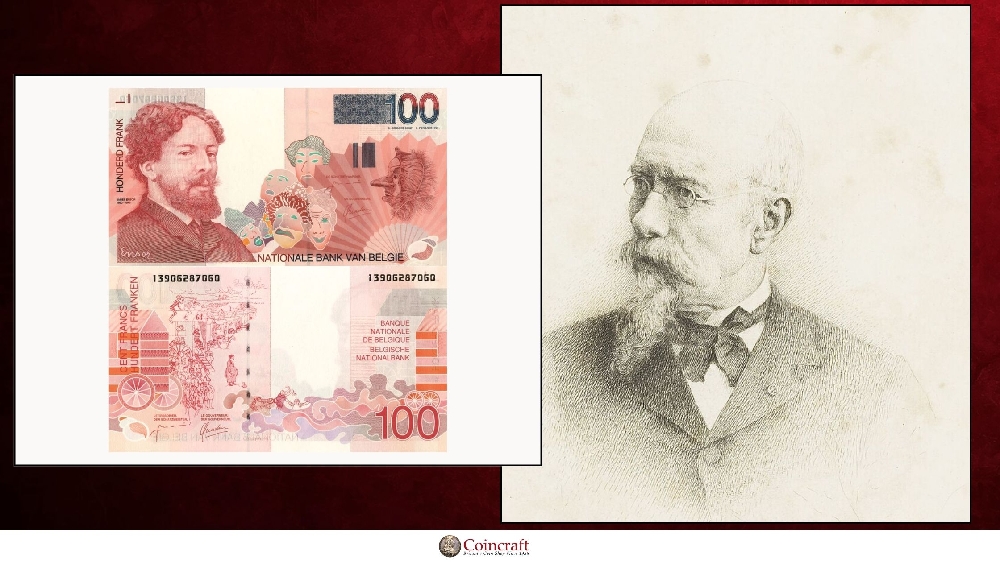
Picture Source of Hendrik Bayaert (1823 - 1894): Wikipedia
Hendrik Beyaert: The Eclectic Master of Belgian Architecture
(Note: The subject of this article is frequently misspelled as "Hendrik Bayert.")
Hendrik Jozef Frans Beyaert (1823–1894) stands as one of the most consequential figures in 19th-century Belgian architecture. Emerging during a period when a newly independent Belgium was forging its cultural identity, Beyaert transitioned from humble origins to become a master of architectural eclecticism. While he built his reputation on historical revivals—most notably the Flemish Renaissance Revival—his deep understanding of structural logic and spatial design laid the foundational groundwork for the spectacular explosion of Art Nouveau at the turn of the 20th century [1].
From grand civic banking headquarters to romantic medieval castle restorations, Beyaert's portfolio shaped the modern aesthetic of Brussels and the surrounding regions, securing his place as a visionary who bridged the gap between historical tradition and modern innovation.
Key Facts
Birth: July 29, 1823, in Kortrijk, Belgium.
Death: January 22, 1894, in Brussels, Belgium.
Profession: Architect and Urban Planner.
Notable Styles: Neo-Baroque, Flemish Renaissance Revival, Eclecticism.
Key Masterpieces: National Bank of Belgium (Brussels), Halle Gate restoration, Maison des Chats, Petit Sablon Square, and Bornem Castle.
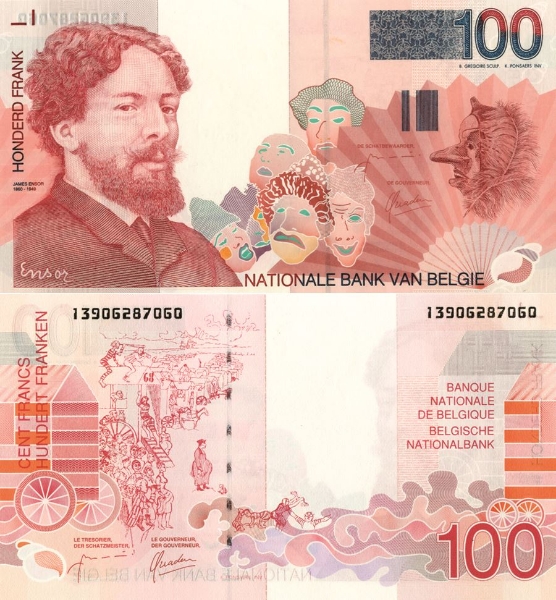
Legacy: Mentor to Paul Hankar; profound influencer of the Art Nouveau movement; featured on the 100 Belgian Franc banknote from 1978 to 1994 [2].
Key Takeaways
From Clerk to Master Builder: Beyaert’s remarkable rise from a humble bank employee to Belgium’s premier architect highlights a career built on raw passion, practical stonemasonry experience, and rigorous academic study.
Architect of Belgian Identity: By pioneering the Flemish Renaissance Revival style, Beyaert helped construct a distinct, prideful visual identity for the newly independent Belgian state.
Structural Rationalism: While his buildings appear historically decorative, Beyaert was a modernist in his structural thinking. He believed ornamentation should serve the structural realities of the building, a concept borrowed from French theorists.
The Father of Art Nouveau's Pioneers: By mentoring Paul Hankar and influencing the broader architectural discourse in Brussels, Beyaert served as the crucial bridge between 19th-century historical eclecticism and 20th-century modernism.
Early Life and Unconventional Education
Unlike many of his aristocratic or wealthy contemporaries in the arts, Beyaert was born into a family of modest means, a circumstance that profoundly shaped his relentless work ethic. Unable to initially afford a traditional university education or fine arts schooling, a 19-year-old Beyaert began his professional life as a simple bank clerk at the National Bank in his hometown of Kortrijk [1]. However, the mundane world of finance could not stifle his creative ambitions.
Driven by a profound fascination with building design and structural engineering, Beyaert made the bold decision to leave his stable banking job. He took a labor-intensive position as an apprentice stonemason on the construction site of the new railway station in Tournai. In a poetic twist of historical fate, that very building would be replaced decades later by a grand railway station of Beyaert's own design [1].
In 1842, he relocated to Brussels. To survive and fund his education, Beyaert opened and managed a small bookshop. He simultaneously enrolled in the Royal Academy of Fine Arts in Brussels, studying under the prominent architect Tieleman François Suys. Bolstered by his wages from the bookshop and a small municipal scholarship from his home city of Kortrijk, Beyaert successfully completed his architectural studies in 1846, armed with a rare combination of practical stonemasonry experience and rigorous academic training [2].
Architectural Style and the Search for a National Identity
Beyaert’s early career was defined by an eclectic approach, heavily influenced by the lavish, heavily ornamented styles popular in Paris during the Second Empire. His first major public commission, designed in collaboration with architect Wynand Janssens, was the Head Office of the National Bank of Belgium (1859–1867) in Brussels [2]. This monumental Neo-Baroque structure firmly established Beyaert's reputation as a premier architect capable of handling grand civic projects.
However, Beyaert’s style underwent a significant philosophical evolution following his exposure to the writings of the French architectural theorist Eugène Viollet-le-Duc [1]. Viollet-le-Duc advocated for structural rationalism in architecture—the idea that a building's design and ornamentation should be logically dictated by its structural materials and its inherent purpose.
This philosophy deeply impacted Beyaert, especially during his restoration projects of medieval structures. He developed an acute appreciation for late Middle Age and early Renaissance local styles. Consequently, Beyaert championed the "Flemish Renaissance Revival," a highly ornamental yet structurally logical style that was quickly adopted as Belgium's "national" style in the late 19th century [1][3]. While his buildings were richly decorated with historical ornamentation, they never lacked a clear, highly original structural basis.
Iconic Masterpieces
Throughout his prolific career, Beyaert transformed the architectural landscape of Belgium. Several of his works remain iconic European landmarks today:
The Halle Gate (1868–1871) Tasked with restoring a decaying vestige of the medieval fortifications of Brussels, Beyaert converted the Halle Gate into a functional museum. Applying Viollet-le-Duc’s romanticized restoration principles, he didn't just preserve the structure; he modified it to fit a 19th-century idealized vision of the Middle Ages, adding a striking neo-Gothic roof, spiraling turrets, and fortified battlements [2].
Maison des Chats (1874) Following the covering of the river Senne in Brussels, an architectural contest was held to beautify the newly created urban boulevards. Beyaert won first prize with his Maison des Chats (House of Cats). This tall, narrow building is widely celebrated for its intricate, asymmetrical facade and whimsical feline sculptures, perfectly demonstrating his mastery of historical ornamentation applied to modern urban spaces [1].
Petit Sablon Square (1879–1899) Demonstrating his immense skill in urban planning, Beyaert designed this exquisite park in the heart of Brussels. The trapezium-shaped green space is enclosed by a magnificent wrought-iron fence topped with 48 bronze statuettes. Each statue represents a traditional medieval Brussels guild, serving as both a public space and a celebration of working-class heritage [2].
Bornem Castle (1883–1894) Commissioned to renovate a ruined Spanish fortification on the Old Scheldt river, Beyaert transformed the remnants into a stunning neo-Renaissance moated castle. Drawing inspiration from the châteaux of the Loire Valley in France, he created a luxurious, peaceful residential palace that appears to magically float on the mirrored surface of the water [4].
Palace of the Nation (1883–1886) When the Belgian Federal Parliament building suffered extensive fire damage, Beyaert was entrusted with its reconstruction and renovation, solidifying his status as the trusted architect of the Belgian state [1].
Legacy: The Bridge to Art Nouveau
While Hendrik Beyaert is historically categorized as an eclectic revivalist, his most enduring legacy arguably lies in his profound influence on the subsequent generation of architects. He possessed a vast personal library on architectural history and decorative arts, and he was deeply committed to the idea of "structural truth." His geometric architecture imitated the spirit, but rarely the exact details, of historical models [1].
This progressive mindset made his studio the ultimate training ground for young, avant-garde architects. Most notably, Paul Hankar worked in Beyaert's studio as a chief designer from 1879 to 1894 [3]. Under Beyaert’s rigorous mentorship, Hankar learned how to combine traditional craftsmanship with innovative structural rationalism. When Hankar left to open his own practice, he immediately designed the Hankar House (1893)—widely considered, alongside Victor Horta's Hôtel Tassel, as one of the first true Art Nouveau buildings in the world [3][5].
Beyaert's emphasis on visible structural joints, the honest use of materials, and geometric clarity directly informed the foundational principles of Belgian Art Nouveau. In recognition of his immense contribution to the nation's cultural heritage, Hendrik Beyaert was inducted into the Royal Academy of Science, Letters and Fine Arts of Belgium in 1888 [1]. Further cementing his iconic status, his bespectacled portrait graced the Belgian 100 Franc banknote for over fifteen years, ensuring his face was as recognized by the public as the buildings he designed [2].
Frequently Asked Questions (FAQs)
Q1: Why is Hendrik Beyaert sometimes spelled as Hendrik Bayert? A: "Hendrik Bayert" is a common phonetic misspelling. His name is officially recorded as Hendrik Jozef Frans Beyaert in Dutch, or Henri Beyaert in French.
Q2: What is Hendrik Beyaert's most famous building? A: His most prominent civic work is the Head Office of the National Bank of Belgium in Brussels. However, his romantic restoration of the Halle Gate and the picturesque urban planning of Petit Sablon Square are arguably his most beloved and frequently visited public works today.
Q3: How did Beyaert influence the Art Nouveau movement? A: Although Beyaert designed in historical revival styles, he prioritized "structural honesty"—meaning a building's internal skeleton and materials should dictate its outward form. He taught this rationalist approach to his chief designer, Paul Hankar. Hankar took these principles, stripped away the historical mimicry, and applied them to modern materials like forged iron and glass to help create the Art Nouveau style.
Q4: Did Hendrik Beyaert build Bornem Castle from scratch? A: No. Bornem Castle was originally a fortified Renaissance structure built by a Spanish nobleman. By the late 19th century, it was largely in ruins. Beyaert preserved the remaining wall sections and tower bases, cleverly incorporating them into a massive renovation that transformed the site into the pristine, Loire-style moated castle seen today.
Q5: Was Beyaert recognized for his work during his lifetime? A: Yes, highly recognized. He won numerous architectural competitions, handled the most important state commissions of his era, and was inducted into the Royal Academy of Science, Letters and Fine Arts of Belgium.
References
"Hendrik Beyaert." Wikipedia, Wikimedia Foundation.
"Hendrik Beyaert in Antwerp." Antwerpist.
"Paul Hankar." Wikipedia, Wikimedia Foundation.
"Castle." Kasteel van Bornem.
"A cosmopolitan chair for Philippe Wolfers' smoking room." Design Museum Gent.