Picture Source of Moritz Daffinger: Wikipedia
The Master of the Miniature: A Deep Dive into the Life and Art of Moritz Michael Daffinger
Before the advent of photography, the task of capturing the intimate, personal likeness of an individual fell to the hands of highly skilled miniature portraitists. In the sweeping cultural landscape of 19th-century Austria—a period defined by the Biedermeier era and the political maneuvering of the Austrian Empire—few artists were as celebrated or as prolific as Moritz Michael Daffinger. Regarded as one of the finest Austrian miniature portrait painters in history, Daffinger’s delicate brushwork, remarkable precision, and psychological insight made him the favored artist of European aristocracy and royalty [1].
Spanning a career that evolved from painting on porcelain cups to crafting masterworks on ivory, and eventually shifting into the world of botanical illustration, Daffinger’s life is a testament to artistic adaptability and genius.
Key Facts
Full Name: Moritz Michael Daffinger
Lifespan: January 25, 1790 – August 21, 1849 (59 years old) [1]
Birthplace & Deathplace: Vienna, Austria
Profession: Miniature portrait painter, porcelain painter, and sculptor
Education: Academy of Fine Arts Vienna (studied under Heinrich Füger) [1]
Primary Mediums: Watercolor and gouache on ivory, paper, and porcelain
Major Patrons: Klemens von Metternich, the House of Habsburg-Lorraine, and the European aristocracy during the Congress of Vienna.
Key Influences: Thomas Lawrence (English portraitist) and Jean-Baptiste Isabey (French miniaturist).
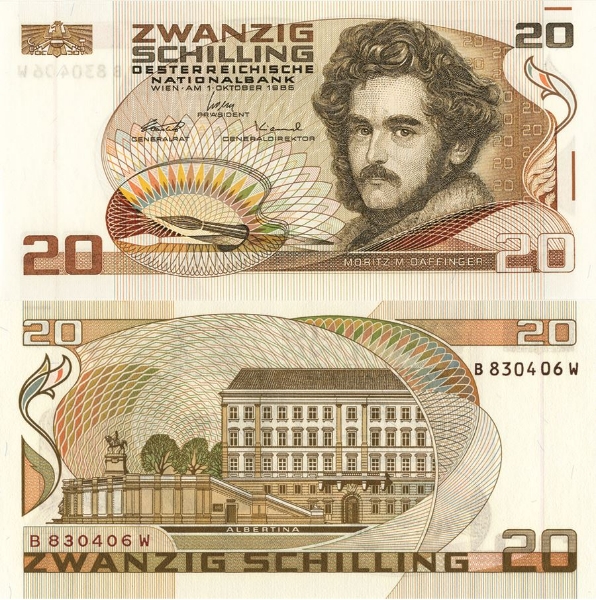
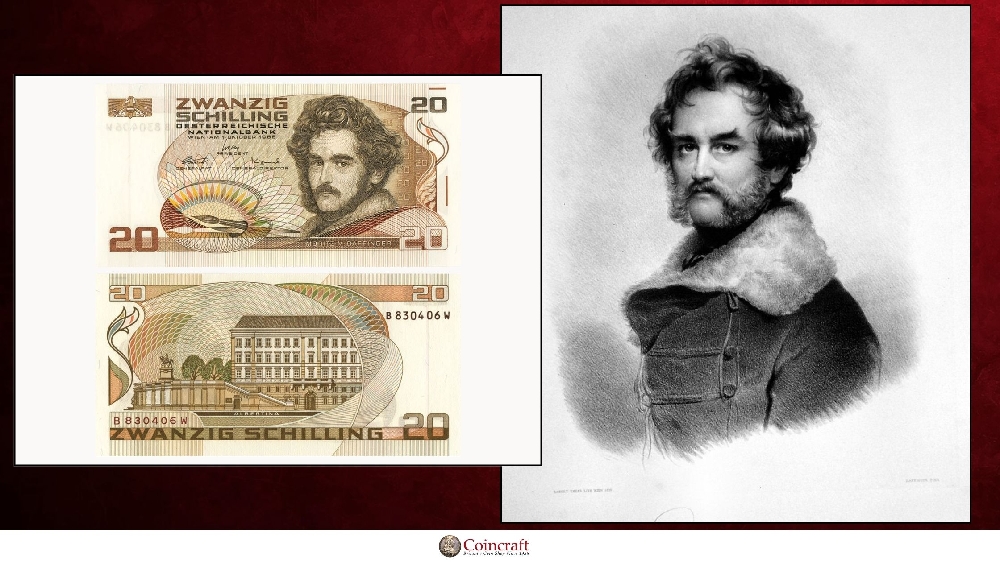
Cultural Honors: Buried in a grave of honor in Vienna; featured on the Austrian 20-schilling banknote (1986–1999) [2].
Key Takeaways
Master of the Miniature: Daffinger is considered one of the greatest miniature portrait painters of the 19th century, uniquely capturing the aesthetics and personalities of the Biedermeier era.
From Porcelain to Ivory: His early rigorous training as a porcelain painter gave him the steady hand and precision required to master the difficult art of painting watercolors on small wafers of organic ivory.
Political and Social Chronicler: By serving as the portraitist for Klemens von Metternich and the attendees of the Congress of Vienna, Daffinger visually documented the most powerful figures shaping post-Napoleonic Europe.
Evolution of Style: Rather than sticking to one method, Daffinger actively studied international artists like Isabey and Lawrence to evolve his style from stiff classicism to vibrant, emotionally resonant romanticism [1].
Late-Life Botanical Focus: His transition from painting society's elite to painting precise, intimate botanical watercolors highlights a deeply personal and contemplative final chapter of his artistic journey.
Early Life and the Porcelain Foundations
Moritz Michael Daffinger was born on January 25, 1790, in Lichtental, a suburb of Vienna, which was then a part of the Holy Roman Empire [1]. Art was quite literally in his blood. His father, Johann Daffinger (1748–1796), was a respected painter at the renowned Imperial and Royal Porcelain Manufactory in Vienna. His stepfather, Johann Philipp Krug, was also involved in the arts, providing young Moritz with an environment steeped in visual expression.
Following his father's death, an eleven-year-old Moritz was accepted as an apprentice at the same Vienna Porcelain Manufactory in 1801 [1]. It was here, under the tutelage of masters like Michael Weixelbaum, that he learned the foundational skills of his trade: a steady hand, an eye for microscopic detail, and an understanding of color theory on challenging surfaces.
His undeniable talent soon earned him a scholarship to the prestigious Academy of Fine Arts in Vienna. From 1802 to 1809, he studied painting under the direction of Heinrich Füger, a prominent classicist painter, alongside Hubert and Maurer [1]. Despite his formal schooling, he continued to work simultaneously as one of the premier porcelain painters at the manufactory, creating highly sought-after historical and mythological scenes, as well as portraits on plates, vases, and cups.
The Rise to Prominence and Imperial Patronage
Around 1809, Daffinger made a pivotal career shift. He began moving away from porcelain to focus almost exclusively on portraiture, specializing in miniature painting on ivory and small gouaches on paper. This transition proved incredibly lucrative and well-timed.
During the Congress of Vienna (1814–1815), the city was flooded with diplomats, royalty, and aristocrats from across Europe. Daffinger found himself in high demand. Miniatures were the ultimate luxury personal keepsakes of the era—often worn as jewelry or kept in private lockets—and Daffinger’s ability to capture both the likeness and the underlying spirit of his subjects made him an overnight sensation among the elite.
By 1812, his reputation had reached the highest echelons of the Austrian government. He was employed as a portraitist by Klemens von Metternich, the powerful Austrian Foreign Minister and architect of the post-Napoleonic European order [1]. Daffinger also became the curator of the extensive portrait collection belonging to Princess Melanie, Metternich's third wife. His access to the Austrian royal family and the main noble families of Austria cemented his status as the premier portraitist of the realm. He famously painted Napoleon II (the Duke of Reichstadt) and beautifully captured Metternich’s daughter, Klementine, posed as the goddess Hebe in 1819 [1].
Influences and Artistic Evolution
Daffinger was not an artist who stagnated; he constantly sought to refine his craft. He commissioned a portrait of himself from the celebrated French miniaturist Jean-Baptiste Isabey specifically to study Isabey's closely guarded techniques for painting on ivory [1].
However, his most profound influence came from the English portrait painter Sir Thomas Lawrence, who visited Vienna in 1819. Lawrence’s romantic, fluid style, his vibrant coloration, and his dramatic use of background deeply moved Daffinger. The Austrian miniaturist spent time copying Lawrence’s works, and this influence fundamentally altered Daffinger's style [1]. He shifted away from the rigid classicism of his early training, adopting a looser, more expressive pictorial structure that imbued his subjects with a striking sense of vitality and emotional depth.
A Late-Life Shift to Botanical Art
In his later years, Daffinger underwent another surprising artistic transformation. Driven by personal tragedy—most notably the death of his beloved daughter—and a desire for a quieter, more contemplative form of expression, he largely turned away from the high-pressure world of aristocratic portraiture [1].
Instead, he channeled his microscopic precision into painting flowers. These were not traditional, decorative floral still lifes arranged in vases; rather, they were meticulous, almost scientific botanical illustrations of plants and wildflowers. This late-career focus resulted in hundreds of exquisite watercolors that demonstrated his unparalleled observational skills and his deep appreciation for the natural world.
Death and Enduring Legacy
Moritz Michael Daffinger’s life was cut short when he contracted cholera during the devastating epidemic that swept through Vienna. He died on August 21, 1849, at the age of 59 [1]. He was initially buried in the St. Marx Cemetery, but his legacy was so profound that in 1912, his remains were exhumed and transferred to a grave of honor (Ehrengrab) in Vienna's Zentralfriedhof (Central Cemetery), alongside other titans of Austrian culture [1].
Daffinger left behind an astonishing body of work, comprising more than a thousand miniature portraits and hundreds of floral studies. Many of these works were owned by the Austrian imperial House of Habsburg-Lorraine and are now housed in major institutions like the Albertina in Vienna, the Museum of Fine Arts in Budapest [4], and the British Museum [5]. Today, his miniatures are highly prized by collectors, frequently commanding prices upwards of $100,000 at international art auctions [3].
Perhaps the most visible tribute to Daffinger's cultural impact was paid by the Republic of Austria itself. In 1986, his portrait—along with a palette and two brushes—was chosen to grace the obverse of the Austrian 20-schilling banknote [2]. The banknote circulated widely until it was demonetized with the introduction of the Euro in 1999, ensuring that the face of Austria's greatest miniaturist remained in the hands of the public for over a decade [2].
Frequently Asked Questions (FAQs)
Q: Why was Moritz Michael Daffinger featured on the Austrian 20-schilling banknote? A: Austria has a long tradition of honoring its most influential artists, scientists, and cultural figures on its currency. Daffinger was chosen for the 20-schilling note (issued in 1986) to celebrate his status as the nation's premier miniature portraitist and his role in documenting the Austrian imperial era. The reverse of the note featured the Albertina museum, which houses many of his works [2].
Q: What materials did Daffinger use to paint his miniatures? A: While he began his career painting with specialized enamels on porcelain, he is most famous for using watercolor and gouache painted directly onto thin, organic wafers of ivory. Ivory was favored for miniatures because its smooth, slightly translucent surface gave human skin tones a luminous, lifelike glow.
Q: Did Daffinger ever paint regular, large-scale portraits? A: Daffinger was almost entirely focused on small-scale works. While he was capable of larger compositions, his genius lay in the miniature. The high demand for personal, pocket-sized keepsakes before the invention of photography meant he could sustain a highly successful career focusing solely on this intimate format.
Q: How did Thomas Lawrence influence Daffinger’s work? A: Sir Thomas Lawrence was a famous English portraitist known for his fluid brushstrokes, vivid use of color, and dynamic, atmospheric backgrounds. When Lawrence visited Vienna in 1819, Daffinger was captivated by his work. Daffinger moved away from the flat, rigid backgrounds of his early career and began incorporating Lawrence's lively coloration and dramatic shading into his tiny ivory canvases [1].
Q: What happened to Daffinger's artwork after his death? A: Because many of his works were commissioned by wealthy aristocrats and the imperial family, a large portion of his art remained in private royal collections. Over time, these were either bequeathed to major museums (like the Albertina in Vienna and the DomQuartier in Salzburg) or passed down through generations. Today, when his miniatures appear at auction, they are highly sought after by private collectors [3].
References
"Moritz Michael Daffinger," Wikipedia, The Free Encyclopedia.
"The 20 Schilling Banknote Commemorating Austrian Artist Moritz Daffinger," Banknote World.
Biographical data and auction records for Moritz Michael Daffinger, Artnet.
"Portrait of a Man (István Széchenyi) - Moritz Michael Daffinger," Museum of Fine Arts, Budapest.
Archival collection data on Moritz Michael Daffinger, The British Museum.