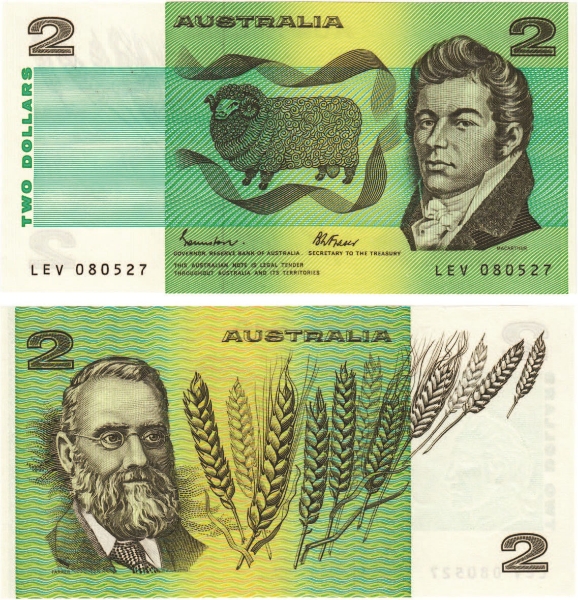
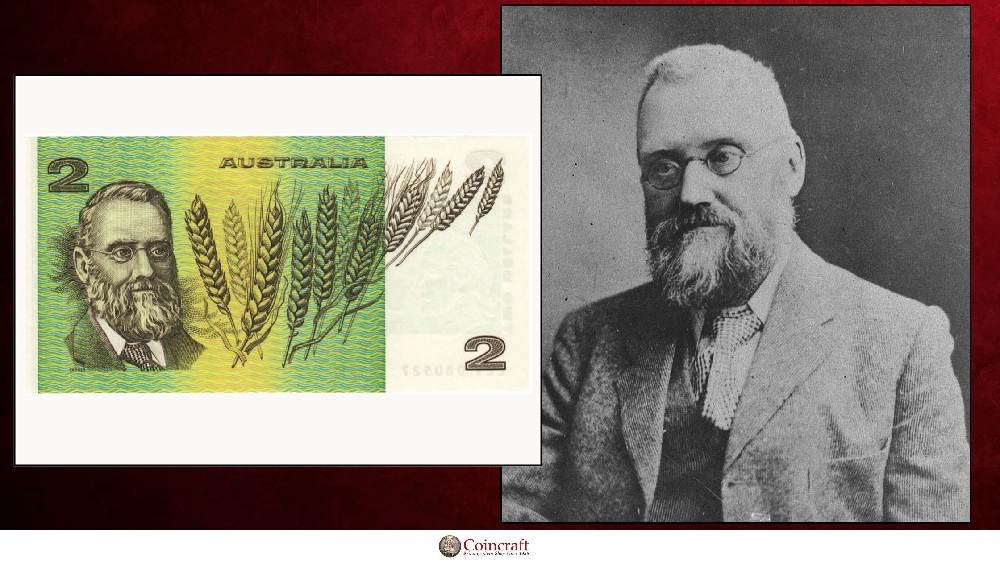
Picture Source William Farrer: Wikipedia
William Farrer: Father of the Australian Wheat Industry
William James Farrer (1845–1906) was a pioneering English-Australian agronomist and plant breeder whose scientific approach to agriculture fundamentally transformed the Australian economy. By recognizing that European wheat varieties were unsuited to the harsh Australian climate, Farrer dedicated his life to developing new, resilient strains through systematic cross-breeding. His crowning achievement, "Federation" wheat, solved critical issues of disease and drought, enabling the vast expansion of the Australian wheat belt and earning him the title of the "father of the Australian wheat industry" [1, 2].
Key Facts
Born: April 3, 1845, Docker, Westmorland (now Cumbria), England.
Died: April 16, 1906, Tharwa, New South Wales, Australia.
Education: Christ's Hospital, London; Pembroke College, Cambridge (B.A. in Mathematics).
Primary Estate: "Lambrigg," near Tharwa (present-day Australian Capital Territory).
Major Achievement: Developed "Federation" wheat (released in 1903), the first specifically Australian variety that was high-yielding, early-maturing, and suited to dry climates.
Titles & Roles: Appointed Wheat Experimentalist to the NSW Department of Agriculture in 1898.
Key Takeaways
Pioneer of Systematic Hybridization: Years before Mendelian genetics were widely understood, Farrer was conducting advanced, systematic cross-breeding experiments—initially transferring pollen between wheat plants using his wife's hairpins until he acquired proper forceps [1].
Solving the Rust Epidemic: Late 19th-century Australian harvests were devastated by stem rust. Farrer combated this not by finding true rust-resistant genes, but by breeding early-maturing varieties that could be harvested before the late-season rust fungus could take hold [1, 4].
Quality Over Quantity: Unlike contemporary farmers who only cared about bulk yield, Farrer worked with chemist F.B. Guthrie to breed wheat specifically for superior milling and baking qualities, putting Australia at the forefront of global wheat standards [2, 4].
Massive Economic Impact: Farrer's drought-tolerant strains allowed the wheat industry to move away from the wet, rust-prone coasts into the drier, inland plains. In New South Wales alone, wheat acreage quadrupled between 1897 and 1915 [1, 2].
Early Life and Arrival in Australia
William Farrer was born into a farming family in northern England. A brilliant student, he earned scholarships to study in London and subsequently at Cambridge University, where he excelled in mathematics. Following his graduation in 1868, Farrer began medical studies but contracted tuberculosis. Seeking a warmer, drier climate to recover, he migrated to Australia in 1870 at the age of 25 [1].
Initially, Farrer worked as a tutor on a sheep station at Duntroon (now part of Canberra). By 1875, he had qualified as a surveyor, a profession he practiced for the New South Wales Department of Lands for over a decade. His work as a surveyor exposed him to the wheat-growing districts of NSW, where he witnessed firsthand the immense struggles farmers faced with European wheat varieties that frequently succumbed to drought and fungal diseases like rust [1, 3].
The Lambrigg Experiments
In 1882, Farrer married Henrietta Nina de Salis. Four years later, her father gifted her a parcel of land on the Murrumbidgee River, which Farrer named "Lambrigg." Farrer resigned from his surveying position in 1886 to settle at Lambrigg and dedicate himself entirely to agricultural science [1, 3].
Following devastating colonial wheat crop failures in 1889 due to stem rust, Farrer's mission became clear. He began collecting wheat varieties from around the world—specifically targeting early-maturing Indian wheats and high-quality Canadian "Fife" wheats. In small, meticulously delineated plots, he began the arduous task of cross-pollination. Farrer evaluated parents and progeny by their results rather than their appearance, selecting only the strongest plants for further breeding [2, 4].
Crucially, in 1892, Farrer began a long-standing collaboration with F.B. Guthrie, a chemist who developed miniature flour-mills and bakehouses. This allowed Farrer to test the milling and baking quality of tiny yields from his experimental cross-breeds, a highly innovative practice for the era [1].
"Federation" Wheat and Later Career
Farrer's independent work was of such high caliber that in 1898, he was appointed as the Wheat Experimentalist to the NSW Department of Agriculture, granting him a salary and greater resources [1, 4].
His ultimate breakthrough came when he cross-bred "Yandilla" (a hybrid he had already created from Indian and Canadian Fife wheats) with "Purple Straw," a high-yielding but disease-prone European variety. The result was a strain with a strong, short straw that resisted wind damage, matured early enough to escape rust, and produced an excellent yield of high-quality grain. Farrer named this strain "Federation" in honor of the unification of the Australian colonies in 1901 [2].
Distribution of Federation wheat to farmers began in 1903. It was an immediate, overwhelming success. Between 1910 and 1925, Federation was the most widely planted wheat variety in Australia [2, 3].
Legacy
William Farrer died of heart disease at Lambrigg on April 16, 1906, and was buried on a rocky ridge overlooking his experimental paddocks. He did not live to see the peak of his work's impact, but his legacy was secured. By 1914, 22 of the 29 wheat varieties recommended for growing in NSW had been bred by him [1].
Farrer’s application of scientific principles to agriculture effectively saved the Australian wheat industry from collapse. By providing the strains necessary to push farming into the drier inland regions, he laid the foundation for Australia to become one of the world's leading grain exporters—a status it maintains today [2, 4].
References
Wrigley, C. W. (1981). "Farrer, William James (1845–1906)". Australian Dictionary of Biography, Volume 8. National Centre of Biography, Australian National University.
National Museum of Australia. (n.d.). "'Federation' wheat". Defining Moments in Australian History.
Encyclopedia of Australian Science and Innovation. (n.d.). "Farrer, William James (1845 - 1906)".
NSW Department of Primary Industries. (2013). "A Farrer Legacy – Innovation through collaboration". Farrer Memorial Oration.