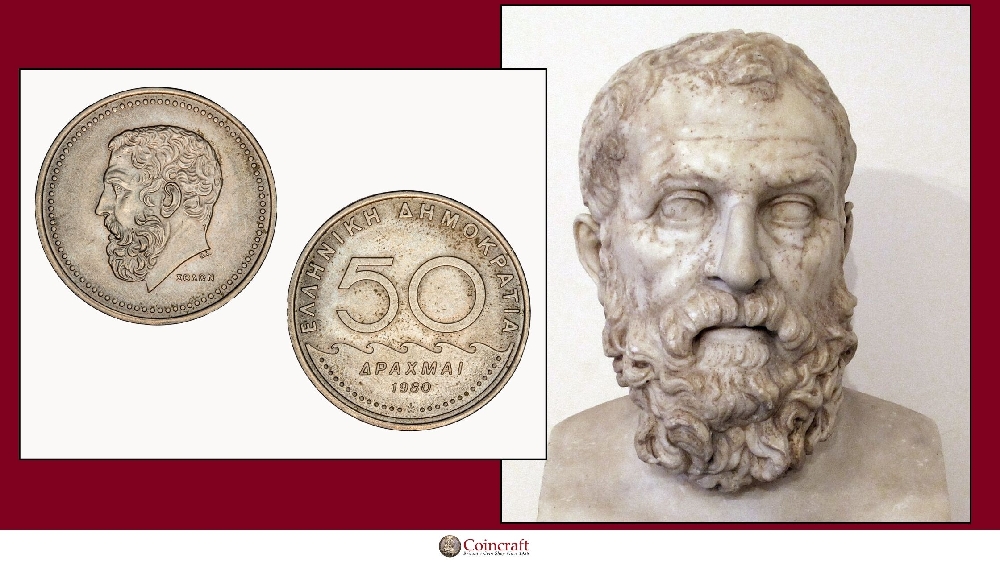
Picture Source of Solon: Wikipedia
The Sage of Athens: How Solon Saved a City and Sparked a Democracy
Imagine a city on the brink of self-destruction. The year is roughly 594 BCE, and Athens is not yet the shining beacon of democracy we picture today. Instead, it is a powder keg of class warfare. The rich hold all the power, while the poor are literally being sold into slavery because they can't pay their debts. The air is thick with the threat of civil war.
Into this chaos steps one man. He isn't a king, and he isn't a revolutionary general. He is a poet, a merchant, and a thinker. His name is Solon, and he is about to change the course of Western history.
Solon is often called the "Father of Democracy," but his story is far more complex and fascinating than a simple title suggests. He was a man of the "middle way," refusing to side completely with the rich or the poor, instead choosing the radical path of justice. Let’s dive into the life of the man who laid the first stones of the path toward a government by the people.
Key Takeaways
The Great Shake-Off: Solon’s most famous reform, the Seisachtheia, cancelled debts and famously outlawed the practice of debt slavery, freeing thousands of Athenians.
Wealth Over Birth: He restructured society into four classes based on agricultural production rather than noble birth, allowing upward social mobility for the first time.
The Middle Path: Solon refused to become a tyrant, despite having the opportunity. He mediated between the aristocracy and the common people to prevent civil war.
Poet-Statesman: Unlike modern politicians who use press releases, Solon used poetry to communicate his policies and justify his controversial decisions to the public.
One of the Seven Sages: His wisdom was so renowned that he was numbered among the Seven Sages of Greece, legendary figures of ancient wisdom.
The Poet in the Marketplace
Born around 630 BCE, Solon came from a noble family—the Eupatrids—that claimed descent from the legendary King Codrus¹. However, despite his blue blood, Solon wasn't fabulously wealthy. In his youth, he worked as a merchant, a profession that allowed him to travel, see the world, and understand economies outside of Athens².
Before he was a lawmaker, he was a celebrity poet. In a time before Twitter or newspapers, poetry was the mass media of the day. Solon first gained fame not for a law, but for a rallying cry. Athens had been fighting a losing war with Megara over the island of Salamis. The war was so unpopular that the government made it illegal to even mention trying to fight for the island again.
Solon, feigning madness to avoid the legal penalty, rushed into the marketplace and recited a passionate poem urging the Athenians to retake Salamis. "Let us go to Salamis to fight for the island / We desire, and drive away our bitter shame!" he cried³. It worked. The people rallied, the law was repealed, and Solon led the campaign that successfully took the island.
The Crisis: Athens on the Edge
By the early 6th century BCE, the economic situation in Athens was dire. The land was concentrated in the hands of a few wealthy families. Poor farmers, known as hektemoroi (sixth-part-ers), were forced to pay a sixth of their produce to landlords. If they failed to pay, the punishment was brutal: they and their families could be sold into slavery⁴.
The city was divided. The poor wanted the land to be redistributed; the rich wanted to keep their property and power. Both sides turned to Solon. The rich liked him because he was a noble; the poor trusted him because he had criticized the greed of the wealthy in his poems.
In 594 BCE, he was elected Archon Eponymous (chief magistrate) and given extraordinary powers to fix the broken state⁵.
The Seisachtheia: Shaking Off the Burdens
Solon’s first move was his most radical. He declared the Seisachtheia, or "Shaking Off of Burdens."
In one sweep, he cancelled all debts. He ordered the horoi—stone markers placed on land to show it was mortgaged—to be uprooted. Most importantly, he banned using human freedom as collateral for loans. Never again could an Athenian be enslaved by another Athenian for debt⁶.
He even used state funds to buy back citizens who had already been sold abroad. In his own poetry, he wrote: "And many a man whom fraud or law had sold / Far from his god-built land, an outcast slave / I brought again to Athens."⁷
While this saved the poor, it angered the rich who lost their money. Simultaneously, Solon disappointed the poor by refusing to redistribute the land entirely. He famously said, "I stood with a strong shield before both parties / And allowed neither to win an unjust victory."⁸
Rewriting the Constitution
Solon didn’t stop at economics; he overhauled the political system. Before him, power was based on birth. If you weren't born a noble, you couldn't rule. Solon changed the metric to wealth, specifically agricultural production. He divided citizens into four classes⁹:
Pentakosiomedimnoi (500-bushel men): The super-rich who could hold the highest offices.
Hippeis (Cavalry): Those who could afford a horse; eligible for high offices.
Zeugitae (Yoke-men): Middle-class farmers who owned oxen; eligible for lower offices.
Thetes (Laborers): The landless poor.
Crucially, while the Thetes couldn't hold office, Solon gave them the right to attend the Assembly (Ecclesia) and serve as jurors in the law courts. This was the masterstroke. By giving the common man a vote in the assembly and a seat on the jury, he planted the seed of the idea that government belongs to all citizens, not just the elite¹⁰.
He also created the Council of 400 to set the agenda for the Assembly, balancing the power of the old aristocratic council, the Areopagus¹¹.
Travels, Croesus, and the "Happy Man"
After implementing his laws, Solon did something unusual for a politician: he left. To ensure he wouldn't be pressured to change his laws (and to avoid becoming a tyrant), he extracted a promise from the Athenians to keep his laws for 10 years and set off on a decade of travel¹².
He visited Egypt, where he discussed philosophy with priests, and Cyprus, where he helped a local king design a new city named Soloi in his honor.
One of the most famous (though likely legendary) stories involves his visit to Croesus, the fabulously wealthy King of Lydia. Croesus showed Solon his gold and asked, "Who is the happiest man you have ever seen?" expecting Solon to name him.
Instead, Solon named an obscure Athenian who died famously in battle, and then two brothers who died peacefully after helping their mother. Frustrated, Croesus asked why his wealth didn't count. Solon replied with a chilling piece of wisdom: "Count no man happy until he is dead." He meant that fortune is fickle; a rich king can lose everything in a day (which Croesus later did)¹³.
Legacy: The Foundation, Not the Finished Structure
Solon eventually returned to Athens to find it slipping back into factionalism. He lived long enough to see his relative Peisistratus seize power as a tyrant, despite Solon’s warnings. Legend has it that Solon placed his weapons outside his house in protest, declaring he had done all he could to save the state¹⁴.
Solon died around 560 BCE. While he did not create a full democracy—that would come later with Cleisthenes and Pericles—he created the conditions for it. He established the rule of law over the rule of men. He gave the poor a voice. He proved that a state could heal itself through compromise rather than sword.
As he wrote in his own defense: "I wrote the laws, alike for noble and base / Fitting straight justice for each."¹⁵
Frequently Asked Questions (FAQs)
Q: Was Solon the first person to create a democracy? A: Not exactly. Solon created a timocracy (rule based on wealth) rather than a pure democracy. However, he is considered the "father" of democracy because he established the principle that all citizens, even the poor, had a right to participate in the Assembly and the justice system.
Q: Did Solon really meet King Croesus? A: This is a subject of historical debate. While the Greek historian Herodotus tells the famous story of their meeting, modern chronologists argue that the dates might not line up perfectly, as Solon would have been an old man before Croesus became king. However, the story remains a powerful example of Greek philosophy regarding wealth and happiness¹⁶.
Q: What happened to Solon’s laws after he left? A: The laws were inscribed on large wooden tablets called axones and set up in the Agora for all to read. While the government fell into tyranny under Peisistratus shortly after Solon's reforms, the tyrant actually kept most of Solon's laws in place to maintain stability. They remained the foundation of Athenian law for centuries¹⁷.
References
Plutarch. (1914). Lives, Volume I: Theseus and Romulus. Lycurgus and Numa. Solon and Publicola. Translated by B. Perrin. Cambridge, MA: Harvard University Press. p. 405.
Britannica, T. Editors of Encyclopaedia (2024). Solon. [online] Encyclopedia Britannica. Available at: https://www.britannica.com/biography/Solon [Accessed 26 Nov. 2025].
Plutarch. (1914). Lives, Volume I. p. 423.
Aristotle. (1984). The Athenian Constitution. Translated by P.J. Rhodes. London: Penguin Classics. Section 2.
Martin, T.R. (2013). Ancient Greece: From Prehistoric to Hellenistic Times. 2nd ed. New Haven: Yale University Press. p. 83.
World History Encyclopedia. (2011). Solon. [online] Available at: https://www.google.com/search?q=https://www.worldhistory.org/Solon/ [Accessed 26 Nov. 2025].
Solon, quoted in Aristotle. (1984). The Athenian Constitution. Section 12.
Solon, quoted in Aristotle. (1984). The Athenian Constitution. Section 12.
Bury, J.B. and Meiggs, R. (1975). A History of Greece to the Death of Alexander the Great. 4th ed. London: Macmillan. p. 122.
Kagan, D. (1998). Pericles of Athens and the Birth of Democracy. New York: The Free Press. p. 16.
Aristotle. (1984). The Athenian Constitution. Section 8.
Herodotus. (2003). The Histories. Translated by A. de Sélincourt. London: Penguin Classics. Book 1, Section 29.
Herodotus. (2003). The Histories. Book 1, Sections 30-33.
Plutarch. (1914). Lives, Volume I. p. 489.
Solon, quoted in Plutarch. (1914). Lives, Volume I. p. 453.
Britannica, T. Editors of Encyclopaedia (2024). Solon.
Pomeroy, S.B., Burstein, S.M., Donlan, W. and Roberts, J.T. (2011). Ancient Greece: A Political, Social, and Cultural History. 3rd ed. New York: Oxford University Press. p. 170.