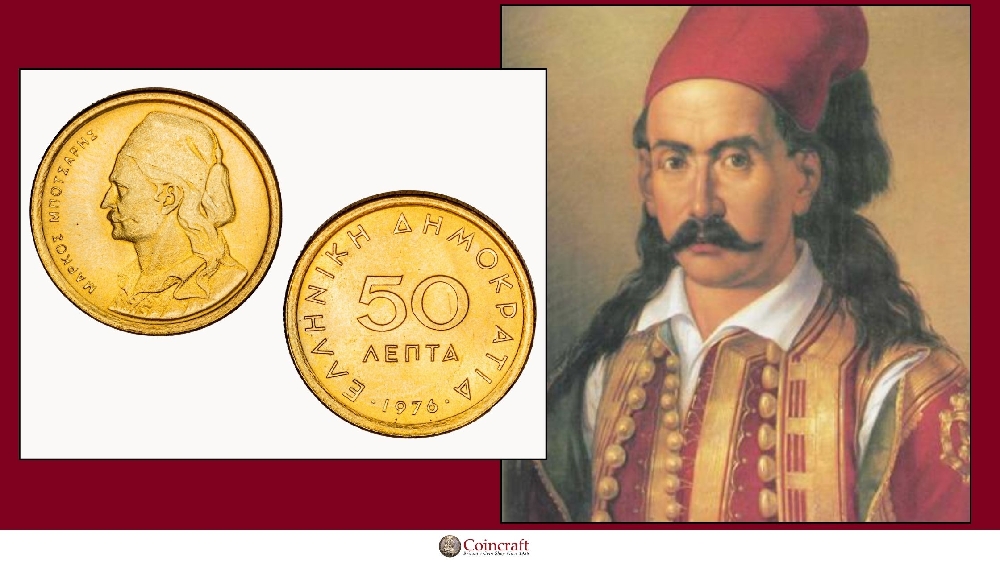
Picture source of Markos Botsaris: Wikipedia
The Eagle of Souli: A Biography of Markos Botsaris
Introduction
In the pantheon of Greek national heroes, few figures command the same level of reverence and romantic admiration as Markos Botsaris. A chieftain of the indomitable Souliots, Botsaris was not merely a warrior; he was a symbol of the Greek War of Independence’s moral and martial spirit. His life, though cut short at the age of 33, bridged the gap between the traditional klephtic warfare of the mountains and the modern ideals of national liberation spreading across Europe. For historians and admirers alike, Botsaris represents the archetype of the selfless patriot—a leader who valued liberty above rank and bravery above safety.
Key Takeaways
Souliot Heritage: Born into the prominent Botsaris clan of Souli, Epirus, Markos inherited a legacy of fierce resistance against Ottoman rule, particularly against Ali Pasha of Ioannina.
Military Evolution: Unlike many irregular chieftains, Botsaris gained formal military experience serving in the French army’s Albanian Regiment on Corfu, which broadened his strategic outlook.
Defense of Missolonghi: He played a pivotal role in the First Siege of Missolonghi (1822–1823), successfully defending the city that would later become the dramatic heart of the revolution.
Heroic Death: Botsaris died leading a daring night raid at Karpenisi in 1823, an event that immortalized him in European art and literature.
International Legacy: His heroism captivated the imagination of the West, deeply influencing Lord Byron and inspiring works by artists such as Eugène Delacroix and Jean-Léon Gérôme.
The Foundations of a Hero: Early Life and Exile
Markos Botsaris was born around 1788 (some sources say 1790) in Souli, a rugged mountainous region in Epirus known for its autonomy and defiance of Ottoman authority.¹ His father, Kitsos Botsaris, was a respected leader of the Botsaris clan. The early years of Markos's life were defined by the brutal conflict between the Souliots and the local Ottoman governor, Ali Pasha of Ioannina.
Following the fall of Souli in 1803, the Botsaris family, along with many other Souliots, was forced into exile. They found refuge on the Ionian Islands, specifically Corfu, which was then under French administration. This period of exile was transformative for young Markos. He enlisted in the Régiment Albanais (Albanian Regiment) formed by the French, where he served as an officer for several years.² This experience was crucial; it exposed him to European military tactics and the organizational discipline of a regular army, distinguishing him from many of his contemporaries who relied solely on guerrilla warfare. During this time, he famously composed a Greek-Albanian dictionary, demonstrating an intellectual curiosity that complemented his martial skills.³
The Spark of Revolution
As the winds of revolution began to stir, Botsaris returned to the mainland in 1820. In a twist of historical irony, the Souliots initially allied with their old enemy, Ali Pasha, who was by then in open rebellion against the Ottoman Sultan. However, this alliance was pragmatic and short-lived.
When the Greek War of Independence officially erupted in 1821, Botsaris fully committed himself to the national cause. He joined the Philiki Etaireia (Friendly Society), the secret organization coordinating the uprising, and turned his focus toward the liberation of Greece. His leadership was characterized by a rare blend of tactical prudence and personal courage, earning him the respect of both his men and the provisional government.
The Defender of Missolonghi
One of Botsaris’s most significant contributions was his defense of Missolonghi during the first Ottoman siege in late 1822. Missolonghi was a strategic stronghold and a spiritual center for the revolution. Botsaris, with a relatively small force, utilized his knowledge of the terrain and fortification to repel superior Ottoman numbers.⁴ His success at Missolonghi not only saved the town but also raised the morale of the insurgent forces across Western Greece.
It was during this period that a famous anecdote highlighting his character occurred. The provisional government promoted Botsaris to the rank of General of Western Greece. This promotion caused friction and jealousy among other chieftains. Sensing the discord, Botsaris took the official diploma conferring his rank and tore it into pieces before his peers, declaring, "He who is worthy gets the diploma tomorrow in front of the enemy."⁵ This act of humility and focus on the collective goal cemented his reputation as a leader free from vanity.
The Final Charge: Battle of Karpenisi
In August 1823, a massive Ottoman army led by Mustai Pasha was advancing towards Missolonghi to crush the rebellion. Botsaris, determining that a direct confrontation would be suicidal given the disparity in numbers, devised a bold plan. On the night of August 21, 1823, near Karpenisi, he led a surprise night attack with a small band of roughly 350 Souliots against the Ottoman encampment of thousands.⁶
The raid was initially a spectacular success, throwing the enemy camp into chaos. However, in the heat of the battle, while rallying his men, Botsaris was struck in the head by a bullet and killed instantly. Despite the loss of their leader, the Greeks inflicted heavy casualties on the Ottoman forces and delayed their advance.
An Enduring Legacy
Markos Botsaris’s death resonated far beyond the battlefields of Greece. His body was transported back to Missolonghi, where he was buried with full military honors. The English poet Lord Byron, who arrived in Missolonghi shortly after, was deeply moved by Botsaris’s legend. Byron famously swore an oath at Botsaris's grave and took the remaining Souliot soldiers under his own pay and command.⁷
In Europe, Botsaris became a romantic icon of the Greek struggle. He was immortalized in paintings by masters like Jean-Léon Gérôme and Ludovico Lipparini, who depicted his death with dramatic, almost saintly, reverence.⁸ Today, he remains a definitive hero of 1821, representing the pure, sacrificial spirit of Greek independence.
Frequently Asked Questions (FAQs)
Q: How exactly did Markos Botsaris die?
A: Markos Botsaris was killed in combat during the Battle of Karpenisi on August 21, 1823. He was leading a night raid against a much larger Ottoman force when he was fatally shot in the head. His death was instantaneous, but his men successfully carried his body off the field to prevent it from being desecrated.
Q: What is the significance of the "torn diploma" story?
A: The story illustrates Botsaris's integrity and lack of ego. When other chieftains became jealous of his promotion to General, he tore up the commission paper to end the dispute, famously stating that true rank is earned on the battlefield, not on paper. This act unified the squabbling factions before the battle.
Q: Did Markos Botsaris meet Lord Byron?
A: No, they did not meet in person. Markos Botsaris died in August 1823, and Lord Byron arrived in Missolonghi in January 1824. However, Byron held Botsaris in the highest esteem, corresponded with the Greek leadership about him, and financially supported the Souliot troops that Botsaris had commanded.
References
Encyclopedia.com. (2001). Botsaris, Markos. [online] Available at: https://www.encyclopedia.com [Accessed 24 Nov. 2025].
The Universal Compendium. (2024). Genealogy and family history: Markos Botsaris. [online] Available at: https://universalcompendium.com [Accessed 24 Nov. 2025].
Greek Herald. (2021). Markos Botsaris: Greek Revolution hero from Souli. [online] Available at: https://greekherald.com.au [Accessed 24 Nov. 2025].
Britannica, T. Editors of Encyclopaedia (n.d.). Markos Botsaris. [online] Encyclopedia Britannica. Available at: https://www.britannica.com/biography/Markos-Botsaris [Accessed 24 Nov. 2025].
Greek Herald. (2021). Markos Botsaris: Greek Revolution hero from Souli. [online] Available at: https://greekherald.com.au [Accessed 24 Nov. 2025].
Wikipedia. (n.d.). Battle of Karpenisi. [online] Available at: https://en.wikipedia.org/wiki/Battle_of_Karpenisi [Accessed 24 Nov. 2025].
Hellenic Parliament. (2021). Emblematic painting on theme of Greek Revolution. [online] Available at: https://www.hellenicparliament.gr [Accessed 24 Nov. 2025].
Latamarte. (2025). An Analysis of Markos Botsaris (1874) by Jean-Léon Gérôme. [online] Available at: https://www.latamarte.com [Accessed 24 Nov. 2025].