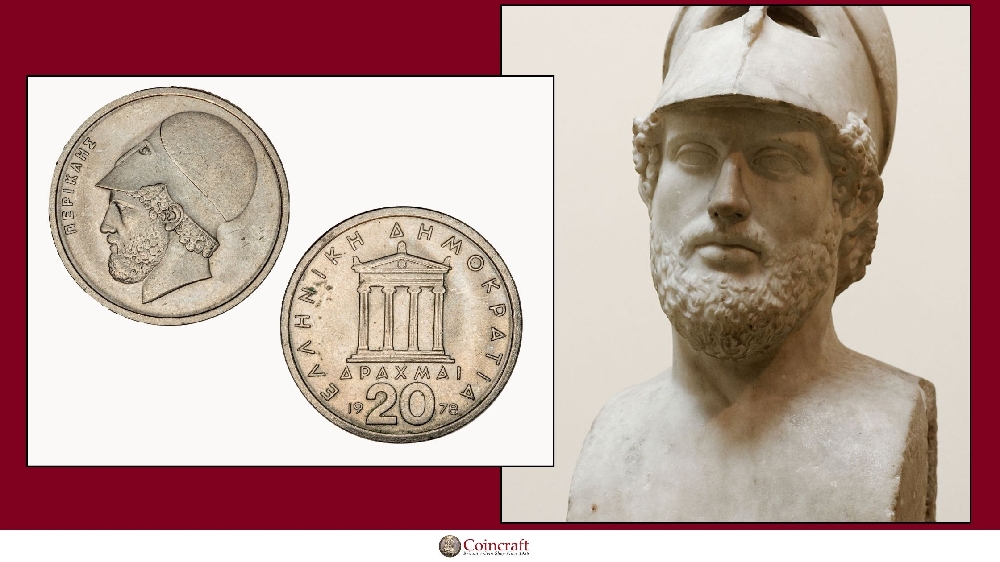
Picture Source of Pericles: Wikipedia
Pericles: The Man Who Defined Athens's Golden Age
Ever heard someone mention the "Golden Age of Athens"? It’s this incredible period in the 5th century BC when the city was an absolute powerhouse of democracy, art, philosophy, and architecture. Well, when you picture that "Golden Age," you’re really picturing the "Age of Pericles."
Pericles wasn't a king or a dictator. In fact, he was a massive supporter of democracy. He was, however, the most influential and important statesman, orator, and general in Athens for a period of about 30 years (from roughly 461 to 429 BC). He was the city's "first citizen," and he had a vision for Athens that would shape the Western world forever.
But was he a flawless hero? Or a brilliant, ambitious politician who may have loved his city too much? Let's get into the story of the man who gave us the Parthenon.
Key Takeaways
Mr. Golden Age: Pericles was the leading statesman of Athens during its peak of power and cultural flourishing.
Champion of Democracy: He introduced reforms that strengthened Athenian democracy, most notably by allowing poor citizens to hold public office for the first time.
The Master Builder: He was the political mastermind behind the ambitious project to rebuild the Acropolis, which included the construction of the Parthenon.
Wartime Leader: His leadership was defined by the outbreak of the devastating Peloponnesian War against Athens's great rival, Sparta.
Tragic End: He died not in battle, but from a terrible plague that swept through the overcrowded city of Athens early in the war.
From Young Aristocrat to Man of the People
You might be surprised to learn that Pericles was born into one of the wealthiest and most powerful aristocratic families in Athens. But from the start of his political career, he didn't side with the rich. He allied himself with the dēmos—the common people.
His main goal was to empower the average Athenian citizen. His biggest move? Proposing that the state pay citizens for public service.³ This was revolutionary! Before this, only the wealthy could afford to take time off from their farms or businesses to serve on juries or as city officials. By paying for service, Pericles essentially opened up the government to everyone. This was the true, radical democracy Athens became famous for.
He wasn't just a back-room politician, either. He was known as a powerful and convincing speaker, though he was reportedly very reserved and calm, not a fiery, fist-pounding orator.
Building the Dream: The Acropolis
Pericles's most lasting, and most visible, legacy is sitting on a hill in Athens right now: the Acropolis.
The Persians had destroyed the original buildings on the Acropolis decades earlier. Pericles launched an incredibly ambitious (and insanely expensive) building program to rebuild it as a monument to the glory of Athens. This project gave us the Parthenon (the massive temple to the goddess Athena), the Propylaia (the grand gateway), and other stunning works of art.
But this is where things get controversial. Where did all that money come from?
It came from the treasury of the "Delian League." This was supposed to be a mutual defense fund, where Athens and its allies all chipped in money to build ships and defend Greece from Persia. Pericles convinced the Athenians to move the league's treasury from the island of Delos to Athens. He then used that money to fund his building projects.
His enemies were furious. They accused him of using the allies' money to "decorate Athens like a harlot," plastering it with gold and marble.¹ Pericles's defense was basically, "We're the ones providing the naval protection, so we can spend the money." It was a classic power move that made Athens look magnificent but also made its "allies" look more like subjects.
The Gathering Storm: War and Plague
This "Golden Age" couldn't last forever. The rising power and arrogance of Athens brought it into direct conflict with the other great power in Greece: the militaristic city-state of Sparta. This kicked off the long and brutal Peloponnesian War.
Pericles's strategy was to avoid fighting the unstoppable Spartan army on land. Instead, he brought the entire population of the countryside into the "Long Walls" that connected Athens to its port. The idea was to let the Spartans rage outside while the Athenian navy—the most powerful in the world—raided the Spartan coast and kept the city supplied by sea.
After the first year of the war, he gave what is probably the most famous speech of his life: the "Funeral Oration." It wasn't just a speech to mourn the dead; it was a powerful, stirring defense of Athens's unique democratic way of life and a call to remember what they were fighting for.²
Sadly, his strategy had a fatal flaw. With so many people packed inside the city walls, it became a ticking time bomb for disease. In 430 BC, a terrible plague broke out. It ravaged the city, killing a huge portion of the population. The plague didn't care about class or power; it took Pericles's two legitimate sons, and finally, in 429 BC, it took Pericles himself.
His death left a massive power vacuum. The great, steady leader was gone, and more extreme, reckless politicians took his place. The war would drag on for another 27 years, ultimately ending in Athens's complete defeat.
Pericles remains one of the most fascinating figures in history—a brilliant, complicated man who built an empire, championed democracy, and left a artistic legacy that still inspires us thousands of years later.
FAQs
1. What was Pericles's most famous speech? That would be his "Funeral Oration," which he gave in 431 BC to honor the first soldiers who died in the Peloponnesian War. It's recorded by the historian Thucydides and is still studied today as a masterpiece of political rhetoric.
2. Who was Aspasia? Aspasia was Pericles's partner and, by all accounts, the love of his life. She was a "metic" (a foreigner) from Miletus, which meant they couldn't be legally married under Athenian law. She was famously brilliant, witty, and intelligent, and it's said that even the great philosopher Socrates was impressed by her. She was also a target for Pericles's political enemies, who mocked her influence over him.
3. Did Pericles cause the Peloponnesian War? That's the big question! It's complicated. His policies—like using the Delian League money and being tough on any ally who tried to leave—definitely contributed to the tension. However, Sparta and its allies were also deeply fearful of Athens's growing power. Most historians would say both sides played a role in the "Thucydides Trap," where a rising power (Athens) inevitably clashes with an established one (Sparta).
References
Plutarch. (n.d.). The Life of Pericles. Translated by John Dryden. The Internet Classics Archive. Available at: http://classics.mit.edu/Plutarch/pericles.html (Accessed: 5 November 2025).
Thucydides. (n.d.). Pericles' Funeral Oration (from The History of the Peloponnesian War). Translated by Richard Crawley. The Internet Classics Archive. Available at: http://classics.mit.edu/Thucydides/pelopwar.2.second.html (Accessed: 5 November 2025).
Cartwright, M. (2018). Pericles. World History Encyclopedia. Available at: https://www.worldhistory.org/pericles/ (Accessed: 5 November 2025).